Last updated on 11 September 2026
As LeBron James and Steph Curry reach basketball old age thoughts are beginning to turn to who could replace them as the new faces of the sport. Giannis Antetokounmpo and Luka Dončić already sell shirts all over the world, but which youngsters’ names will you see on a jersey hanging outside a shop in Dubrovnik on your next European trip?
You will not be surprised to read that Victor Wembanyama leads my ranking of the 30 best young NBA players in 2026. After that, the arguments become considerably more interesting. Cooper Flagg edges Paolo Banchero, the Thompson twins receive proper credit for defence, and three incoming rookies make the cut without being waved straight into the top ten.
Young NBA players are rarely short of potential. Every draft supplies another collection of future stars and a burst of hope for underperforming franchises. Every rebuilding team has somebody it would rather not trade, and every promising October performance seems capable of supporting a five-year forecast. Your franchise’s shiny new 22 year old is of course important for the future of your team but these youngsters are also increasingly important today in the new more stringent cost cap era. A youngster on a rookie deal (the number one pick earns around 7% of the salary cap in his first year) that you can put into your starting five allows a team to have one of the very best today (for example: Dallas, Kyrie Irving) alongside possibly one of the very best tomorrow (for example: Dallas, Cooper Flagg) alongside a deep supporting cast, while staying within the confines of the cost cap. This is how you build championship winning rosters today.
Once the excitement settles on a rookie the questions turn to more practical matters: who can already carry an offence? Who makes life difficult for opponents without needing 20 shots? And whose potential is substantial enough to justify a place ahead of someone who has actually done the job?
There are 27 with NBA experience and three incoming rookies, which means balancing what we have already seen against what we think might happen next. Potential matters. It does, nevertheless, help to have played some basketball against the people you are expected to beat.
Best young NBA players in 2026: the full ranking
| Rank | Player | Team | Age on 20 October 2026 | Position |
| 1 | Victor Wembanyama | San Antonio Spurs | 22 | Centre |
| 2 | Cooper Flagg | Dallas Mavericks | 19 | Forward |
| 3 | Paolo Banchero | Orlando Magic | 23 | Forward |
| 4 | Amen Thompson | Houston Rockets | 23 | Guard / forward |
| 5 | Jalen Duren | Detroit Pistons | 22 | Centre |
| 6 | Stephon Castle | San Antonio Spurs | 21 | Guard |
| 7 | Kon Knueppel | Charlotte Hornets | 21 | Wing |
| 8 | Keyonte George | Utah Jazz | 22 | Guard |
| 9 | Brandon Miller | Charlotte Hornets | 23 | Wing |
| 10 | Dyson Daniels | Atlanta Hawks | 23 | Guard |
| 11 | Shaedon Sharpe | Portland Trail Blazers | 23 | Shooting guard |
| 12 | Ausar Thompson | Detroit Pistons | 23 | Wing |
| 13 | VJ Edgecombe | Philadelphia 76ers | 21 | Guard |
| 14 | Dylan Harper | San Antonio Spurs | 20 | Guard |
| 15 | Alex Sarr | Washington Wizards | 21 | Centre / forward |
| 16 | Matas Buzelis | Chicago Bulls | 22 | Forward |
| 17 | Donovan Clingan | Portland Trail Blazers | 22 | Centre |
| 18 | Kel’el Ware | Milwaukee Bucks | 22 | Centre |
| 19 | Jabari Smith Jr. | Houston Rockets | 23 | Power forward |
| 20 | Reed Sheppard | Houston Rockets | 22 | Guard |
| 21 | Anthony Black | Orlando Magic | 22 | Guard |
| 22 | AJ Dybantsa † | Washington Wizards | 19 | Wing |
| 23 | Darryn Peterson † | Utah Jazz | 19 | Guard |
| 24 | Cedric Coward | Memphis Grizzlies | 23 | Wing |
| 25 | Kyshawn George | Washington Wizards | 22 | Wing |
| 26 | Cason Wallace | Oklahoma City Thunder | 22 | Guard |
| 27 | Brandin Podziemski | Golden State Warriors | 23 | Guard |
| 28 | Cameron Boozer † | Memphis Grizzlies | 19 | Power forward |
| 29 | Jaylon Tyson | Cleveland Cavaliers | 23 | Wing |
| 30 | Ace Bailey | Utah Jazz | 20 | Wing |
† Incoming 2026 rookie; no NBA regular-season record yet.
Who qualifies, and what do we mean by best?
Every player must be 23 or younger on 20 October 2026 – that means a date of birth on or after 21 October 2002.
The list includes players who appeared in the 2025–26 NBA season, alongside selected members of the incoming 2026 draft class. Twenty-seven have NBA regular-season experience; AJ Dybantsa, Darryn Peterson and Cameron Boozer are the three exceptions.
What a player has already done in the NBA carries the most weight. Age then changes how we judge it: a teenager averaging 15 points is asking a different question of us from a 23-year-old doing the same. Defence, passing, shooting, availability and how much improvement we can reasonably expect all influence the order.
That creates some awkward comparisons. A guard who can run an offence and a centre who can organise a defence are doing different jobs, while an incoming rookie is still waiting to show whether he can do either against NBA opposition. There is no formula that settles all of this. Some of the calls are much closer than a numbered list makes them look.
The figures beneath each profile cover the 2025–26 NBA regular season.
PTS means points, REB rebounds, AST assists, BLK blocks, STL steals and TOV turnovers. All are per-game averages. 3PT is three-point shooting percentage and FT% is free-throw percentage, both rounded to one decimal place; a dash means no attempts. Incoming rookies have no NBA figures yet. Positions describe each player’s broad role.
The player profiles count down from No. 30 to No. 1.
30–24: The final places
30. Ace Bailey
Utah Jazz | 20 | Wing
2025–26: 13.8 PTS · 4.2 REB · 1.8 AST · 3PT: 34.4% · BLK: 0.7 · STL: 0.8 · TOV: 1.5 · FT%: 75.0%
The final place goes to Ace Bailey, although Derik Queen has reasonable grounds for an appeal. Bailey’s case rests on how difficult it is to find a wing who can create his own shot, and how much time a player who will still be only 20 in October has to work out which shots he should actually take.
There were 13.8 points per game and 34.4% shooting from three in 2025–26, so the scoring promise has already produced something more useful than a collection of impressive practice clips. The harder part will be recognising when a possession would benefit from somebody else having the ball, while doing enough defensively to justify staying on the court when his own shot is missing.
Queen offers the more appealing passing game. I narrowly prefer Bailey’s chances of becoming a difficult wing to defend, which is why he gets the last place and Queen gets the first paragraph in the omissions section.
29. Jaylon Tyson
Cleveland Cavaliers | 23 | Wing
2025–26: 13.2 PTS · 5.1 REB · 2.2 AST · 3PT: 44.6% · BLK: 0.4 · STL: 0.8 · TOV: 1.5 · FT%: 73.8%
Shooting 44.6% from three and finding yourself twenty-ninth is a fairly effective demonstration of how demanding this list has become. Tyson gives Cleveland scoring, rebounding and a player who can make himself useful while more prominent teammates occupy most of the defence’s attention. Those are valuable things to have.
The caution is about how much more we should expect. He will be 23 at the cutoff, and one season’s three-point percentage should not be allowed to write the entire forecast. There is a convincing case for a good NBA wing here; there is rather less evidence that an offence will eventually revolve around him. That keeps him towards the bottom of a ranking which has to accommodate both the players already helping their teams and the teenagers we suspect might one day do considerably more.
28. Cameron Boozer
Memphis Grizzlies | 19 | Power forward
Incoming rookie · 2026 draft pick No. 3.
2025–26 NBA statistics: N/A — no NBA regular-season record yet.
Boozer’s appeal is that passing, rebounding and understanding where the ball ought to go are useful at almost any level. A young frontcourt player who can do those things gives a team several ways to involve him, even before deciding how much of the scoring he should take on.
The less comfortable question concerns the other end. NBA forwards will test his ability to move with them, and Memphis will have to establish which defensive assignments suit him. Being able to read a possession is an advantage; getting to the required spot quickly enough is a separate matter.
I have put him behind Dybantsa and Peterson because their potential to create from the perimeter is harder to find. Boozer could nevertheless be the quickest of the three to look comfortable in an NBA team. Twenty-eighth leaves room for that possibility without awarding him credit for games he has yet to play.
27. Brandin Podziemski
Golden State Warriors | 23 | Guard
2025–26: 13.8 PTS · 5.1 REB · 3.7 AST · 3PT: 37.1% · BLK: 0.2 · STL: 1.1 · TOV: 1.6 · FT%: 79.7%
Podziemski is the sort of player whose case improves once we stop asking whether everyone on the list can become a superstar. Golden State get a guard who rebounds, passes and shoots well enough to require attention, with 5.1 rebounds per game a particularly useful contribution from the backcourt.
There is a difference between helping an offence work and being able to manufacture a good shot when the rest of it has stopped working. The latter is what separates many of the guards above him, and it remains the part of Podziemski’s game that would have to grow most for him to climb substantially.
For now, 13.8 points per game and 37.1% from three, alongside the passing and rebounding, make a respectable case. A team assembled entirely from players who expect to be its first option would eventually require a difficult conversation about who gets the ball.
26. Cason Wallace
Oklahoma City Thunder | 22 | Guard
2025–26: 8.6 PTS · 3.1 REB · 2.6 AST · 3PT: 35.1% · BLK: 0.4 · STL: 1.9 · TOV: 0.9 · FT%: 80.9%
Wallace averages 8.6 points per game, which makes him an awkward inclusion if the exercise is simply to find the largest numbers in the scoring column. Oklahoma City have other people to take shots. A guard who can make life difficult for the opposition and keep his own mistakes to a minimum has a fairly obvious use alongside them.
His 1.9 steals and 0.9 turnovers per game illustrate that contribution, although steals alone will never tell us how well somebody defends. The point is that Wallace already has a job he can do for a good team, and doing it well deserves more credit than being given additional shots elsewhere.
Whether he can take on much more of the creation is the question that keeps him down here. His place rests on what he already offers; a larger offensive role would give us a different argument to consider.
25. Kyshawn George
Washington Wizards | 22 | Wing
2025–26: 14.8 PTS · 5.1 REB · 4.5 AST · 3PT: 38.1% · BLK: 0.9 · STL: 1.0 · TOV: 2.6 · FT%: 80.2%
The most interesting number in George’s line may be the 4.5 assists. A wing who can shoot 38.1% from three is useful; one who can also find the next pass gives Washington more options than simply deciding which corner he should stand in.
There is still some tidying up to do. His 2.6 turnovers per game are a reminder that seeing a pass and successfully completing it are separate skills, particularly when the defence has worked out what you are trying to do. Better decisions under pressure would make both his scoring and his passing easier to trust.
George sits ahead of Wallace and Podziemski because there is more scope for him to become a regular creator from the wing. That is the attraction. The task now is to make those possibilities appear often enough that they become expectations.
24. Cedric Coward
Memphis Grizzlies | 23 | Wing
2025–26: 13.6 PTS · 5.9 REB · 2.8 AST · 3PT: 33.8% · BLK: 0.4 · STL: 0.6 · TOV: 1.7 · FT%: 84.3%
Coward gives Memphis a wing who can score, rebound and find a pass without needing the entire evening organised around him. His 13.6 points, 5.9 rebounds and 2.8 assists per game make a substantial case for a player whose value comes from doing several things well.
The shooting is the area I would most like to see improve. At 33.8% from three, he is not yet making opponents pay consistently enough for leaving him, although his 84.3% at the foul line offers encouragement about his touch. A more dependable outside shot would make the rest of his game easier to accommodate.
He will be 23 in October, which is still young by most reasonable standards, if slightly less so in an article containing several teenagers. His existing work earns him this place; moving much higher will require an improvement we can point to rather than simply another year being added to his age.
23–18: How much credit should potential receive?
23. Darryn Peterson
Utah Jazz | 19 | Guard
Incoming rookie · 2026 draft pick No. 2.
2025–26 NBA statistics: N/A — no NBA regular-season record yet.
Peterson arrives in Utah with the second pick in the draft attached to his name and the expectation that he can eventually do rather more than make up the numbers. His scoring and passing offer the possibility of a guard who can run an attack, which is a sufficiently valuable possibility to earn him a place before his first NBA game.
There is, however, a fairly large difference between looking like a future leading scorer and having NBA defenders agree to the arrangement. Utah will need to find out how well he chooses his moments, how effectively he works with other creators and how much he can offer defensively.
I have him immediately behind Dybantsa, with very little confidence that one place captures a meaningful gap. The order reflects a slight preference for Dybantsa’s potential as a scoring wing. Peterson will have ample opportunity to make that preference look mistaken.
22. AJ Dybantsa
Washington Wizards | 19 | Wing
Incoming rookie · 2026 draft pick No. 1.
2025–26 NBA statistics: N/A — no NBA regular-season record yet.
Being the first pick in the NBA Draft guarantees a great deal of discussion about your future. Washington’s interest is in how much of it Dybantsa can turn into actual basketball.
The attraction is easy to see: a wing with the potential to create shots for himself and others is the sort of player around whom an offence can eventually be built. That is why he leads the three incoming rookies in this ranking. It is also why I can justify putting him ahead of several players who already have a useful NBA season behind them.
Twenty-second is still a substantial distance from the top. He has to show which shots he can make against NBA defenders, when to pass and how to contribute on possessions intended for somebody else. Draft position explains the expectations. Over the next few seasons, it will become steadily less useful as an explanation for his place on lists like this one.
21. Anthony Black
Orlando Magic | 22 | Guard
2025–26: 15.0 PTS · 3.8 REB · 3.7 AST · 3PT: 33.3% · BLK: 0.7 · STL: 1.4 · TOV: 2.1 · FT%: 73.2%
Black gives Orlando a large guard who can pass, defend and now make a substantial contribution to the scoring as well. Fifteen points per game makes it considerably easier to argue about what else he might become than it would be if we were still relying entirely on his height and a promising first impression.
The three-point shot remains the issue. At 33.3%, opponents still have a reason to leave some room and wait for him closer to the basket, which makes driving and finding passing angles more difficult. Improve that figure and several parts of his game become more useful at once.
Sheppard gets the place immediately above him because I give his shooting a slight edge over Black’s size and defensive advantages. It is a close choice, and one that could change without either player needing to become something radically different.
20. Reed Sheppard
Houston Rockets | 22 | Guard
2025–26: 13.5 PTS · 2.9 REB · 3.4 AST · 3PT: 39.4% · BLK: 0.7 · STL: 1.5 · TOV: 1.5 · FT%: 80.2%
Houston have plenty of players who can run, jump and make the court look rather small. Sheppard helps by giving defenders a reason to follow somebody away from the basket: 39.4% from three is a useful accompaniment to the physical gifts of players such as Amen Thompson. His passing and quick decisions also mean a possession can keep moving when the ball reaches him.
The concern is what happens when opponents decide to use his size against him. Anticipation helps, as his 1.5 steals per game suggest, but it does not make a taller guard disappear. To move much higher, Sheppard will have to create more of the offence himself while holding up defensively against players who can shoot over him. For the moment, there is plenty to like about a guard whose shooting makes the jobs of several teammates easier.
19. Jabari Smith Jr.
Houston Rockets | 23 | Power forward
2025–26: 15.8 PTS · 6.9 REB · 1.9 AST · 3PT: 36.3% · BLK: 0.9 · STL: 0.7 · TOV: 1.4 · FT%: 77.5%
Smith’s game makes sense alongside players who already want the ball. He can move outside to give them room, rebound when a shot misses and provide the size to take on different defensive assignments. Houston do not have to redesign their offence to find a use for a forward averaging 15.8 points and 6.9 rebounds while shooting 36.3% from three.
The harder question is whether that is roughly the player he will remain. His 1.9 assists per game do not suggest someone around whom the creation currently revolves, and becoming more dangerous with the ball would give him a route up this list. At 23, we should be looking for evidence of that expansion. There is already a good player here, but the forwards above him offer stronger reasons to think they can take responsibility for more of a game.
18. Kel’el Ware
Milwaukee Bucks | 22 | Centre
2025–26: 11.1 PTS · 9.0 REB · 0.7 AST · 3PT: 39.5% · BLK: 1.1 · STL: 0.8 · TOV: 0.8 · FT%: 74.0%
A centre averaging nine rebounds and shooting 39.5% from three is bound to attract attention, particularly when he is only 22. Those figures come from Ware’s 2025–26 season with Miami; Milwaukee are now the team hoping to benefit from the next stage of his career.
The appeal is having a big man who can finish near the rim, collect rebounds and give a defence something to think about further out. The three-point percentage adds to that appeal, although the real test is whether opponents consistently feel obliged to follow him.
There is less glamour in setting a firm screen, holding a defensive position or making the right rotation for the fourth time in a possession. Those are nevertheless the things that decide whether a centre stays on the court when the games become difficult. I put Clingan one place higher because we are more confident about that part of his work. Ware has the more intriguing possibilities with the ball.
17–11: Where the comparisons become difficult
17. Donovan Clingan
Portland Trail Blazers | 22 | Centre
2025–26: 12.1 PTS · 11.6 REB · 2.1 AST · 3PT: 34.1% · BLK: 1.7 · STL: 0.6 · TOV: 1.2 · FT%: 68.0%
Clingan provides an encouraging answer to a fairly basic basketball question: who is going to get the rebound? His 11.6 per game come alongside 1.7 blocks, giving Portland a centre with an obvious job and substantial evidence that he can do it.
That should not be treated as a modest ambition. Ending an opposition possession after one shot and making the next drive towards the basket less inviting are useful ways to improve a defence. His finishing gives him a straightforward role at the other end, even if somebody else generally needs to create the opening.
The doubts begin when opponents take him away from the rim and ask him to change direction repeatedly. That is where the greater mobility of Sarr and Buzelis becomes attractive, and why both sit above him. Clingan’s case is that a team already knows what it can ask him to do. Several more fashionable prospects are still working towards that point.
16. Matas Buzelis
Chicago Bulls | 22 | Forward
2025–26: 16.3 PTS · 5.8 REB · 2.1 AST · 3PT: 34.9% · BLK: 1.5 · STL: 0.7 · TOV: 2.1 · FT%: 78.6%
Buzelis gives Chicago reasons to watch both ends of the court. His 16.3 points per game are accompanied by 1.5 blocks, and the combination of movement, length and some ability to create a shot makes him more interesting than a forward whose entire offensive job is to wait for a pass.
The issue is how reliably those skills come together. At 34.9% from three, the outside shot is useful enough to develop but still needs to become more dependable; with 2.1 assists and 2.1 turnovers, there is also room to make better use of the ball. A good stretch of play can show us several things he might become. A full season needs to show which of them Chicago can expect.
Sixteenth puts a fair amount of faith in his ability to join it all up. Sarr gets the narrow edge because we are more persuaded by his defensive role and passing at this stage.
15. Alex Sarr
Washington Wizards | 21 | Centre / forward
2025–26: 16.3 PTS · 7.4 REB · 2.7 AST · 3PT: 33.3% · BLK: 2.0 · STL: 0.8 · TOV: 1.7 · FT%: 69.2%
Sarr is already averaging two blocks per game at 21, which gives Washington something fairly tangible to build around. The further attraction is that he can move: a centre who remains useful when the opposition takes the ball away from the basket gives a coach more choices about how to defend.
His own shooting creates a less settled argument. There is value in a big man who can step outside, but 33.3% from three still gives opponents a decision about how urgently to follow him. Improving that shot would help; becoming a better finisher, screener and passer would help on considerably more possessions.
The 16.3 points and 2.7 assists per game mean the offensive discussion has some substance already. Fifteenth reflects my view that the defence provides a good foundation and that there are several realistic ways to add to it. Washington should have plenty to work with.
14. Dylan Harper
San Antonio Spurs | 20 | Guard
2025–26: 11.8 PTS · 3.4 REB · 3.9 AST · 3PT: 34.3% · BLK: 0.3 · STL: 0.8 · TOV: 1.4 · FT%: 75.6%
Harper’s position requires a little explanation. Several players below him scored more than his 11.8 points per game, and some did so by a considerable margin. He gets the benefit of being only 20 at the cutoff and of showing the sort of guard play that can become increasingly valuable with more responsibility.
He can get into the lane, make a defender leave somebody else and then find the pass that decision has opened up. His 3.9 assists against 1.4 turnovers per game are an encouraging starting point for a player still learning how much he can control.
San Antonio’s question is how well those decisions survive a larger role. A more reliable three-point shot would make the route towards the basket easier, while the presence of Castle and Wembanyama gives Harper good players with whom to develop an understanding. I am projecting more here than with Clingan or Smith, but the age and the passing make it a projection worth backing.
13. VJ Edgecombe
Philadelphia 76ers | 21 | Guard
2025–26: 16.0 PTS · 5.6 REB · 4.2 AST · 3PT: 35.4% · BLK: 0.5 · STL: 1.4 · TOV: 1.8 · FT%: 81.8%
It is easy to become interested in Edgecombe because of the athleticism. The more persuasive reason is that his 16 points per game arrive with 5.6 rebounds and 4.2 assists, so Philadelphia are getting rather more than an occasional spectacular finish.
That matters for a young guard. There will be evenings when a defender prevents the preferred drive or the jumper stops falling, and being able to rebound, pass and defend gives him ways to remain involved. His 35.4% from three and 81.8% at the foul line also give a sensible starting point for the shooting.
The next test comes when the opposition is organised, the space has disappeared and he has to decide what should happen next. That is a harder examination than attacking an open court. Edgecombe is above Harper because his contribution is already more substantial, although Harper’s age and passing keep the gap small. Playing in the same team as LeBron James, Joel Embiid and Tyrese Maxey should help Edgecombe in taking the next steps forward – or show that he is not quite cut-out to be a leader for a play-offs focussed team.
12. Ausar Thompson
Detroit Pistons | 23 | Wing
2025–26: 9.9 PTS · 5.7 REB · 3.1 AST · 3PT: 25.0% · BLK: 0.9 · STL: 2.0 · TOV: 1.5 · FT%: 57.1%
Ausar Thompson’s inclusion this high is likely to irritate anyone who has begun by sorting the list into points per game. He averages 9.9. The argument for twelfth is what he can do to the player trying to score at the other end.
His movement, reach and anticipation make him a difficult defender to escape, and his 5.7 rebounds help ensure that forcing a miss actually ends the possession. Two steals per game capture some of that disruption, though they cannot record all the passes an opponent decides would be unwise.
The shooting is a substantial problem. At 25.0% from three and 57.1% at the foul line, he gives defences an obvious reason to concentrate on his teammates. Cutting at the right time and moving the ball quickly help, but a more dependable shot would make him much easier to use. Amen’s more developed scoring and passing explain the eight places between the twins. Ausar’s defence explains why the gap is not larger.
11. Shaedon Sharpe
Portland Trail Blazers | 23 | Shooting guard
2025–26: 20.8 PTS · 4.3 REB · 2.6 AST · 3PT: 33.7% · BLK: 0.1 · STL: 1.4 · TOV: 2.9 · FT%: 78.7%
Sharpe can produce a basket from situations in which most players would be better advised to pass. The elevation, the finishing and the ability to create a shot are why 20.8 points per game still feel like a starting point for what he might eventually manage.
The difficulty is knowing when to use those gifts. His 2.9 turnovers against 2.6 assists per game make the decisions worth examining, particularly when a second defender arrives and there is an easier opportunity elsewhere. More consistent defensive effort would also give Portland a better return on the evenings when the difficult shots do not go in.
He sits just outside the top ten because Daniels offers a more rounded contribution and Miller a more convincing outside shot. Sharpe has the scoring talent to challenge both. Making the rest of the game catch up is what will decide whether he does.
10–6: The closest arguments near the top
10. Dyson Daniels
Atlanta Hawks | 23 | Guard
2025–26: 11.9 PTS · 6.8 REB · 5.9 AST · 3PT: 18.8% · BLK: 0.4 · STL: 2.0 · TOV: 1.8 · FT%: 61.5%
Daniels makes the top ten with a scoring average of 11.9 and a three-point percentage of 18.8. That is a fairly determined way of testing whether I meant what I said about valuing defence.
I did. He can make it difficult for an opponent to begin a possession, recover when the first attempt to disrupt it fails and then help finish the job by collecting the rebound. There are two steals per game in the statistics, but the wider effect is the time and effort opponents have to spend getting to an opportunity they actually want.
The 6.8 rebounds and 5.9 assists also matter. He does enough with the ball, and enough after somebody else has shot it, to offer more than a single defensive speciality. The shooting nevertheless places a clear limit on how far we can take the argument. At 18.8% from three and 61.5% at the line, Atlanta still have an offensive problem to accommodate. His place ahead of Sharpe reflects how much we value the things he already does well.
9. Brandon Miller
Charlotte Hornets | 23 | Wing
2025–26: 20.2 PTS · 4.9 REB · 3.3 AST · 3PT: 38.3% · BLK: 0.7 · STL: 1.0 · TOV: 2.5 · FT%: 89.2%
A tall wing who can score over a defender and make 38.3% of his three-point attempts is unlikely to struggle for people interested in his services. Miller gives Charlotte 20.2 points per game, with 89.2% free-throw shooting adding to the impression that the jumper is a sound basis on which to build.
The question is how much else he can make happen. His 3.3 assists per game leave room to become a more influential passer, and getting to the basket more often would give defenders another problem beyond deciding how closely to contest the shot. The best scorers eventually make their opponents choose which unpleasant outcome they would prefer.
I put him ahead of Sharpe because we trust the shooting more, and ahead of Daniels because that scoring is difficult to find at his position. George’s larger role as a creator keeps Miller ninth. It is a strong place to start for a player whose most obvious skill is one almost every team needs.
8. Keyonte George
Utah Jazz | 22 | Guard
2025–26: 23.6 PTS · 3.7 REB · 6.1 AST · 3PT: 37.1% · BLK: 0.3 · STL: 1.1 · TOV: 3.1 · FT%: 89.2%
If this list were ordered by scoring average, George would be second. His 23.6 points per game are behind only Wembanyama among the players selected, and they come with 6.1 assists. Utah are asking him to do a substantial amount of the attacking, and there is enough in those figures to make eighth look cautious.
The shooting helps his case: 37.1% from three and 89.2% at the foul line give him ways to score beyond relying on a difficult drive. The issue is how consistently he controls a game, including the possessions on which somebody else should take the shot. His 3.1 turnovers per game are part of that discussion, as is how well he holds up when the opposition chooses to attack him.
Castle and Knueppel narrowly get the places above him because we prefer Castle’s defence and passing, and Knueppel’s shooting and decisions. George has a perfectly respectable objection. Of the close calls in the top ten, this is one we would spend a long time arguing about.
7. Kon Knueppel
Charlotte Hornets | 21 | Wing
2025–26: 18.5 PTS · 5.3 REB · 3.4 AST · 3PT: 42.5% · BLK: 0.2 · STL: 0.7 · TOV: 2.0 · FT%: 86.3%
Knueppel is unlikely to need much persuasion that putting the ball in the basket is a useful alternative to winning the warm-up dunk contest. His 42.5% from three gives Charlotte a wing whom defenders have to account for, and his passing means following him closely does not automatically solve the problem.
There is substance beyond the shooting percentage: 18.5 points, 5.3 rebounds and 3.4 assists per game at 21. He understands where an opportunity is likely to appear and can help create the next one when the first has gone. Those qualities are less spectacular than exceptional speed or elevation, but they tend to remain useful after opponents have watched the highlights.
The harder test will be creating against defenders who can crowd him and still recover if he drives. That limits how confidently I can project him as the player who runs an entire attack. Castle’s defence gives him sixth by a small margin; Knueppel’s combination of shooting and judgement keeps George eighth by an equally debatable one.
6. Stephon Castle
San Antonio Spurs | 21 | Guard
2025–26: 16.7 PTS · 5.3 REB · 7.4 AST · 3PT: 33.2% · BLK: 0.3 · STL: 1.1 · TOV: 3.2 · FT%: 73.4%
Castle comes out on top of the close argument with Knueppel and Keyonte George because a guard who can create for teammates and take on difficult defensive assignments gives a team two substantial things at once. His 7.4 assists per game are the highest figure among the players on this list, and the 16.7 points mean he is doing some of the finishing as well.
There is an obvious qualification. At 33.2% from three, he has not yet given opponents a compelling reason to follow him over every screen. A more reliable jumper would force defenders closer and make the passing opportunities easier to create; reducing the 3.2 turnovers per game would help turn more of them into useful possessions.
I give Castle’s defence and passing the slight edge. Anyone who thinks the modern NBA places a sufficiently high premium on shooting to put Knueppel first in this group has a reasonable argument. Anyone starting with George’s scoring has one too. Sixth is a judgement, rather than a claim that the three are neatly separated.
5–1: Who could become the face of the NBA?
5. Jalen Duren
Detroit Pistons | 22 | Centre
2025–26: 19.5 PTS · 10.5 REB · 2.0 AST · 3PT: — (no attempts) · BLK: 0.8 · STL: 0.8 · TOV: 1.9 · FT%: 74.7%
Duren averaged 19.5 points and 10.5 rebounds without attempting a three-pointer. In a league increasingly determined that everybody should be able to shoot from further away, there is something reassuring about a young centre finding so much work close to the basket.
Detroit have a powerful target inside and somebody who can finish a possession after the first attempt has failed. His 74.7% at the free-throw line matters too, because conceding a foul should not become an especially comfortable alternative to letting him finish. At 22, this is already substantial production.
The reason he is fifth rather than pushing closer to Wembanyama is what remains to be established defensively. Rebounds and scoring can make a centre’s evening look very good while saying relatively little about whether he was in the right place to prevent the opposition’s best opportunities. Positioning, decisions when defending screens and passing under pressure will decide how much further Duren can go. For now, his existing output earns him the final place in the top five.
4. Amen Thompson
Houston Rockets | 23 | Guard / forward
2025–26: 18.3 PTS · 7.8 REB · 5.3 AST · 3PT: 21.6% · BLK: 0.6 · STL: 1.5 · TOV: 2.4 · FT%: 77.9%
Amen Thompson can get to places on a basketball court before an opponent has finished deciding whether he ought to be allowed there. That speed is useful in several directions: towards the rim, into a passing lane or back into a defensive position that appeared to have been lost.
The numbers show how much of the game it touches. He averaged 18.3 points, 7.8 rebounds and 5.3 assists, providing Houston with a player who can score, create and do defensive work that will never receive quite as much attention as a dunk. His ability to pass is particularly valuable because it gives a purpose to the space his movement creates for other people.
Then there is the jumper. At 21.6% from three, it gives opponents a fairly clear idea of which attempt they would like him to take. Fourth already places considerable faith in his finishing, passing and defence. Make the outside shot respectable and the decisions become much harder for the opposition: allowing him room would carry a cost, while moving closer gives him a better chance to get past. That is why his possible improvement feels especially significant.
3. Paolo Banchero
Orlando Magic | 23 | Forward
2025–26: 22.2 PTS · 8.4 REB · 5.2 AST · 3PT: 30.5% · BLK: 0.6 · STL: 0.7 · TOV: 3.1 · FT%: 77.5%
Banchero has grounds to be mildly irritated by the choice for second place. He has already spent time doing the job we are excited to imagine Flagg performing: taking responsibility for an NBA offence when the first option has disappeared and somebody still needs to produce a shot.
A large forward who can create that shot and pass when the help arrives is difficult to find. His 22.2 points, 8.4 rebounds and 5.2 assists per game show how much Orlando receive from him, particularly when a possession becomes awkward and the easier opportunities have gone.
The efficiency still needs attention. At 30.5% from three, defenders have a shot they are more willing to concede, while 3.1 turnovers per game leave room to make better decisions under pressure. Being able to rescue a possession does not mean every possession should need rescuing.
If the question were who we would currently trust to carry the larger offensive burden, Banchero would have a strong claim to second. Flagg gets the place because this ranking also asks how much a player has achieved at his age and what that suggests about the next few years. It is a close decision, and one Banchero could make look unnecessarily clever.
2. Cooper Flagg
Dallas Mavericks | 19 | Forward
2025–26: 21.0 PTS · 6.7 REB · 4.5 AST · 3PT: 29.5% · BLK: 0.9 · STL: 1.2 · TOV: 2.3 · FT%: 82.7%
Flagg averaged 21 points, 6.7 rebounds and 4.5 assists in an NBA season and will still be 19 at the start of the next one. There are occasions when the simplest way to explain the excitement about a prospect is to write down his age next to what he has already done. This is one of them.
Dallas have a forward who can score, pass, rebound and take on different defensive responsibilities. That breadth matters because it gives him several ways to help while the more demanding parts of leading an offence develop. He can remain involved on an evening when he is not the best option to take every important shot.
The outside shooting is the clearest weakness. His 29.5% from three will have to improve if defenders are to treat the jumper with the same concern as the rest of his game. The 82.7% free-throw figure offers encouragement about his touch, although a free throw is a considerably more civilised arrangement than an NBA defender closing towards you.
Putting him above Banchero therefore involves a judgement about where this is heading. Banchero has done more of the difficult work of carrying an attack; Flagg has shown enough, sufficiently early, to make us think he can eventually do that while influencing more of the game defensively. I give him second by a narrow margin. Wembanyama presents a rather different problem.
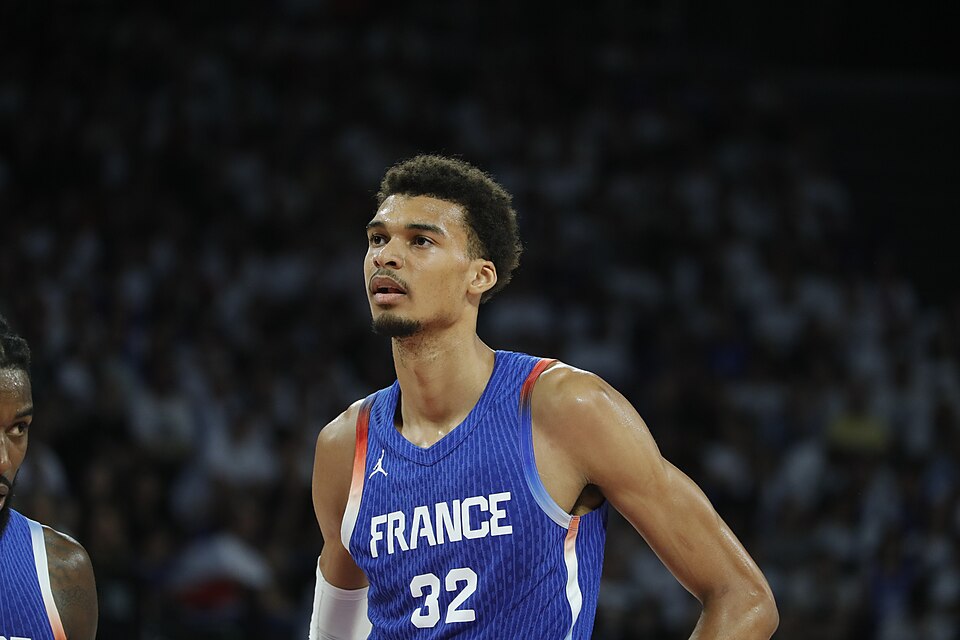
1. Victor Wembanyama: the best young NBA player in 2026
San Antonio Spurs | 22 | Centre
2025–26: 25.0 PTS · 11.5 REB · 3.1 AST · 3PT: 34.9% · BLK: 3.1 · STL: 1.0 · TOV: 2.4 · FT%: 82.7%
Wembanyama is the easy part. We can spend a considerable amount of time arguing about whether Flagg has earned second, whether George should be above Knueppel or whether Queen deserved Bailey’s place. Putting the San Antonio centre first requires rather less negotiation.
At 7ft 4in (2.24m), the Frenchman selected first in the 2023 NBA Draft was always going to be noticed. The difficulty for everyone else is that he can move, handle the ball and shoot. Men over 7ft are not meant to be able to do those things, they just do not go together – Travis Kelce does not have a sub 4.4 second 40-yard dash time, Shaquille O’Neal did not shoot 80% of his free throws, Tiger Woods does not both drive a golf ball and a car at a world-class level; Wembanyama blocking 50% more shots per game last season than the person in second place and scoring 25 points per game is freaky.
His 2025–26 season made the argument considerably stronger. He became the youngest and first unanimous NBA Defensive Player of the Year, leading the league in blocks for a third successive season. An average of 3.1 blocks per game is an extraordinary starting point, and still manages to understate how much inconvenience he causes.
A player who decides against driving has no abandoned lay-up added to his statistics. Nor is there a particularly convenient column for the pass made earlier than intended or the shot released at an angle its owner would normally consider inadvisable. Wembanyama’s reach influences all of those decisions. The block is simply the occasion on which the opponent proceeds with the original plan and receives a more obvious explanation of the problem.
There is also the small matter of 25 points per game in only 29.2 minutes. His field-goal percentage rose from 47.6% in 2024–25 to 51.2%, while 82.7% at the foul line gives him a dependable way to collect points when defenders resort to contact. The 34.9% from three leaves room to improve, which is an unsettling qualification to attach to somebody already this difficult to contain.
An All-NBA First Team selection followed, along with Western Conference Finals MVP honours as San Antonio reached their first NBA Finals since 2014. At 22, he has already taken the leading role on a team playing for the championship. That is the destination we are still discussing as a possibility for most of the players below him.
New York nevertheless supplied a useful reminder that remarkable ability does not make every basketball problem disappear. The Finals defeat left San Antonio with work to do, and Wembanyama can still make better decisions under pressure and become a more consistent threat from outside. Opponents with a whole series to examine his habits will keep looking for whichever option is least uncomfortable.
He is the best young NBA player in 2026 because he already combines major scoring responsibility with an exceptional influence on the opposition’s attack. The prospect of further improvement makes the choice easier still. Flagg and Banchero can continue their argument about second.
Some players who narrowly missed out
Derik Queen is first in line if a place becomes available. His passing makes the comparison with Bailey particularly close; we have backed the younger wing’s scoring, but anyone who prefers Queen’s ability to involve other people has a reasonable argument.
Dereck Lively II is the most difficult omission to separate from availability. Foot surgery ended his 2025–26 season after seven appearances. His finishing and defence still give him a strong long-term case, but we would like to see him back on the court before putting him above the centres included here.
Bilal Coulibaly offers the defensive ability to make a case for this company. The problem is how many of the wings selected can also shoot or create more convincingly. He needs to make that offensive comparison harder to resolve against him.
Jared McCain has an obvious way back through his shooting. Sheppard’s combination of shooting and passing, and Wallace’s defence, win our votes for the lower guard places this time. McCain could make those decisions uncomfortable with a stronger season.
Zaccharie Risacher remains interesting, but we would like to see more of his shooting, movement and defensive ability come together over full games. Being a former first pick guarantees that people will keep discussing you. It is a less compelling reason to stay ahead of players doing more now.
Egor Demin is the omission I have the greatest incentive to argue with as a Nets supporter. A young guard with his size and passing ability offers Brooklyn something worth developing, and 38.5% from three in his rookie season gives the optimism a more substantial foundation than simply hoping the rebuild eventually ends. His 10.3 points and 3.3 assists per game nevertheless leave work to do before I can put him ahead of the guards selected here. The next step is to create more opportunities around the basket and turn the passing promise into greater control of the offence. There is a plausible future top-30 player here. Supporting Brooklyn does not, unfortunately, entitle me to bring that future forward.
What could change the order?
For several players here, the next step is unusually easy to identify. A dependable jumper would change the choices available to the Thompson twins and Castle. Sharpe and Bailey could make their scoring more valuable by becoming better at recognising when to pass. The young centres may move further by making the correct defensive decision and adding some attacking strings to their bow.
The rookies will give us the quickest indication of how much weight we have placed on promise. Dybantsa, Peterson and Boozer enter with expectations, but their first NBA season will provide a much better basis for deciding where they belong. Some of the players beneath them have already supplied evidence; the rookies have been allowed a little credit in advance.
The larger question is whether any of this group can become one of the players around whom the sport revolves. Flagg has time and a remarkably broad starting point. Banchero already carries the sort of responsibility that can lead there. For the others, reaching that level will require a substantial improvement in at least one part of their game.
Wembanyama has already brought San Antonio to the NBA Finals at 22. LeBron and Curry’s eventual successors will need to do rather more than produce an exciting highlights package. He is making a fairly persuasive start.
FAQs about the best young NBA players in 2026
Who is the best young NBA player in 2026?
Victor Wembanyama is my No. 1 among NBA players aged 23 and under. He averaged 25 points, 11.5 rebounds and 3.1 blocks in 2025–26 and helped San Antonio reach the NBA Finals. His scoring and defence give him the strongest case already; at 22, he still has plenty of time to improve.
Who are the best NBA players under 21 in 2026?
Cooper Flagg and Dylan Harper are the highest-ranked players who will still be under 21 on 20 October 2026. Flagg is second overall and will be 19; Harper is 14th and will be 20. AJ Dybantsa, Darryn Peterson, Cameron Boozer and Ace Bailey also meet that younger age limit and make our top 30.
What is the age limit for this young NBA players ranking?
Players must be 23 or younger on 20 October 2026, meaning they were born on or after 21 October 2002. The list therefore includes 23-year-olds. Every age shown is calculated for that cutoff, so all players are assessed on the same basis.
Why are Anthony Edwards, Cade Cunningham and Chet Holmgren missing?
All three exceed the age limit. On 20 October 2026, Anthony Edwards and Cade Cunningham will be 25, while Chet Holmgren will be 24. They are therefore ineligible for this ranking, regardless of how highly we rate their basketball.
Which 2026 NBA draft picks make the top 30?
AJ Dybantsa ranks 22nd, Darryn Peterson 23rd and Cameron Boozer 28th. The three incoming rookies earn places on their projected potential. Their NBA statistics are marked N/A because they have yet to play a regular-season game.
Why is Cooper Flagg ranked above Paolo Banchero?
Flagg averaged 21 points, 6.7 rebounds and 4.5 assists in 2025–26 and will still be 19 at our cutoff. I give that early production, alongside his defensive versatility, a narrow edge over Banchero’s stronger established record. If the priority were simply who we would trust to lead an NBA offence today, Banchero would have a strong argument for second.
 The Penwarden Review
Leave a comment