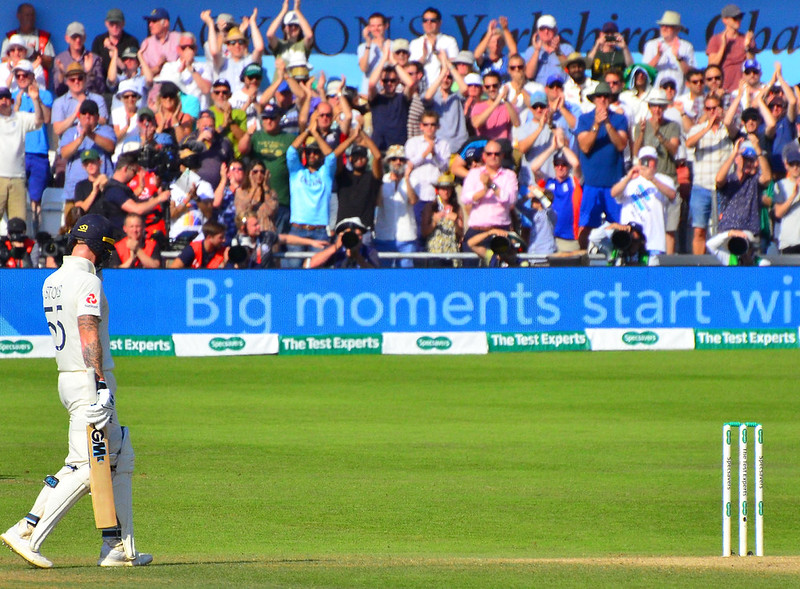
Who could replace Ben Stokes as England’s test all-rounder? As Trump concentrates on ending the Iran War for the eighteenth time this week and Burnham does his train fare reimbursement admin for last week’s Manchester to London journey, they both ignore this era’s defining issue – how do England replace Ben Stokes?
What attributes are England actually trying to replace? (i) Leadership; (ii) a number 6/7 batsman; and (iii) a fourth seamer. No new player put into the team can replicate his leadership (the ECB have had a good root (pun intended) around on Hinge and decided to get back with their ex), so the main purpose of the replacement is to chip in with useful runs (Stokes averaged just under 27 with the bat in his final three years) and to bowl around 17.5% of England’s overs (the typical load of a fourth/fifth bowler).
The obvious assumption is that England’s Ben Stokes-shaped hole should be filled by another seam-bowling all-rounder. The numbers suggest they may be better off looking for a spinner. I wanted to see whether the statistics could tell us who.
Statistics are helpful, but they can never account for every relevant — and potentially unquantifiable — piece of information. No statistical model can account perfectly for context: Division One versus Division Two, home conditions, strength of opposition, a player’s role within his side, or even the quality of wickets taken.
Statistics can be guilty of telling you whatever you have decided you want to see (and don’t forget, 40% of statistics are made up). Remember the obsession with six-foot-seven Josh Hull’s high release point ahead of his Test debut? Analysis showed that his collapsing back leg meant he released the ball less than 5cm above his standing height, compared with around 30cm for Jofra Archer. Archer is 14cm shorter than Hull but releases the ball 12cm higher.
A tape measure tells you Hull is tall; five minutes of video analysis tells you that at the moment of release he is more Warwick Davis than Greg Davies. Two statistics about the same player can lead you in completely opposite directions.
But taking a step back, can a certain set of objective statistics guide us to the correct all-rounder answer?
I have looked at statistics from the 2024, 2025 and 2026 County Championship (up to the matches which began on 20 August) for every cricketer who (i) has scored more than 750 runs; (ii) has taken more than 40 wickets; and (iii) was not older than 30 on 20 August 2026. I have then given each player a score out of 100 in an attempt to sort the wheat from the chaff and remove any bias towards players who may be more fashionable than others.
The runs and wickets thresholds try to ensure only real all-rounders appear, and the age limit avoids looking at prospects who are not realistic England Test selections (sorry, 36 year old Luis Reece and 34 year old Ben Raine). However, the arbitrary age limit does ignore the 32 year old Craig Overton, who has averaged a startling 38 with the bat and 26 with the ball in the past three years! You could easily argue that Overton deserves a place in England’s squad on the basis of his bowling alone, as a back up to the also 32 year old Ollie Robinson (a man who similarly has the distinction of averaging more with the bat than the ball in our research period), but we have to draw a line somewhere.
Here I have set out how each player’s score out of 100 has been calculated:
| Category | Points | How are these points scored? |
| Batting average | 20 | 0 points for an average of 20 or below; 20 points for 50 or above. For example, average of 35 earns 10 points |
| Average share of team runs | 10 | 0 points at 5% or below; 10 points at 15% or above |
| Centuries | 8 | 1 point per century, capped at eight centuries |
| Scores of 50–99 | 5 | 0.5 points per score, capped at ten scores |
| Total runs | 5 | 0 points at 750 runs; 5 points at 2,250 runs or more |
| Matches played | 2 | 0 points at 20 matches or fewer; 2 points at 36 matches or more |
| Batting total | 50 | |
| Bowling average | 20 | 20 points for an average of 20 or below; 0 points for 45 or above. |
| Average share of team balls | 8 | 0 points at 10% or below; 8 points at 25% or above |
| Total wickets | 7 | 0 points at 40 wickets; 7 points at 110 wickets or more |
| Overs per match | 5 | 0 points at 15 overs or fewer; 5 points at 35 overs or more |
| Economy rate | 4 | 4 points at 2.50 runs per over or lower; 0 points at 4.50 or higher |
| Five-wicket innings | 4 | 0.8 points for each five-wicket innings, capped at five |
| Ten-wicket matches | 2 | 1 point for each ten-wicket match, capped at two |
| Bowling total | 50 | |
| Overall total | 100 |
I have deliberately split the 100 points equally between batting and bowling. The model rewards not merely averages, but volume and responsibility: scoring a large share of your team’s runs matters (scoring 20 goals in the Premier League for Ipswich Town is more impressive than scoring 10 goals for Arsenal), as does bowling a large share of its overs. The idea is to find players already doing something resembling an all-rounder’s job rather than part-timers with flattering averages.
| Player | Type | Verdict |
| Rehan Ahmed | Wrist spin all-rounder | Best fit |
| George Hill | Right arm seam all-rounder | Strong statistical case |
| James Coles | Slow left arm all-rounder | Long-term contender |
| Ben Kellaway | Off-spin all-rounder | High upside prospect |
| Matt Critchley | Wrist spin all-rounder | Best statistical score |
Ranking England’s Best All-Rounders
Now the results:
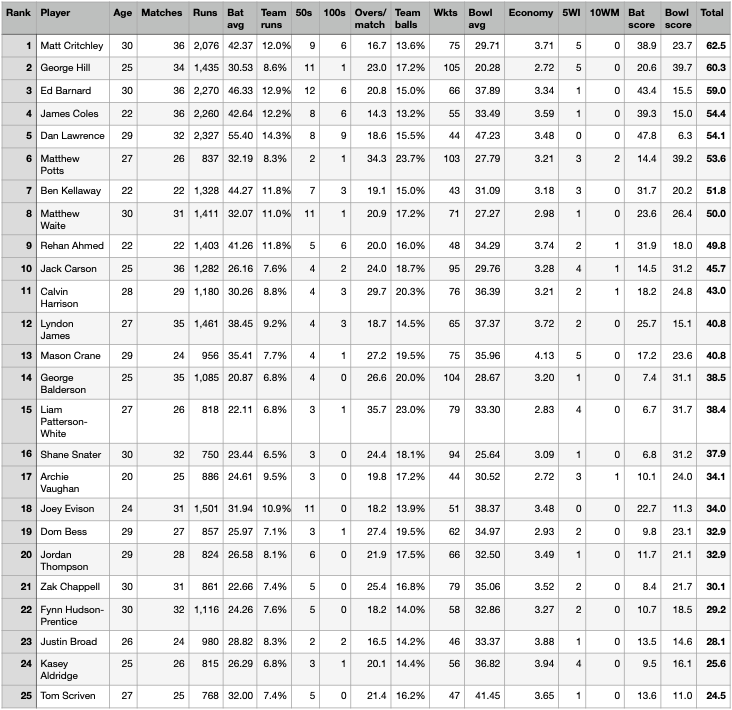
Tap or click the table to view it at full size.
Essex’s Matt Critchley comes out on top – a man who has never really been in the England selection conversation. Averaging more than 40 with the bat and less than 30 with the ball over the past three years he is an all-round all-rounder. He may be light on overs compared with others who appear in this list, but those overs appear to be highly effective, with a very good economy rate for a spinner.
George Hill’s results are striking as a 25 year old. Coming in second with a batting average that just creeps over 30 shows how exceptional his bowling has been. His economy rate of 2.72 suggests he’s spent the past three years bowling to a Geoffrey Boycott in full survival mode.
Hill’s ability to rank highly while not excelling at batting is the opposite of Dan Lawrence. Dan Lawrence’s fifth-place finish also exposes one of the limitations of the exercise. His extraordinary batting numbers — 2,327 runs at 55.40 — lift him to a score of 54.1 despite his 44 wickets costing 47.23 apiece. The model is designed to reward contributions with both bat and ball, but it cannot distinguish perfectly between a genuine all-rounder and an outstanding batsman who bowls enough to clear the wickets threshold. Nobody looking for a replacement fourth or fifth bowler for Stokes would regard a bowling average of 47 as sufficient. So the final scores should be treated as a way of identifying candidates, rather than picking the team for us.
The first thing I thought when going through this list was, ‘who am I surprised isn’t on there?’
The most obvious candidate is the one flagged by Marcus North in his media appearances following the announcement of the squad for the first Test versus Pakistan – Sam Curran. He passes the age requirement (28) but his IPL and England white-ball commitments immediately explain his lack of County Championship cricket – in the period, he has only played eight matches – scoring 357 runs and taking 15 wickets. If we extrapolate this out to 30 games, he would have been expected to have scored 1,339 runs and taken 56 wickets. But, he didn’t, so we can’t. An injury means he won’t play any of the remaining County Championship fixtures this year, but if he swerved the 2027 IPL you could easily imagine him averaging 40+ with the bat in Surrey’s top 6 and averaging ~30 with the ball. He just needs to go and do it.
It’s basically the same story with his Surrey teammate Will Jacks – 27 years old, 6 matches, 246 runs and 13 wickets. The statistics make his Ashes selection all the more remarkable: he bowled just 158.4 County Championship overs in our period. How could he ever have been expected to bowl with any consistency in Australia when he has spent the last few years just bowling up to four overs of darts in Twenty20 matches? Anyway, we digress…
I also thought another Surrey player, Tom Lawes, may appear. But the 23 year old’s 20 matches in the period have resulted in 511 runs and 36 wickets. Ben Green misses out due to being 40 runs short and Tom Price 78 runs and one wicket short. The fact that these two came closest statistically to making the cut suggests that the thresholds of 750 runs and 40 wickets are about right.
Which Young All-Rounders Could Replace Stokes?
There were only nine players who were not older than 25 on 20 August who made the cut:
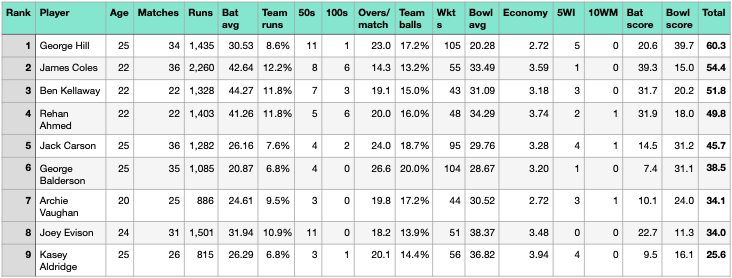
Tap or click the table to view it at full size.
How Do Today’s Young All-Rounders Compare with Stokes, Flintoff and Woakes?
That made me wonder how these numbers compare with England’s great all-rounders at the same age. To put the youngsters’ statistics into some context, what would Ben Stokes, Chris Woakes and Andrew Flintoff have scored in this system if we took the County Championship seasons that began when they were 20, 21 and 22 years old? For Stokes this would be 2012-2014, Woakes 2009-2011 and Flintoff 1998-2000.

Tap or click the table to view it at full size.
This is where the exercise becomes more interesting. A score in the low 50s looks fairly ordinary until you discover that Ben Stokes himself would have scored 52.9 at the same age.
The most pleasing point from this data is that it pours fuel on my ‘Chris Woakes is the most underrated cricketer of my lifetime’ fire. In his early twenties, he had batting numbers that bettered Flintoff’s Test batting statistics and took on the lead role in Warwickshire’s bowling attack. He was highly effective – his lack of flamboyance compared to Stokes and Flintoff and his coming through as a new ball bowler during the reigns of Anderson and Broad probably counted against him.
Stokes’ batting average of 27.75 in his early twenties (versus a Test batting average of 34.46) shows that all-rounders are not born fully formed. He would sit just above Ben Kellaway on our scoring system. Flintoff would be just behind Rehan Ahmed. So we should bear in mind that the best 21 year old is not necessarily going to be the best 30 year old.
The Woakes, Stokes and Flintoff statistics show Hill, Coles, Kellaway and Ahmed in a very good light.
Why Rehan Ahmed Is My Choice
So what do these numbers actually tell us? Most importantly, that the best all-rounder is not necessarily the best selection.
Critchley comes out on top statistically (and has the differentiator of being a leg spinner) but at 30 years old, I am not sure he is worth the long-term investment. In the long term, Rehan is the bet as a wrist-spinner, and it is a marginal call in the short term.
George Hill is an interesting candidate. He leads the statistics for the 25-and-under category by a good margin. But a batting average of 30 over the past three years just seems too light to bat at 7 for England. Although England’s obsession with pace seems to have subsided, would England go into a Test match with both Ollie Robinson and George Hill averaging less than 80mph? This seems a stretch even in the post ‘Bazball’ era. I could see Hill rivalling Robinson and batting at 8, but not at 7.
The youngest player who meets the criteria is Archie Vaughan. He seems to be sliding down the batting order to number 6 or 7 (and into an all-rounder role) at Somerset and is, considering he plays with Jack Leach, bowling a good number of overs when he plays. It is far too early for him, but he and the likes of Seb Morgan at Middlesex, James Minto at Durham, Caleb Falconer at Middlesex and Rocky Flintoff at Lancashire (when he is fit to bowl) are exciting prospects.
If we pass on the two players with the highest scores, who is the man?
In any selection, you have to take into account the opportunity cost: if I pick player A, I cannot pick player B. If your all-rounder is a seamer (and you want to play a spinner) you have to lose one of Tongue or Atkinson. If your all-rounder is a spinner, you lose Bashir. That is not an equal trade. England have an abundance of high-class fast bowlers and no spinner currently demanding selection. Replacing Bashir costs far less than replacing Atkinson or Tongue.
The parallel is Moeen Ali in 2014. England did not pick Moeen because they thought he was the best spinner in the country. They picked him because the gap between Moeen and the specialist alternatives was small enough that his batting transformed the balance of the XI. Rehan Ahmed presents England with the same calculation.
Today, who is the spinner (player B) demanding selection? Leach? His time appears to have come and gone at 35 years old and nearly two years on from his most recent Test match. Bashir? A player whose bowling dispersion map looks like a Jackson Pollock painting. Hartley? Cannot get a game for Lancashire. Jacks? 41% of his red ball overs in the past two years were bowled in the Ashes – he just doesn’t play red ball cricket. Lawrence? Averaging 47 with the ball in the past three years just looks like a typo.
In turning to Ahmed, you are not ignoring the next Jim Laker – and you get to pick Archer, Robinson, Tongue and Atkinson. Four excellent bowlers who also have nineteen 50s and three 100s in first class cricket between them.
Also, Rehan has one advantage over his part time spin rivals in bowling wrist spin (I won’t say leg spin as he very rarely bowls a ball that spins away from the right handed batsman). Realistically, can we say today with any confidence that Coles is a better left arm spinner than Bethell? Is Kellaway a better off spinner than Root? Akin to having a left armer in your seam attack, Rehan brings something that no one else in the team has. At a dinner party you don’t want everyone to bring a bottle of red wine; one person needs to bring the tequila.
England should prioritise Coles and Kellaway bowling as many overs as possible in the County Championship and for England Lions, starting in South Africa later this year. Today Coles is very much Sussex’s second spinner behind Jack Carson and Kellaway is behind Mason Crane at Glamorgan. The leap from a second spinner bowling less than 15% of a county’s overs to a frontline Test spinner bowling upwards of 20% of England’s overs would be enormous. In the subcontinent you may even be able to find a way of picking Rehan, Coles and Kellaway (and create the 8, 9, 10 and 11 that England didn’t quite manage with Caddick, Mullally, Tufnell and Giddins: four players who can actually bat).
In England a line-up of 7 Ahmed; 8 Atkinson; 9 Robinson; 10 Archer; and 11 Tongue has sufficient batting depth and bowling variety. Ahmed can bowl wrist spin; Root off spin; and Bethell slow left arm. The only missing ingredient is a left arm seamer. Put Sam Curran in for one of the seamers and the bowling variety — and batting depth — only increases.
England cannot replace Ben Stokes. They can, however, replace what he allowed them to do. Rehan Ahmed offers perhaps the neatest way of doing it: enough runs at seven, a genuinely different spin option, and the freedom to pick England’s four best fast bowlers. The statistics don’t prove he is the answer. But they make a compelling case that he should be given the chance to become it.
That is also the structure I have used in my projected England Test team for 2030, with Ahmed at seven and four seamers beneath him.
Frequently Asked Questions
Who could replace Ben Stokes as England’s Test all-rounder?
Rehan Ahmed is arguably the most natural option, not because he is a like-for-like replacement for Ben Stokes, but because his combination of batting and wrist-spin could give England the best balance. Picking a spin-bowling all-rounder at number seven would allow England to select four specialist fast bowlers alongside him.
Could Rehan Ahmed replace Ben Stokes?
Rehan Ahmed cannot replicate everything Ben Stokes provides, particularly his leadership and seam bowling. However, if he can score enough runs at number seven and develop into a frontline Test spinner, his selection could allow England to replace the balance Stokes brought to the side rather than trying to find another identical player.
Who are England’s best young all-rounders?
Rehan Ahmed, George Hill, James Coles and Ben Kellaway are among the most interesting young all-rounders based on recent County Championship performances. Younger prospects including Archie Vaughan, Tom Lawes, Rocky Flintoff, James Minto, Seb Morgan and Caleb Falconer could also enter the England conversation as they develop.
For more on the next generation, see my ranking of the 30 best young English cricketers under 23. For a comparison with an even deeper talent pool, I have also ranked the 30 best young Indian cricketers, including several all-rounders who could eventually face the same selection problem from the other side.
Does England need a seam-bowling all-rounder to replace Ben Stokes?
Not necessarily. England could instead select a spin-bowling all-rounder and use the remaining four bowling positions for specialist fast bowlers. Given England’s current depth of fast bowling, that may involve less of a selection compromise than replacing one of the specialist seamers with an all-rounder.
 The Penwarden Review
Leave a comment