Statistics and player ages correct as of 3 September 2026.
Who could replace Joe Root and Ben Stokes? This is my predicted England Test team for the first home Test of 2030, featuring the established internationals and young cricketers who could define the next era.
England after Root
Three and a half years feels like a very long way away but in a blink of an eye England will be trudging off / dancing around (delete as applicable) the Sydney Cricket Ground in January 2030.
Ben Stokes will be making his seventh comeback. Joe Root will be 39. Ben Duckett will be 35. Ollie Robinson will be 36. Jofra Archer will be 34. Old in the historic context of Test cricket, but young versus their opponents; a 58 year old Pat Cummins and 71 year old Nathan Lyon.
As some of the main men head into cricketing old age some others will be in their prime. Harry Brook will be 30; Jamie Smith 29; and Jacob Bethell 26.
From the squad that has been playing the 2026 home Tests versus Pakistan you could see Bethell and Brook remaining in the middle order, Smith behind the stumps and Tongue and Atkinson bowling seam. All others will likely be too old (Root, Robinson) or are not guaranteed their place in the side today, let alone in four years time (Gay, Cox, Lawrence).
England will need to replace their leading Test run scorer (maybe even the world’s leading Test run scorer by then); a man who takes wickets at an average that has only been bettered three times since the 1800s; and a man who can bowl spells with an average speed over 90mph. None of these will be easy boots to fill.
Injuries will intervene, careers will stall and someone will get hit in the face by a bouncer (either delivered by a fast bowler, or outside a nightclub). At least one player way off the radar will emerge and make his omission seem inexplicable in hindsight. Nevertheless, the exercise tells us something useful about the shape of English cricket: where succession plans already exist, where genuine depth is developing and where England are still waiting for an answer.
England will have around 35 Test matches between now and the end of the 2029/2030 Ashes. This is not a ranking of England’s eleven most talented young players. I have ranked England’s 30 best young cricketers separately; this exercise is about constructing a balanced XI rather than identifying the prospects with the highest individual ceilings. It is an attempt to construct the balanced Test team England could select for the first match of the 2030 home summer, using age, current ability, development trajectory, pathway recognition and the vacancies likely to appear over the next four years. The same exercise looks very different elsewhere: my ranking of India’s best young cricketers shows just how many plausible future internationals can be competing for the same handful of places.
England’s Possible Test XI for 2030
| No. | Player | Age in 2030 | Role |
| 1 | Ben McKinney | 25 | Opening batsman |
| 2 | Jordan Cox | 29 | Opening batsman |
| 3 | Jacob Bethell | 26 | Top order batsman / slow left arm spin |
| 4 | Harry Brook | 31 | Captain / middle order batsman |
| 5 | James Rew | 26 | Middle order batsman |
| 6 | Jamie Smith | 29 | Wicketkeeper / batsman |
| 7 | Rehan Ahmed | 25 | All-rounder / right arm wrist spin |
| 8 | Gus Atkinson | 32 | Fast bowler |
| 9 | Tom Lawes | 27 | Seam bowler |
| 10 | Josh Tongue | 32 | Fast bowler |
| 11 | Sonny Baker | 27 | Fast bowler |
There are five players here who have demonstrated that they belong at Test level: Bethell, Brook, Smith, Atkinson and Tongue; one batsman who has just got into the Test team: Cox; two batsmen who are developing reputations in the county game: McKinney and Rew; one young all-rounder who already has seven first-class centuries and could be England’s first regular wrist-spinner since before the old King died: Ahmed; and two young seam bowlers, one who can bat a bit and bowls briskly and the other who could be England’s next 90mph+ regular: Lawes and Baker.
This is a team designed for the beginning of an English summer (who knows what the climate could be like by then…) when England will likely want four seamers. Later in the summer or away from home a Shoaib Bashir, Ben Kellaway or Farhan Ahmed could replace one of the seamers.
Who Will Survive From the Current England Test Team?
The temptation when picking any future side is to throw away everyone over 30 and pick an XI made up of players who have three first-class appearances (but lots of hype) between them. England have never had an XI full of 24 year olds and are unlikely to start now.
England’s 2030 team is likely to contain a mixture of players already established today, cricketers currently moving through the Lions pathway and at least one name barely visible from the senior game. The difficult part is deciding which of the current players will remain.
Harry Brook is the most comfortable selection. The highest average of any English Test batsman since Ken Barrington retired in 1968 and the highest strike rate ever (just ahead of Ben Duckett and scoring 20 runs per hundred balls more than Zak Crawley, the next highest specialist batsman on the list). Brook will be 31 by the beginning of the 2030 home summer and should be in his prime. For others the biggest risk is a dip in form or being seduced by the bright lights (and big cheques) of the franchise world – for Brook it’s probably having one too many pints one evening.
Jamie Smith and Jacob Bethell are not quite as automatic as Brook but are likely to still be in the Test team. Both will still be in their twenties. Smith already supplies the rarest commodity in the side: an improving wicketkeeper capable of batting in the top six (averaging just under 39 with a strike rate of 73) without his selection feeling like a compromise. Bethell has the range to become a long-term top-order batter (hopefully his overall record follows his second innings batting average (54) rather than his first (16)), while his slow left-arm bowling gives England a useful additional option.
Gus Atkinson and Josh Tongue will each be 32 and should by then, injuries permitting, have more than 40 Tests each under their belt.
Ben Duckett was the most difficult omission among the current regulars. He has maintained an excellent average in an era of declining returns for Test openers, while his remarkable strike rate of 86 reflects an ability to score around the entire ground. The question is simply whether a 35-year-old Duckett will remain a better option than a 25-year-old McKinney.
There is no guarantee that Emilio Gay will make it past the 2026 Pakistan series, let alone the 2029/2030 Ashes. A 39 year old Joe Root may have gone past Sachin Tendulkar’s Test runs record and hung up his boots by then, and the end of an Ashes cycle appears a natural stopping point – if he hasn’t already retired earlier. Ollie Robinson and Jofra Archer will be younger in 2030 than Anderson, Broad and Woakes were when they retired but with each of them carrying a long injury list having any confidence in them at 36 (Robinson) and 35 (Archer) in the summer of 2030 is optimistic.
A New Opening Partnership
Ben McKinney
The selection of Ben McKinney is a bet on opportunity as much as talent.
England have spent years searching for Test openers. You could argue that at least one of the England’s opening pair has been looking over his shoulder since Andrew Strauss retired in 2012 – the post Strauss merry-go-round of Compton, Carberry, Robson, Lyth, Hameed, Jennings, Burns, Sibley etc. turned into 64 matches of Crawley averaging 31, which has turned into Emilio Gay trying to make the step up from County Championship Division 2 to the Test arena.
The constant search has been because opening the batting in England is difficult and partly because the alternatives have rarely forced the selectors’ hand.
McKinney has the ingredients to change that. He is tall, left-handed, comfortable scoring rather than merely surviving, already established within England’s development pathways and when he makes hay when the sun shines (244 versus Gloucestershire in 2026, 150 versus Warwickshire in 2025 and 140 versus Derbyshire in 2026). By the beginning of the 2030 home summer he will still be only 25, but he could have several full county seasons and extensive Lions experience behind him.
There is an obvious danger in projecting a young opener too quickly. Plenty of gifted batters have looked destined for England before county attacks discovered a technical weakness or patience ran out during an inevitable lean season. McKinney does not need to be ready today. The question is whether he can become ready over the next three years.
The vacancy is also not guaranteed. Crawley could make a reappearance. Emilio Gay and other contenders will have their opportunities. Asa Tribe or Ben Dawkins could score bucketfuls of runs. A player not yet in the leading group could surge past all of them.
McKinney is therefore not selected with the certainty attached to Brook or Smith. He is selected because, among the likely candidates, he has the clearest combination of ceiling, pathway and opportunity.
Jordan Cox
The selection of Jordan Cox is not quite the extrapolation of potential that is required with McKinney, but it is thinking about what he can be rather than what he is today.
Since joining Essex ahead of the 2024 season he has averaged over 68 in first-class cricket. None of those runs have come as an opener but he did open for Kent 30 times earlier in his career (and scored his career best 238 not out from that position). That puts Cox in a similar position to the England openers versus Pakistan – Duckett bats at three for Nottinghamshire and Gay the same for Durham.
His first three Test innings versus Pakistan have resulted in scores of 73, 55 and 11 – a small sample size but immediate evidence that he does not appear to be overawed by Test cricket.
His Twenty20 average of 29 at a strike rate of 140 shows that, like the incumbent Duckett, he does not lack scoring options. His selection would continue the positive ‘bat-on-ball’ ethos that has started with Duckett and Crawley, rather than the careful accumulation of an Alastair Cook or Dom Sibley.
Rebuilding the Middle Order
Jacob Bethell at Three
While Bethell’s talent is not in doubt, his precise position remains open to debate.
By 2030, England should know whether he is a destructive middle-order player, a genuine top-three batter or something more flexible. He will be 26 when that summer begins, and should have built on his maiden first-class (154 against Australia in the 2025/2026 Ashes), ODI (110 from 82 balls versus South Africa) and T20I (105 from 48 balls against India in the World Cup semi-final) centuries.
His bowling matters too. Bethell’s left-arm spin would not make him the frontline slow bowler, but it would offer control, match-up value and a way of managing Rehan’s workload. England have often benefited from Root’s ability to provide useful overs without selecting him for that purpose. Bethell could inherit part of that function.
Harry Brook, Captain
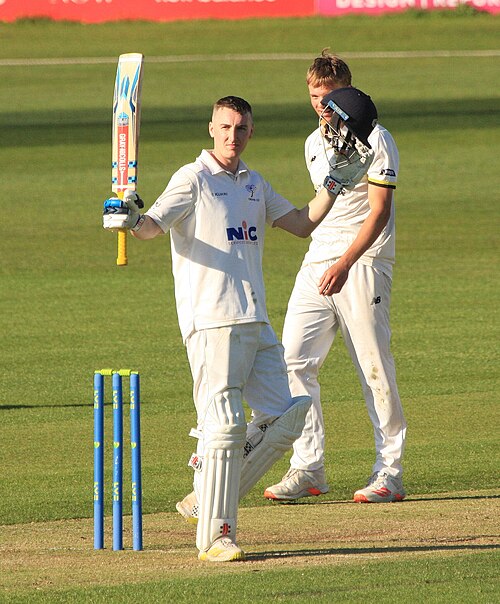
Harry Brook is the likeliest captain of this projected England side. Photo: Dave Morton/Wikimedia Commons, public domain.Selecting Brook at four is not an amazing act of fortune telling, but predicting his captaincy is a little less certain.
Brook will likely be the most logical choice for the captaincy as England’s senior elite batter and with a few years of the white ball captaincy behind him, but the captaincy may burden his batting and the relentless schedule could make the job less attractive.
But if Root is gone and Brook remains, the team is likely to feel like his side whether or not he is formally in charge. On balance, he gets the job.
James Rew
Rew has been in and around England selection conversations for a while, even though he is only 22 today. His Test debut as a wicketkeeper was ultimately disappointing but did come in the madness of the Stokes/Atkinson drinking affair. Rew’s selection is based on more concrete evidence than McKinney’s selection – becoming the youngest Englishman since Denis Compton to reach ten first-class hundreds, scoring a double century and having multiple thousand-run seasons behind you do bring you to the front of the queue.
What stands out is not simply the volume of runs but the frequency with which Rew converts starts. His tenth hundred, 116 against Essex in 2025, came after Somerset slipped to 54-4 chasing 321 against one of the strongest attacks in county cricket. He didn’t merely accumulate runs; he won the game.
The main question is whether he or his brother, Thomas, play the most Tests for England.
Jamie Smith, wicketkeeper
By the summer of 2030 Smith will be 29 and should have spent several years keeping wicket at Test level.
His Test match batting so far, while being inconsistent, has returned remarkable statistics (a batting average just below Matt Prior and Alec Stewart). Also, his ever improving wicket keeping has been exemplified when standing up to the stumps to Ollie Robinson in the 2026 summer.
With Cox and Rew in the side, other wicketkeeping options will exist in the event of injury or to give Smith a break. If Cox’s or Rew’s wicketkeeping abilities were to surpass those of Smith there is every chance that he could justify selection on the basis of his batting alone.
Replacing What Ben Stokes Allowed England to Do
England cannot replace Ben Stokes – they can, however, replace what he allowed them to do.
That distinction is fundamental. The search for another player capable of batting in the top six, bowling genuinely fast, changing matches in the field and captaining through force of personality is unlikely to end well. England could spend a generation rejecting perfectly useful cricketers because they fail to resemble an extraordinary one.
The better question is how to reproduce the balance Stokes created. My ranking of the leading candidates to replace Ben Stokes considered the individual all-rounders who could assume part of his role. This projected XI takes a different approach by distributing his responsibilities between Rehan Ahmed, Tom Lawes and the rest of the attack.
In this team, Rehan Ahmed bats at seven and operates as the principal spinner. Atkinson, Baker, Tongue and Lawes then provide four seam options suited to an early English summer, while Bethell offers supplementary spin. Five frontline bowlers remain available without asking one of the top six to perform an imitation of Stokes.
Rehan is not yet certain to become that player. His batting must develop sufficiently for number seven in Test cricket, while his leg-spin must be reliable enough to carry frontline responsibility. Being capable of contributing in two disciplines is not the same as being selectable in both, but his first-class statistics up to the age of 22 (over 2,000 runs at 32 and over 90 wickets at 36) suggest enormous potential and his ceiling is unusually high.
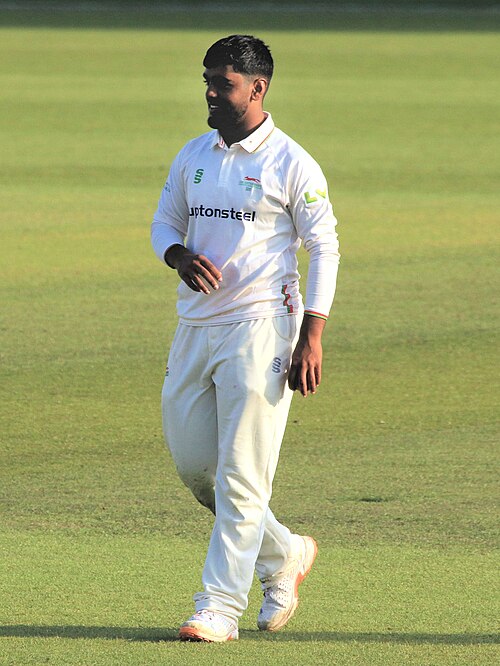
Rehan Ahmed’s development as both a batter and leg-spinner could determine the balance of England’s 2030 side. Photo: Dave Morton/Wikimedia Commons, public domain.A Rehan who averages somewhere around 30 with the bat and develops into a threatening Test spinner would transform England’s choices. He would allow them to select four fast bowlers in Australia, two additional spinners in Asia or a more conventional attack at home.
Statistics can identify all-round candidates but there is something intangible to the balancing of the side that a genuine all-rounder affords. Balance is partly about opportunity cost: what does selecting one player allow England to do elsewhere? On that measure, Rehan has a credible claim to become one of the most structurally important players in the side.
The 2030 Bowling Attack
Gus Atkinson: The Leader of the Attack
Atkinson can act as the bridge between generations. He made his debut alongside Anderson and Woakes, in the Test after Broad had retired. By 2030 he could be the senior man introducing the next wave to Test cricket.
He will be 32 in 2030. Depending on injuries – bowling a few thousand more deliveries between now and then will have some effect – he should still be pacy and capable enough with the bat to be a good number 8.
Sonny Baker: The Pace Bet
England’s interest in pace will not disappear with Mark Wood.
Wood’s quickest spells have demonstrated why outright speed retains value even when it produces neither immediate wickets nor flattering economy figures. It creates dismissals unavailable to a conventional seamer and gives a captain somewhere else to turn when the pitch becomes flat.
Baker is the obvious candidate to inherit that function. He has already moved rapidly through the England pathway and possesses the raw speed selectors continually seek. By the 2030 home summer, he will be 27: old enough to have developed the physical resilience and control required for Test cricket, but young enough to be approaching his quickest years.
His selection is not based on pace alone. England have encountered enough fast bowlers whose dispersion maps resemble Jackson Pollock paintings. Baker must show that his speed can survive longer spells and that he can threaten Test batters without waiting for them to dismiss themselves.
The attraction is nevertheless obvious. A fit Baker offers something few English bowlers can reproduce.
Josh Tongue: Experience and Bounce
Tongue is the less glamorous but more established selection.
He will be 32 and, if his body cooperates, should have accumulated far more Test experience. His height, bounce and ability to take wickets would make him dangerous even on a slow early-season surface, while his experience would complement the younger Baker and Lawes.
Fitness is the qualification attached to every discussion of Tongue. His career has already been interrupted by serious physical problems. Projecting a fast bowler four years forward requires crossed fingers; projecting one with Tongue’s history requires taking your shoes and socks off too.
Tom Lawes: The Depth Selection
Lawes offers a different sort of projection. He will not bowl as quickly as Tongue or Baker, but could do for the 2030 side what Woakes did for many years.
By the start of the 2030 home summer, Lawes will be 27. He already has substantial first-class experience for Surrey, has passed 100 first-class wickets and has travelled with the England Lions. His right-arm seam bowling has been developed in a demanding county environment, while three first-class half-centuries – including a career-best 83 in 2026 and an excellent List A batting average of 36 – suggest that he can contribute more with the bat than the average number eleven.
The attraction is balance. Lawes could operate as a fourth seamer without leaving England with an excessively long tail, giving Rehan Ahmed room to bat at seven and the three specialist quicks permission to attack. He would not replace Ben Stokes, but his combination of useful lower-order runs and sustained seam bowling could recover a small part of the flexibility Stokes once supplied.
Where Is the Specialist Finger Spinner?
The omission of a finger spinner tells you about the usual conditions in the opening weeks of an English summer, and the lack of one truly outstanding candidate.
Shoaib Bashir, still only 22, could be on the way to developing into a 100 Test match veteran or he could be without a County contract – neither would be surprising.
Farhan Ahmed presents another possibility. He could overtake both Bashir and his elder brother, particularly if his batting develops sufficiently to affect the balance of the side. England could also go down the Moeen Ali route of selecting a finger spinner who bats – Ben Kellaway and James Coles could be the prime candidates.
The Players Who Could Prove This Prediction Wrong
The easiest criticism of any future team is to list all the plausible alternatives. In this case, there are plenty.
| Player | Route into the 2030 XI |
| Zak Crawley | Clearly liked by the powers that be – would need to boost his average to nearer 40 to stand a chance |
| Ben Dawkins | Scores more runs than Crawley for Kent and develops quickly enough to challenge McKinney and Cox |
| Ollie Pope | Converts his experience into sufficient consistency to survive the transition |
| Emilio Gay | Establishes himself as the strongest alternative opener |
| Shoaib Bashir | Becomes England’s undisputed first-choice spinner |
| Farhan Ahmed | Develops into a spinner whose batting also affects team balance |
| Josh Hull | Adds control and durability to his unusual left-arm angle |
| Brydon Carse | Remains fit and supplies pace, aggression and lower-order batting |
| Rocky Flintoff | Develops into a genuine Test-level batting all-rounder |
| Archie Vaughan | Becomes a top or middle order batter capable of contributing useful spin |
| Thomas Rew | Overtakes the older middle-order candidates |
| Seb Morgan | Progresses rapidly from age-group promise to senior wickets |
| James Minto | Converts his physical attributes into sustained county performance, with the differentiator of left arm seam |
| Caleb Falconer | Forces his way in through the scarcity value of a genuine all-rounder if his bowling develops |
The final half a dozen in the list are examples of the youngsters who have the potential to take a big leap in the next three years, there are many others that could have been included – there will also be a number of players that are just not on the radar today. Four years before his Test debut, few England supporters were constructing future batting orders around Harry Brook. Development is neither linear nor respectful of published prospect lists.
The Verdict
The striking feature of this projected England team is not how much it changes, but how much it stays the same.
Bethell, Brook, Smith, Atkinson and Tongue are already central to England’s plans today, and Cox has already made a name for himself. Less than half of the team require England to produce something new.
But these five do matter. McKinney must become a Test opener; Rew must prove he can make the step up; Ahmed must show that he is not merely a jack of all trades; Lawes must prove that his all-round value is strong enough for Test cricket rather than merely convenient in county cricket; and Baker must convert pace into a sustained international threat.
The greatest challenges will be England’s response to (i) losing the man who will, in all likelihood, be the leading run scorer in the history of Test cricket; and (ii) working out how you include seven genuine batters and five genuine bowlers in an eleven man team.
No individual will replace what Root and Stokes bring. England’s response must be collective: Brook becoming the side’s defining batter and leader, Smith and Bethell supplying more runs, Rehan creating balance and Atkinson guiding a reconstructed attack.
The names in this article will almost certainly be wrong in places. The underlying question will not be: by 2030, can England find eleven Test cricketers? It will be whether they can make eleven players perform the work that Root and Stokes once allowed twelve to do.
Frequently Asked Questions
Who could captain England’s Test team in 2030?
Harry Brook is the leading candidate in this projection. He will be 31 by the beginning of the 2030 home summer and should be one of England’s most experienced established players. Jamie Smith and Ollie Pope could also emerge as alternatives.
Will Joe Root still play Test cricket in 2030?
Root will be 39 during the 2030 home summer, so continuing is possible. This projection assumes England will have entered the post-Root era, but his form, fitness and pursuit of further records could keep him in the side longer than expected.
Who could replace Ben Stokes in England’s Test team?
England are unlikely to replace everything Stokes provides with one player. Rehan Ahmed could help reproduce the balance of the side by batting at number seven and operating as a frontline spinner, allowing England to select four specialist fast bowlers.
Who are England’s leading young Test prospects?
Ben McKinney, James Rew, Sonny Baker and Tom Lawes are among the emerging players with plausible routes into the Test side by 2030. Shoaib Bashir, Farhan Ahmed, Rocky Flintoff, Archie Vaughan and several others will also be competing for places.
What could England’s Test XI look like in 2030?
This projection selects Ben McKinney, Jordan Cox, Jacob Bethell, Harry Brook, James Rew, Jamie Smith, Rehan Ahmed, Gus Atkinson, Tom Lawes, Josh Tongue and Sonny Baker.
Who could open the batting for England in 2030?
Ben McKinney and Jordan Cox are selected in this projection. Emilio Gay, Ben Dawkins, Zak Crawley and Asa Tribe are among the other possible candidates.
 The Penwarden Review
Leave a comment