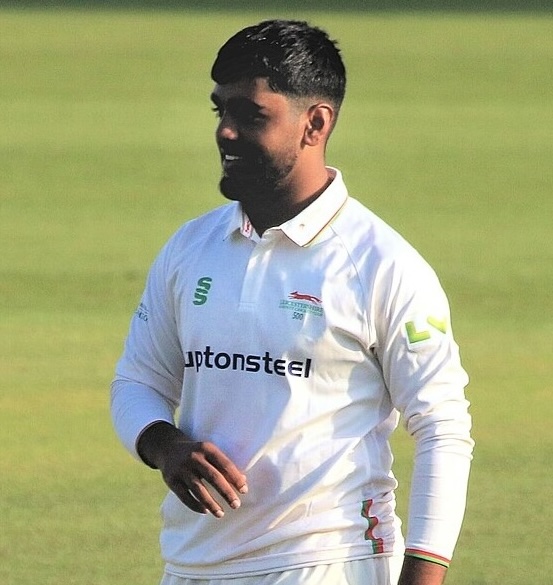
Writing an article about England’s best young spin bowlers prospects is considerably more complicated than a list of promising batsmen or exciting fast bowlers.
When I ranked the best young batsmen and fast bowlers, it was a struggle to narrow each list down to 20. Same with the best young wicket keepers. Some potentially excellent cricketers were left on the cutting-room floor. To rustle up 20 future England spinners I would need to go down to Glamorgan’s Under 8s third XI. The cupboard is not bare, but it could do with restocking in order for the County Championship to produce a future England test spinner.
When you open the spinners cupboard (it’s just off to the left hand side of the Long Room at Lord’s) you do not see lots of cricketers with ‘spinner’ badges on. They all say ‘batsman who bowls a bit’ with the odd ‘spinner, but I play because I can bat at 7’. None of them say ‘spinner and I bat at 11’. English spinners are now less Phil Tufnell and more Moeen Ali.
James Coles is high on my list but has taken five wickets in an innings only once before (but he has scored nine first-class centuries). Ben Kellaway has as many five-wicket hauls as first-class centuries (three). Rehan Ahmed has three more first-class centuries versus five-wicket hauls (7 v 4).
Very few young English cricketers are assessed on their bowling alone. It has been true for some time that a wicket-keeper who is poor with the bat cannot make a life as a professional cricketer (sorry, Michael Bates) – are we approaching the same point with spin bowlers?
It’s obvious what England are looking for when it comes to batsmen – proven run scoring (apart from if your name is Crawley). With fast bowlers, wickets, swing, pace, bounce are all taken into consideration.
With spinners the question is a bit more convoluted. How do you assess a 22 year old who has bowled only 100 overs in first-class cricket? Has been used as a genuine front-line spinner, or as someone to throw the ball to until the new one is available and the seamers take over again?
Shoaib Bashir has already played Test cricket extensively. Rehan Ahmed became England’s youngest men’s Test debutant in 2022. Jacob Bethell is established in the senior England set-up. James Coles has pushed his way into England’s white-ball squads.
Behind them are teenagers who have barely begun their first-class careers.
On the face of it, that looks like reasonable depth, but there is a problem. Being a promising young spinner and actually getting to bowl are increasingly different things. A fast bowler can force his way into a Championship attack simply by becoming one of his county’s four best seamers. A young spinner is usually competing for one place.
Sometimes that place does not exist at all. And even when it does, there is an increasingly obvious catch.
It helps enormously if he can bat.
Look around the County Championship in 2026 and relatively few counties regularly field a spinner who offers virtually nothing with the bat. The modern county spinner increasingly looks like Liam Dawson, Rehan Ahmed or James Coles rather than a classic No.11 whose job begins and ends with taking wickets.
That makes perfect sense if your immediate concern is winning a County Championship match.
It may be less helpful if your aim is producing England’s best possible Test spinner.
So this is my attempt to rank the 10 best English spin bowlers aged 23 and under in 2026.
The distinction matters.
Jacob Bethell is obviously a better overall cricketer than several players ranked above him. That does not necessarily make him a better spinner.
Likewise, the players with the most wickets are not automatically those with the highest ceilings.
This ranking considers what they have already done, how good their bowling actually looks, their age, their potential and – perhaps most importantly – whether they are getting enough opportunities to develop.\
The 10 Best Young English Spinners in 2026
| Rank | Player | County | Age | Bowling role |
| 1 | Rehan Ahmed | Leicestershire | 22 | Right-arm wrist spin |
| 2 | Shoaib Bashir | Derbyshire | 22 | Off-spin |
| 3 | James Coles | Sussex | 22 | Slow left-arm |
| 4 | Ben Kellaway | Glamorgan | 22 | Off-spin |
| 5 | Archie Vaughan | Somerset | 20 | Off-spin |
| 6 | Farhan Ahmed | Nottinghamshire | 18 | Off-spin |
| 7 | Fateh Singh | Worcestershire | 22 | Slow left-arm |
| 8 | Tazeem Ali | Warwickshire | 20 | Right-arm wrist spin |
| 9 | Ralphie Albert | Surrey | 18 | Slow left-arm |
| 10 | Jacob Bethell | Warwickshire | 22 | Slow left-arm |
There is already something unusual about that list – the player at No.10 is an England international and the player at No.9 has barely started his senior career. And the player at No.6 is still only 18 despite having already taken ten wickets in a County Championship match.
Spin development is rarely straightforward.
Why young English spinners have a problem
There are 18 first-class counties in England. It is tempting, therefore, to imagine 18 jobs for specialist spinners. But there aren’t.
Some counties are perfectly willing to enter a Championship match without one – Surrey won the County Championship in 2022, 2023 and 2024 without what you would recognise as a regular front-line spinner. English conditions during the early and late parts of the season hardly encourage captains to throw the ball to a young spinner.
Even when a county does want spin, the player increasingly needs to provide something else.
That might be genuine top-seven batting. It might simply be enough lower-order resistance to prevent the tail beginning at No.8.
Either way, being able to bat makes selection much easier.
Look at some of the established county options. Rehan Ahmed can bat in the top order. Liam Patterson-White has three first-class hundreds. Mason Crane has one, Jack Carson two and Dom Bess two.
Very few counties regularly accommodate a spinner whose batting contribution can effectively be ignored, Shoaib Bashir is the obvious exception. That matters when we are trying to work out why some talented young spinners receive hundreds of Championship overs while others receive almost none.
Imagine two 20-year-old spinners.
One is slightly better with the ball but averages eight with the bat.
The other is close behind him as a bowler but capable of averaging 25 and batting at No.7 or No.8.
Which one does a county pick? It is hardly a mystery.
The county is not doing anything wrong. Its job is to win next week’s match rather than prepare a spinner to dismiss India in 2030.
But those perfectly rational decisions can produce an irrational result for English cricket as a whole.
The best future Test spinner may not be the best No.8 today.
The 2025–26 workload problem: who is actually getting to bowl?
This may be the most important question in the entire article.
Wickets and bowling averages matter. But before either of those things, young spinners need to bowl.
For seamers, appearances give us at least a reasonable indication of workload. If a young fast bowler plays ten Championship matches, it is extremely unlikely that he has spent them standing at fine leg while somebody else sends down 50 overs.
Spinners can.
A player might appear in a team primarily because he bats. He may bowl six overs in the first innings, none in the second and technically have another first-class appearance against his name.
That is not the same development experience as being given the ball for 25 overs and being asked to work out how to dismiss a set Championship batsman.
The difference becomes obvious when we compare the Championship workloads of the ten players in this ranking.
How England’s Young Spinners performed in 2025 and 2026
| Player | 2025 Overs | 2025 Wickets | 2025 Average | 2026 Overs* | 2026 Wickets* | 2026 Average* |
| Rehan Ahmed | 164.1 | 23 | 19.00 | 177.4 | 18 | 39.56 |
| Shoaib Bashir | 71.5 | 2 | 152.00 | 343 | 24 | 42.12 |
| James Coles | 194.3 | 20 | 33.25 | 182.2 | 24 | 29.79 |
| Ben Kellaway | 248.0 | 25 | 32.00 | 151.2 | 17 | 30.29 |
| Archie Vaughan | 242.2 | 20 | 41.65 | 136.3 | 14 | 27.00 |
| Farhan Ahmed | 217.4 | 13 | 46.15 | 0 | 0 | — |
| Fateh Singh | 43.4 | 4 | 41.25 | 74.0 | 9 | 29.56 |
| Tazeem Ali | 112.0 | 11 | 41.64 | 0 | 0 | — |
| Ralphie Albert | 31.3 | 5 | 17.80 | 20.3 | 3 | 26.67 |
| Jacob Bethell | 20.0 | 2 | 45.00 | 0 | 0 | — |
*2026 figures through matches completed on 11 September
There is a lot going on in that table. Perhaps the most striking number is not an average, it is the number of times the number zero appears.
Farhan Ahmed bowled 217.4 overs in the County Championship in 2025, this year he has bowled none.
Tazeem Ali went from 112 Championship overs to none.
For two young spinners whose development still depends heavily on county cricket, Farhan and Ali’s numbers are interesting.
Farhan’s case is particularly strange. He was trusted to bowl more than 200 Championship overs as a 17-year-old. A year later, when presumably a better and more experienced bowler, he has not bowled a single one.
He has not stopped developing. Nottinghamshire have given him significant responsibility in the One-Day Cup.
But it is a very different type of education.
Shoaib Bashir shows what regular selection can do
At the other end of the scale is Shoaib Bashir, his move to Derbyshire was largely about one thing: bowling.
Bashir was England’s first-choice Test spinner in 2025 but could not get into Somerset’s Championship side ahead of Jack Leach and Archie Vaughan.
He therefore spent three matches on loan at Glamorgan and the results were fairly horrible. Bashir bowled 71.5 overs, conceded 304 runs and took two wickets.
Average: 152.00.
It is difficult to imagine a stranger situation than England’s first-choice Test spinner being unable to command a county place and then averaging 152 when another county borrowed him.
His move to Derbyshire has changed the equation – Bashir has already bowled 343 Championship overs in 2026.
The returns – 23 wickets at 38.87 – are respectable rather than spectacular. But the workload matters, Bashir is getting long spells. He is bowling when conditions do not suit him. He is having to work out how to dismiss set batsmen rather than waiting for an England captain to throw him the ball in a Test match.
That is exactly the development experience he was missing.
Rehan’s numbers are almost the opposite
Rehan Ahmed’s 2025 figures jump off the page for a different reason. He took 23 Championship wickets at 19.00. For a player who also scored five Championship hundreds during the season, that is a fairly absurd combination.
His bowling returns have fallen back in 2026 – 18 wickets at 39.56 – but his workload has actually increased slightly. That is encouraging. Rehan is not being protected as a batsman who happens to bowl wrist-spin, Leicestershire are giving him the ball.
And because his batting is good enough to guarantee his place, there is very little danger of a poor run with the ball removing those opportunities.
It is one of the biggest reasons I have him at No.1.
Archie Vaughan may be making the biggest bowling leap
Vaughan’s progression is another interesting one.
In 2025 he bowled 242.2 Championship overs and took 20 wickets at 41.65. This year the workload has been lower, but the returns have been substantially better. Fourteen wickets at 27.00 is a significant improvement.
It is far too early to conclude that Vaughan has suddenly become a 27-average Championship spinner.
But this is what development is supposed to look like, Somerset have given him the opportunity to do that while bowling alongside and learning from Jack Leach.
James Coles is becoming a genuine bowler
James Coles provides perhaps the strongest evidence that a batting all-rounder can gradually turn himself into a serious spin option.
He took 20 Championship wickets at 33.25 in 2025. In 2026 that has improved to 24 at 29.79. More importantly, the workload has barely changed.
Coles is not taking wickets from the occasional six-over spell after Sussex’s seamers have done the real work, he has bowled more than 180 overs in each of the past two Championship seasons.
That is enough cricket to develop a craft, it is also why I am increasingly uncomfortable describing him simply as a batsman who bowls.
At some point, if you keep taking Championship wickets at under 30, you are just an all-rounder.
Playing is not the same as bowling
Ben Kellaway demonstrates the other side of the argument. Kellaway’s batting makes him relatively easy for Glamorgan to select.
In 2025 that produced 248 Championship overs and 25 wickets. This year he has remained a regular first-team cricketer but his bowling workload has fallen to 151.2 overs.
The good news is that his returns have improved slightly, from 32.00 per wicket to 30.29.
But Kellaway illustrates why appearances alone tell us very little about the development of a young spinner. He can play a full Championship match because Glamorgan value his batting.
Whether he bowls four overs or 40 is another matter.
And then there are the players barely getting started
The numbers for Fateh Singh and Ralphie Albert need to be treated differently.
Singh has gone from 43.4 Championship overs in 2025 to 74 this year. That is still a small sample, but at least it is moving in the right direction. Nine wickets at 29.56 in 2026 are encouraging too.
Albert’s numbers are smaller again. Across the two seasons he has bowled only 51.5 Championship overs.
Farhan Ahmed bowled more than four times that number in 2025 alone.
It is one reason Albert is so difficult to rank.
There are interesting signs – including his 3/58 and 6/68 bowling figures alongside scores of 88 and 40 in the one-off under 19 Youth Test versus Pakistan in early September 2026.
There is obvious potential, there simply isn’t much senior red-ball evidence yet.
White-ball cricket changes the picture
None of this means Farhan Ahmed and Tazeem Ali have spent 2026 doing nothing – far from it.
Farhan has instead received a substantial One-Day Cup workload, while Ali’s breakthrough in 2025 came largely in that competition.
Ali took 18 wickets in the 2025 One-Day Cup, including consecutive five-wicket hauls.
Fateh Singh has followed a similar path in 2026, taking 15 One-Day Cup wickets, including his 6-32 against Derbyshire.
White-ball cricket is clearly useful for developing young spinners. It gives them responsibility and forces them to vary pace and trajectory.
And unlike Championship cricket, captains cannot simply decide after four overs that conditions are not spinning and return to their seamers for the rest of the day. But it cannot teach everything.
Bowling ten overs to batsmen trying to score from you is one challenge, and bowling your 25th over to somebody on 137 on a flat pitch is another. The latter is the skill England will eventually require from a Test spinner.
The numbers explain the ranking
This is why I would be wary of simply sorting these players by bowling average.
Albert’s 17.80 average in 2025 looks fantastic, but it came from only 31.3 overs.
Rehan’s 19.00 came from 164.1.
They are not remotely equivalent samples.
Likewise, Farhan’s 46.15 average in 2025 does not look especially exciting until you remember that Nottinghamshire were prepared to let a teenager bowl 217.4 Championship overs.
That experience may ultimately prove more valuable than protecting a young spinner until conditions are perfect.
The biggest takeaway from the table is therefore not that one player has a better average than another, it is the extraordinary variation in opportunity.
One 22 year old has bowled almost 300 Championship overs this season. Two of the most exciting young spinners in the country have bowled none. One teenager has accumulated hundreds of senior overs. Another has barely reached 50 across two seasons.
That matters when judging where these players are now and it may matter even more when deciding where they eventually end up. Put simply, a young spinner’s wickets tell us what he has already achieved. His overs tell us how much opportunity he has been given to become better.
10. Jacob Bethell
Warwickshire | 22 | Slow left-arm
- Bethell has taken only 18 first-class wickets, at an average of 58.50, with a best of 4-20.
- Remarkably, eight of those 18 first-class wickets have come in Test cricket.
- His best international bowling figures are already 4-11 in a T20I.
There are not many rankings of young English cricketers in which Jacob Bethell would finish tenth, but this one is different.
Bethell is already an England international across formats and one of the country’s most exciting young batsmen. He is also a talented slow left-arm spinner.
The question is whether he is really going to become a frontline one, and that remains much less certain.
Bethell has the natural advantages. He is athletic, bowls quickly enough to trouble batsmen and has been regarded as a genuine all-round talent since his teenage years.
But his career trajectory increasingly points towards being a batsman who provides useful overs rather than a spinner who also happens to bat.
There is absolutely nothing wrong with that.
England would happily take a top-order batsman capable of bowling 10 or 15 overs when conditions demand it.
It simply puts him behind the nine players above him when we isolate spin bowling.
That distinction could change.
Bethell is still only 22 and has hardly been allowed the volume of first-class bowling required to discover exactly how good his spin could become.
But if I were ranking England’s best young cricketers, he would be at the top.
Ranking their young spinners, he starts at No.10.
9. Ralphie Albert
Surrey | 18 | Slow left-arm
- Albert took 10 wickets in an England U19 Test against India in 2025.
- In only his second List A appearance for Surrey, he made 96 and then took two wickets against Nottinghamshire.
- His grandfather is six-time World Snooker Championship finalist Jimmy White.
Ralphie Albert might be the most speculative selection in the ten. He is also one of the most interesting.
Albert has barely begun his first-class career, yet his earliest senior appearances have offered enough encouragement to justify including him here.
His first-class debut came for Surrey in September 2025 and he finished his first couple of appearances with five wickets. More unusually, he also showed immediate ability with the bat, including a score of 63.
That second part matters. Albert does not currently have to develop into a player who is selected for his bowling alone. If his batting proves good enough to occupy a genuine place in the order, Surrey have far more ways of getting him into a Championship XI.
The obvious problem is the county. Surrey are not exactly short of cricketers, but they are short of spinners – if you do not count them dropping in one or two last minute overseas spinners when the timing suits.
There is not remotely enough evidence yet to put him close to the top of this list – there is more than enough talent to put him on it.
8. Tazeem Ali
Warwickshire | 20 | Leg-spin
- Ali’s 7-29 against Zimbabwe at the 2024 U19 World Cup were the best bowling figures recorded by an England player in an U19 ODI.
- He finished that tournament with 14 wickets at 9.64, England’s leading wicket-taker.
- In the 2025 One-Day Cup he took back-to-back five-wicket hauls, returning 5-43 against Northamptonshire and 5-54 against Kent.
Leg-spinners are always tempting. Their best deliveries can dismiss batsmen who have done very little wrong. And England have spent most of the period since Adil Rashid’s Test career ended looking for someone capable of offering that attacking threat.
Tazeem Ali is therefore worth watching.
His first real senior breakthrough came in the 2025 One-Day Cup. Ali took 18 wickets, including those consecutive five-wicket hauls. He also made his Championship debut and took 11 wickets. Those numbers do not make him a future England spinner by themselves. They do demonstrate something important: he can get good professional batsmen out.
Ali had already offered a glimpse of that potential at Under-19 level. His 7-29 against Zimbabwe at the 2024 Under-19 World Cup was the sort of spell that makes people take notice.
The next challenge is predictable, getting meaningful Championship overs.
A young leg-spinner will occasionally bowl a long hop. He will occasionally disappear at five an over. The only way of learning how to survive those spells is to be allowed to keep bowling.
Ali has enough wicket-taking ability to be intriguing. Warwickshire now need to find out how far it can take him.
7. Fateh Singh
Worcestershire | 22 | Slow left-arm
- Singh took his maiden first-class five-for in only his fourth first-class match, claiming 5-74 against Gloucestershire in June 2026.
- A month later he produced career-best List A figures of 6-32 against Derbyshire, triggering a collapse from 107-2 to 138 all out.
- He made 106 from 117 balls for Worcestershire’s second XI in 2026, suggesting there may be considerably more batting potential than his senior record currently shows.
Fateh Singh is one of the more difficult players on this list to evaluate.
His senior red-ball opportunities remain limited, which makes it tempting simply to push him below players with much larger first-class records.
But his white-ball performances keep providing evidence that there is something there. His 6-32 against Derbyshire was already his second five-wicket haul of the summer.
There is also an interesting counterpoint to the argument that specialist spinners need to bat. That second-team hundred does not suddenly make Singh an all-rounder. But if he can turn himself into a credible lower-order batsman, his pathway suddenly becomes much easier.
At 22, the next season or two feels important.
He needs to move from being a player who produces eye-catching spells into one who can be trusted with a significant senior red-ball workload.
For now, seventh feels about right.
6. Farhan Ahmed
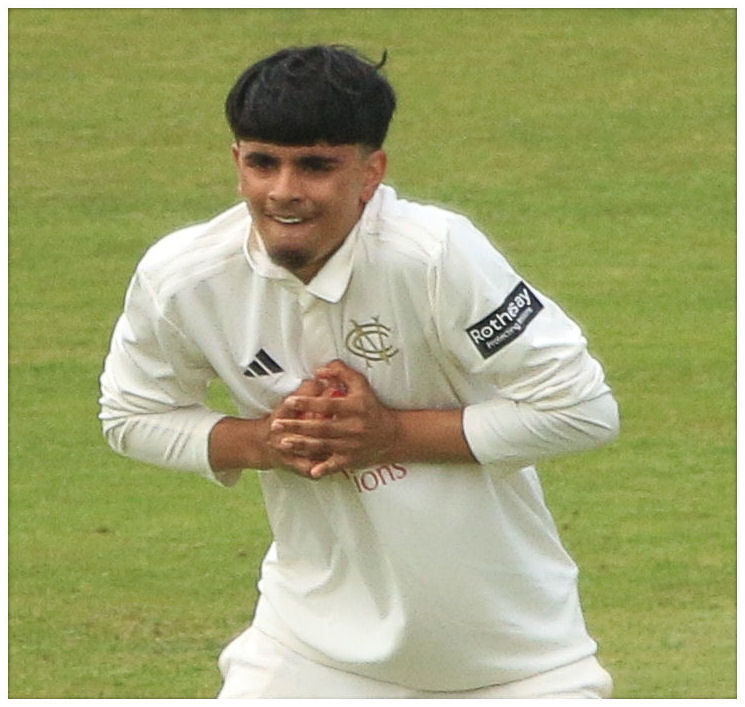
Nottinghamshire | 18 | Off-spin
- At 16 years and 192 days, Ahmed became the youngest player to take 10 wickets in a first-class match in Britain, breaking a record previously held by WG Grace.
- He finished his first four Championship appearances in 2024 with 22 wickets at 23.22.
- Still only 17, he became Nottinghamshire’s first ever T20 hat-trick taker in 2025, finishing with 5-25 against Lancashire.
It feels slightly ridiculous that Farhan Ahmed is still only 18.
He was 16 when he made his County Championship debut for Nottinghamshire. He then took ten wickets against Surrey. That is a reasonably dramatic way to introduce yourself to senior cricket. He has since shown that the red-ball performance was not a complete freak.
His T20 hat-trick and five-wicket haul against Lancashire offered another reminder that his off-spin can take wickets in very different formats.
Farhan is therefore already unusual among the teenagers in this list. We do not merely have junior cricket and potential to work with. We have evidence that his off-spin can dismiss professional batsmen.
He is also several years younger than most of the players above him. That leaves an enormous amount of development time.
The frustration is his 2026 red-ball season. After bowling 217.4 Championship overs last year, he has bowled none this season.
That does not make him a worse prospect. If anything, it demonstrates the problem this article is trying to identify.
He has played plenty of second XI cricket this year and has been pushed up to number 3 in the order – scoring 78 and 52 versus Durham’s second XI and 80 versus Kent’s second XI.
If this list is repeated in two years, I would be surprised if Farhan is still sixth.
5. Archie Vaughan
Somerset | 20 | Off-spin
- In only his second County Championship match, aged 18, Vaughan took match figures of 11-140 against Surrey.
- In the 2026 Championship he has taken 14 wickets at 27.00, a substantial improvement on his 2025 average of 41.65.
- He was subsequently made England U19 captain, following a rather familiar family route into England captaincy: his father Michael captained England to the 2005 Ashes.
Archie Vaughan may initially have attracted attention because of his surname. His cricket has now done enough to make that increasingly irrelevant.
Vaughan is a top-order batsman who bowls off-spin, but his early Championship performances demonstrated that the second part of that description is not decorative.
In only his second first-class match, he produced match figures of 11-140 against Surrey. That is not a bad way to convince a county that your bowling should be taken seriously.
Vaughan’s development circumstances are also unusually good. Somerset have been able to use him alongside Jack Leach, giving a young spinner the opportunity to bowl substantial spells at the other end from one of England’s most experienced slow bowlers.
The obvious question is what Vaughan eventually becomes. Is he a top-order batsman whose off-spin is good enough to make him extremely useful? Or could the bowling become good enough that it is one of the main reasons England pick him? That remains unclear.
Either version gives him a very plausible international future.
4. Ben Kellaway
Glamorgan | 22 | Off-spin and slow left-arm
- Kellaway genuinely bowls spin with both arms and in 2024 became the first county bowler since 1980 to take a wicket with each arm in the same match.
- Against Gloucestershire in 2025 he scored 139 and took 6-111, becoming the youngest Glamorgan player to make a century and take a five-for in the same match.
- His 2025 Championship season produced 813 runs at 54.20 and 25 wickets at 32.00.
Ben Kellaway is the wonderfully odd one.
Most young spinners are trying to master one method. Kellaway bowls with both arms. More importantly, this is not simply a party trick.
He has already taken first-class five-wicket hauls while also establishing himself as a serious batsman.
That combination is exactly why Kellaway is so interesting in the context of this article.
There is almost no selection problem.
Glamorgan do not need Kellaway to become Nathan Lyon before they can justify putting him in the team. He can bat. That means the bowling gets time to develop while he is already playing senior cricket.
Kellaway is also capable of approaching different batsmen in different ways. The ability to bowl off-spin and slow left-arm offers obvious tactical possibilities, even if ultimately one becomes substantially better than the other.
There are young spinners below him who may turn the ball more. There are probably players with more obviously international-looking bowling attributes. But development is partly about getting onto the field.
Kellaway has constructed a route which should keep putting him there. That makes him extremely difficult to ignore.
3. James Coles
Sussex | 22 | Slow left-arm
- Coles scored 1,032 Championship runs at 46.9 in 2025, while also taking 35 wickets across all formats.
- In June 2026 he smashed 224 not out and then took 3-34 as Sussex beat Glamorgan by an innings.
- He has taken 24 Championship wickets at 29.79 in 2026, evidence that his slow left-arm bowling is becoming far more than a useful second skill.
James Coles may be the player in this ranking whose reputation has changed most substantially. It would have been easy a couple of years ago to describe him as a talented batsman who offered useful left-arm spin. That now undersells him.
His 224 not out against Glamorgan and 3-34 with the ball was an absurdly complete all-round performance. He has continued to take significant wickets in Championship cricket.
England have noticed, Coles has already been selected in senior white-ball squads. Again, his batting helps enormously.
Nobody is debating whether Sussex can afford to carry him in the XI while his bowling develops. He plays. He bowls. He gets better.
That may sound embarrassingly simple. For young English spinners it increasingly isn’t.
The question now is whether the left-arm spin can move from being an excellent second skill into something England would trust at international level.
I think it can.
That is enough to put Coles third.
2. Shoaib Bashir
Derbyshire | 22 | Off-spin
- Bashir already has a substantial Test record despite still being only 22, including multiple five-wicket hauls.
- At 20 years and 282 days, he became the youngest England men’s bowler to take a five-for in a home Test, with 5-41 against West Indies at Trent Bridge.
- After averaging 152.00 during his 2025 Championship loan spell, he has bowled 296 overs and taken 23 wickets at 38.87 for Derbyshire in 2026.
Shoaib Bashir is easily the most difficult player to rank.
If this were a list of England’s current Test spin options, he would be No.1. If it were based purely on county cricket, he probably wouldn’t be No.2.
That contradiction tells you almost everything about his career.
Bashir had barely begun his first-class career when England decided that his height, release point and potential mattered more than his domestic record. They were rewarded quickly.
There is no other spinner on this list with anything approaching his amount of Test bowling experience. There are still questions. His control can disappear. His county record has not always looked like that of England’s obvious premier spinner. And unlike almost everybody immediately around him in this ranking, Bashir offers very little with the bat.
But the upside remains significant. A 6ft 4in off-spinner who can generate bounce that conventional finger-spinners cannot is always going to interest England.
We have also reached the strange point where Bashir is still a developmental cricketer despite already having played a substantial amount of Test cricket. That makes him almost impossible to compare with everybody else.
Almost. There is one player I would put above him.
1. Rehan Ahmed
Leicestershire | 22 | Right-arm wrist-spin
- At 18 years and 126 days, Rehan became the youngest bowler in men’s Test history to take a five-wicket haul on debut, finishing with 5-48 against Pakistan.
- Against Derbyshire in 2025 he produced one of the great county all-round performances: 115 with the bat and match figures of 13-144.
- Across 2025 he scored 1,337 runs, took 52 wickets across formats and made five Championship hundreds, helping him win the PCA Men’s Young Player of the Year award.
Rehan Ahmed has been around for so long that it is remarkably easy to forget he is still only 22.
He made his Test debut at 18. He took five wickets in the second innings. And since then his career has taken the slightly less dramatic but probably more useful route of actually becoming a much better all-round cricketer.
Rehan is no longer simply an exciting teenage wrist-spinner (I do not call him a leg-spinner because he very rarely bowls a delivery that turns away from the right-handed batsman). He is a genuine county top-order batsman, a dangerous white-ball bowler and a spinner capable of operating in all phases of an innings. That matters for exactly the reasons discussed throughout this article.
Rehan will play. A county is never going to look at its batting line-up and decide it cannot afford to select him because he is a spinner. He is capable of getting into the side on batting alone. That creates thousands of deliveries over the next decade in which his wrist-spin can continue to improve.
The bowling still isn’t finished. There are days when he can be expensive. He is not yet a spinner who will automatically lock down an end for 30 overs in the way the best Test spinners do.
But that is the key phrase, not yet. Rehan is 22. He possesses the rarest style of bowling on this list, already has senior international experience and has developed dramatically as a cricketer since making his England debut.
Bashir may currently be ahead of him in England’s Test thinking. If I had to choose which of these ten players will be the best spinner in five years, however, I would take Rehan.
That is why he is No.1.
The strange case of Shoaib Bashir
Bashir deserves a second section because his career tells us something larger about English spin bowling.
England essentially removed him from the normal development system, they saw attributes they liked and decided that his relatively modest county record did not matter.
It was bold but it was also probably necessary.
Bashir’s batting makes him exactly the sort of spinner county cricket increasingly struggles to accommodate. If he is selected, it is because the county thinks his bowling alone is worth a place. That sounds completely normal but for spinners, it increasingly isn’t. Which produces an interesting question.
If England had never selected Shoaib Bashir, would county cricket naturally have developed him into a Test spinner anyway?
Perhaps, but I am not sure. That should concern England. Bashir was noticed. How many other talented specialist spinners never receive that intervention?
Does a young spinner now have to be able to bat?
The top ten provides a fairly convincing answer.
Not quite, but it certainly helps.
Rehan Ahmed bats in the top order; James Coles scored more than 1,000 Championship runs last season; Ben Kellaway scored more than 800; Archie Vaughan is a top-order batsman; Jacob Bethell is primarily a batsman; and Ralphie Albert has already shown enough with the bat to suggest that he may develop into an all-rounder.
That is six of the ten and it is not a coincidence – and any number of them could ultimately end up being Ben Stokes’ replacement, which I have looked into previously.
The problem for a specialist bowler is straightforward: imagine he is currently 80% as good as the spinner he might become at 26.
A batting all-rounder at the same stage can still get into the team and develop that remaining 20%. The specialist may simply not play. This is why Bashir is such an interesting exception. England saw something the domestic numbers had not yet proved and picked him anyway.
The county game is unlikely to make that gamble very often. Again, this is not really the counties’ fault. If two spinners are roughly equal and one can score Championship hundreds while the other averages eight, the selection decision is hardly difficult.
The England-development problem is that the best future Test spinner need not be the best No.8 today.
Batting ability should be an advantage but it should not become a prerequisite for learning how to bowl spin.
Who is actually developing fastest?
One of the problems with ranking players aged between 18 and 22 is that the list can become obsolete remarkably quickly.
A few categories probably tell us more about where things are heading.
Biggest riser: James Coles
Coles is no longer simply a batsman who can bowl.
His Championship performances in 2026 increasingly justify treating the spin as a significant part of his value.
If that continues, his England case becomes very strong indeed.
Most encouraging pathway: Ben Kellaway
Kellaway’s batting guarantees opportunities that many specialist spinners would love to have.
Every Championship appearance gives him another chance to bowl.
The fact he can spin the ball with either arm is a fairly useful bonus.
Best current specialist: Shoaib Bashir
This scarcely needs explaining.
Nobody else in the list has already bowled successfully for England across multiple Test series.
Highest ceiling: Rehan Ahmed
Wrist-spin, genuine batting ability, international experience and still only 22.
There is a great deal to work with.
Best teenage prospect: Farhan Ahmed
Farhan has already done the thing most teenage spinners spend years trying to do.
He has taken Championship wickets in bulk.
At 18, the question is no longer whether he belongs in senior cricket.
It is how good he might become in it.
Wildcard: Ralphie Albert
The sample is tiny.
That is precisely why he is the wildcard.
Come back to this ranking in three years and Albert could be nowhere near the top five.
He could also be one of the first names on it.
What does England’s spin depth chart actually look like?
The age limit makes this ranking slightly artificial.
England do not care whether their spinner is 22 or 32.
If they needed to pick a Test team tomorrow, Bashir would plainly sit much closer to the front of the queue than this ranking alone suggests.
Jack Leach remains an obvious red-ball option.
Then there are players such as Rehan and several established county spinners outside the age criteria.
But looking towards 2030 produces a different picture.
Bashir will still be only 26.
Rehan Ahmed will be 25.
Coles, Kellaway and Bethell will be 26.
Vaughan will be 24.
Farhan Ahmed will still only be 22.
That is why England should not be panicking about the absence of young spin talent – it is not there in great quantities, but it is there.
The bigger question is whether enough of them will receive the bowling workload required to find out how good they can become.
Who could actually be England’s spinner in 2030?
If I had to pick today, I would take Rehan Ahmed.
Bashir is the safer answer, he already has the Test wickets and England clearly rate him.
But Rehan’s combination of age, wrist-spin, batting and sheer opportunity gives him the route I like most.
Highest ceiling: Rehan Ahmed.
Most likely Test specialist: Shoaib Bashir.
Most likely bolter: James Coles.
Best teenage bet: Farhan Ahmed.
Wildcard: Ralphie Albert.
There is one further possibility, England may not need to choose just one.
A Test team containing Rehan as an all-rounder and Bashir as its main spinner is entirely plausible.
So is one in which Coles or Vaughan provides a second spin option from the top seven.
That may ultimately be where this generation’s greatest strength lies.
Not necessarily one outstanding spinner.
Lots of different ways of getting spin into an England XI.
Final Verdict
England do not necessarily have a shortage of young spinners but they definitely have an opportunity problem.
There are already three 22-year-olds with Test experience. There are all-rounders forcing their way towards England selection. There is an 18-year-old who has already taken ten wickets in a Championship match. There are wrist-spinners, off-spinners and slow left-armers. There is even one bloke who bowls spin with both hands.
The talent is there, the more difficult part is making sure they bowl enough.
A young spinner can spend several years in professional cricket without ever receiving anything resembling a full Championship workload. That is very different from the pathway available to a promising young fast bowler.
Batting increasingly provides the solution. It is no accident that Rehan, Coles, Kellaway and Vaughan occupy four of my top five places. Their counties can select them without asking whether their spin alone justifies a place.
Bashir has had to take the other route – England effectively decided his bowling was worth developing themselves. That has worked well enough for him but it cannot be the answer for everybody.
Perhaps Rehan Ahmed becomes England’s long-term Test spinner. Perhaps Bashir holds the job for the next decade. Perhaps Farhan Ahmed overtakes his older brother. Or perhaps somebody currently much lower down this ranking eventually turns out to be the best of them all.
Whatever happens, England’s problem is not finding ten interesting young spinners.
It is making sure they get the chance to become good ones.
FAQs
Who is England’s best young spinner?
I rank Rehan Ahmed as England’s best spinner aged 23 or under in 2026, narrowly ahead of Shoaib Bashir. Bashir currently has considerably more Test bowling experience, but Rehan’s wrist-spin, batting ability and long-term ceiling put him first.
Who are England’s best young spin bowlers?
My top ten are Rehan Ahmed, Shoaib Bashir, James Coles, Ben Kellaway, Archie Vaughan, Farhan Ahmed, Fateh Singh, Tazeem Ali, Ralphie Albert and Jacob Bethell.
Who could replace Jack Leach for England?
Shoaib Bashir is already established in England’s Test plans and is the most obvious specialist successor. Rehan Ahmed offers a different option as a wrist-spinning all-rounder, while James Coles and Archie Vaughan could also enter the conversation before 2030.
Who is England’s best young wrist-spinner?
Rehan Ahmed is currently England’s leading young wrist-spinner. Warwickshire’s Tazeem Ali is another player to watch, with his 2025 One-Day Cup performances demonstrating significant wicket-taking potential.
Who are England’s best teenage spinners?
Farhan Ahmed and Ralphie Albert are the two teenagers in this top ten. Farhan is considerably further along in senior cricket, having already taken ten wickets in a County Championship match, while Albert remains a more speculative long-term prospect.
Why don’t English counties play more young spinners?
English conditions, particularly in spring and autumn, often favour seam bowling. Team balance is another major factor: counties increasingly favour spinners who can also contribute with the bat, which makes it harder for young specialist bowlers to earn regular Championship opportunities.
Do modern English spinners need to be able to bat?
Not necessarily, but batting makes regular selection considerably easier. Rehan Ahmed, James Coles, Ben Kellaway, Archie Vaughan and Jacob Bethell all offer significant batting value, while Shoaib Bashir is unusual among England’s leading young spinners in being selected overwhelmingly for his bowling.
 The Penwarden Review
Leave a comment