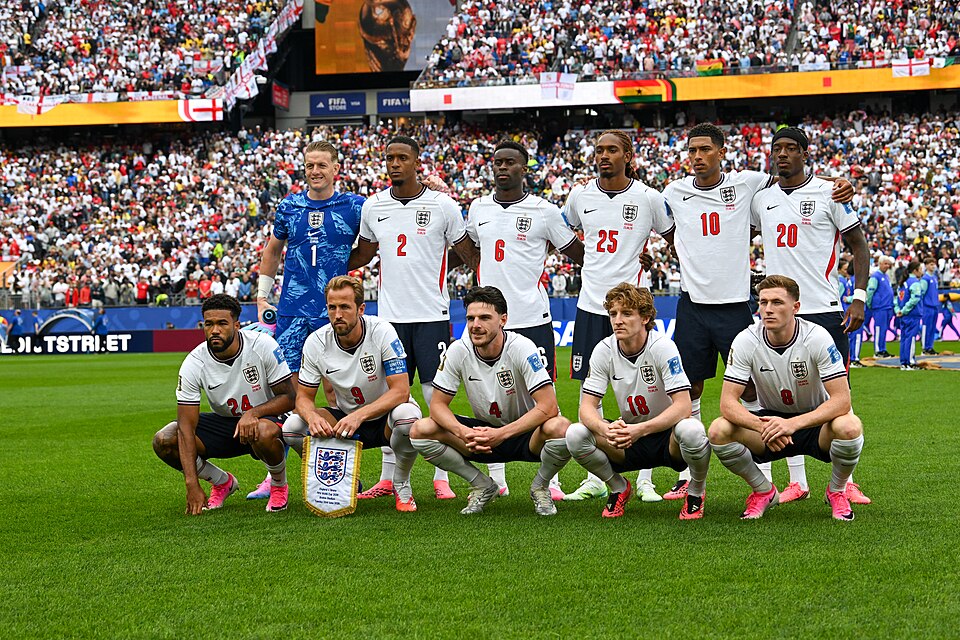
Four years in football is an awkward length of time. It is short enough that most of England’s current players can reasonably imagine themselves at the 2030 World Cup, but long enough that history suggests most of them won’t actually be there.
The logical temptation when predicting England’s 2030 World Cup team is to take the squad that finished third in 2026 and add a Dowman here and a Ngumoha there.. But historically that is not how England World Cup squads have worked.
After the 2022 World Cup, would anyone have predicted that Phil Foden wouldn’t be there in 2026? That would have sounded ridiculous two years ago when he won the Premier League Player of the Season. When Cole Palmer was named England Men’s Player of the Year in 2024 what were the chances that he wouldn’t be picked in 2026? When the 2002 World Cup ended who was putting a 13 year old in their 2006 squad prediction?
Predicting an England squad four years ahead is a fool’s exercise – let’s give it a go.
Rather than just ageing up England’s 2026 World Cup squad by four years step one is to choose 60 plausible players, then narrow then down to 40 serious candidates, then a final 26 and a possible starting XI.
Two questions immediately jump out to me: how much will England change in fours years and what do England do about Harry Kane?
The result includes 13 players from England’s 2026 World Cup squad, five players who will still be 23 or younger and one 36 year old centre-forward who may prove considerably harder to replace than England would like.
My predicted England starting XI for the 2030 World Cup is Trafford; James, Quansah, Guéhi, O’Reilly; Rice, Anderson; Saka, Bellingham, Palmer; Delap. Thirteen of my predicted 26 were in England’s final 2026 World Cup squad – although history suggests even that may be too many.
How Much Does an England Squad Change in Four Years?
The first problem with predicting England’s 2030 squad is assuming that four years is not very long.
Recent history suggests otherwise.
Only six players from England’s 2010 World Cup squad returned in 2014. Four years later, just five members of the 2014 squad went to Russia. The unusually young 2018 team proved much more durable, with 12 players surviving for Qatar, before that number fell back to eight between 2022 and 2026.
| World Cup Transition | Players Retained | Retention Rate |
| 2010 > 2014 | 6/23 | 26.1% |
| 2014 > 2018 | 5/23 | 21.7% |
| 2018 > 2022 | 12/23 | 52.2% |
| 2022 > 2026 | 8/26 | 30.8% |
| Average | 7.75 | 32.7% |
Across those four cycles, England have therefore retained an average of fewer than eight players from one World Cup squad to the next.
There are good reasons for some of the variation. England went out in the group stage in 2014 and Gareth Southgate subsequently rebuilt the team around a much younger generation. The 2018 side, by contrast, reached the semi-finals with one of the youngest squads at the tournament. It is hardly surprising that considerably more of them were still around four years later.
There is another important qualification. Squad turnover is not necessarily the same thing as turnover among England’s best players.
England started their 2022 World Cup quarter-final against France with Jordan Pickford, Kyle Walker, John Stones, Harry Maguire, Luke Shaw, Jordan Henderson, Declan Rice, Jude Bellingham, Bukayo Saka, Harry Kane and Phil Foden.
Seven of those 11 – Pickford, Stones, Henderson, Rice, Bellingham, Saka and Kane – were still in England’s World Cup squad four years later.
So while only 31% of the entire 2022 squad survived to 2026, almost two-thirds of the team that started England’s biggest game in Qatar did.
That distinction matters when looking ahead to 2030.
The lesson from history is not that we should arbitrarily limit ourselves to eight members of the 2026 squad. It is that predicting 18 or 20 of them to return simply because they are young enough would probably be a mistake.
Some players will lose form. Some will be injured. Some will be overtaken by players who have barely started their senior careers. And there will almost certainly be somebody in England’s 2030 squad whom very few people would think to include today.
But the genuine core can survive.
If England’s best young players from 2026 continue to develop, there is no particular reason why Jude Bellingham, Bukayo Saka, Declan Rice, Elliot Anderson or Morgan Rogers should disappear simply because previous squads have experienced heavy turnover.
The challenge is working out which of today’s England players belong to that core – and which merely look like they do from the perspective of 2026.
How Old is a Typical England World Cup Squad?
If England’s World Cup squads change more than we might expect, the obvious temptation is to fill a 2030 prediction with teenagers.
History provides a useful warning against doing that too.
England’s last five World Cup squads have generally looked remarkably similar in age. The obvious exception was 2010, when Fabio Capello took Dad’s Army to South Africa with an average age approaching 29. Since then, England’s average has consistently sat at around 26 to 27.
| World Cup | Average Age | Median Age | 23 or Younger | 32 or Older |
| 2010 | 28.4 | 29 | 2 | 3 |
| 2014 | 26.0 | 26 | 8 | 3 |
| 2018 | 25.6 | 25 | 5 | 2 |
| 2022 | 26.4 | 27 | 6 | 3 |
| 2026 | 26.7 | 26 | 7 | 5 |
Methodology: Historical squad retention and age figures are calculated from England’s final World Cup squads from 2010 to 2026. Ages are measured in whole years at the start of each tournament.
The median is perhaps even more revealing than the average. Since 2014, the middle player in an England World Cup squad has always been between 25 and 27.
In other words, international tournament squads are not generally dominated by either exciting teenagers or ageing veterans. Most of the players are exactly where you would expect them to be: somewhere in their mid-to-late twenties.
There are still places for youth. Across these five tournaments, England have taken an average of 5.6 players aged 23 or younger. The number has ranged from just two in the ageing 2010 squad to eight in 2014.
That is useful when considering players such as Ethan Nwaneri, Josh King, Rio Ngumoha and Max Dowman. Selecting several of them for 2030 might look aggressive from four years away, but selecting five or six players aged 23 or younger would be completely normal by England’s recent standards.
The same applies at the other end.
England have averaged just over three players aged 32 or older across the last five World Cups. That makes Harry Kane, who will be 36 in 2030, an obvious exception. It does not make a 31-year-old Declan Rice old.
That distinction matters.
It is easy when predicting four years ahead to look at a player who will be 30 or 31 and assume that England will have moved on. But players of that age sit comfortably within the normal profile of a World Cup squad. Reece James will be 30. Marc Guéhi will be 29. Bukayo Saka will be 28. None should be excluded because of age alone.
Equally, being an exciting 17 or 18 year old today is not enough. England will almost certainly take some members of the current teenage generation to the 2030 World Cup. They are unlikely to take all of them.
That leaves a useful template for the prediction that follows.
A plausible England squad in 2030 should probably still have an average age somewhere around 26 or 27, contain roughly five or six players aged 23 or younger, and include a small number of players who have moved into their thirties.
As it happens, the 26 players I have selected fit that profile almost suspiciously well.
So What Should England’s 2030 World Cup Squad Look Like?
Putting those two pieces of history together gives us a reasonable idea of what we should be looking for.
There needs to be significant turnover from 2026, but not simply for the sake of it. England’s best players – particularly those who are already established internationals in their early-to-mid twenties – have a much better chance of surviving than somebody occupying the 24th or 25th place in the current squad.
There also needs to be room for the next generation without turning this into an England Under-21 prediction.
The squad I have ended up with has an average age of 26.7 and a median age of 27. Five players will be 23 or younger and only two will be 32 or older. On age profile, at least, it looks remarkably similar to the England squads that have gone to recent World Cups.
Where it is more unusual is continuity.
Thirteen of my 26 were members of England’s 2026 World Cup squad. That is exactly half the team and considerably higher than the 32.7% average retention across the previous four World Cup cycles.
There is, however, a reason for that.
England took a substantial group of young players to the 2026 World Cup. James Trafford, Nico O’Reilly, Jude Bellingham, Elliot Anderson, Morgan Rogers, Jarell Quansah and Robbie Mainoo were all 23 or younger. Four years later, none will be remotely old.
More importantly, several of the players being carried forward are already central to the England team rather than speculative members of the squad. Bellingham and Bukayo Saka are obvious examples. Declan Rice will only be 31. If Morgan Rogers and Anderson remain important players over the next four years, leaving them out simply to make the turnover numbers look more historically normal would make little sense.
The 2018 to 2022 cycle also shows that this level of continuity is possible. Twelve of England’s 23 players in Russia returned four years later.
So this prediction sits somewhere between two competing lessons from recent history: England squads change much more than we tend to remember, but successful young cores can survive.
The difficult bit is deciding who belongs to that core.
Starting with around 60 plausible candidates, I have cut the field to 26. Some selections require very little imagination. Others require rather more.
And at least a few will almost certainly look ridiculous by 2030.
England 2030 World Cup Squad: My Predicted 26
So, after starting with around 60 plausible candidates, this is my England squad for the 2030 World Cup (for this exercise, I am assuming FIFA retains the 26-player squad used at the 2026 World Cup).
| Player | Position | Projected Age in June 2030 | In 2026 World Cup Squad? |
| James Trafford | Goalkeeper | 27 | Yes |
| Dean Henderson | Goalkeeper | 33 | Yes |
| James Beadle | Goalkeeper | 25 | No |
| Reece James | Defender | 30 | Yes |
| Tino Livramento | Defender | 27 | No – initially selected, withdrew injured |
| Marc Guéhi | Defender | 29 | Yes |
| Jarell Quansah | Defender | 27 | Yes |
| Levi Colwill | Defender | 27 | No |
| Josh Acheampong | Defender | 24 | No |
| Nico O’Reilly | Defender | 25 | Yes |
| Myles Lewis-Skelly | Defender | 23 | No |
| Declan Rice | Midfielder | 31 | Yes |
| Jude Bellingham | Midfielder | 26 | Yes |
| Elliot Anderson | Midfielder | 27 | Yes |
| Adam Wharton | Midfielder | 26 | No |
| Josh King | Midfielder | 23 | No |
| Cole Palmer | Attacking Midfielder/Forward | 28 | No |
| Morgan Rogers | Attacking Midfielder/Forward | 27 | Yes |
| Ethan Nwaneri | Attacking Midfielder/Forward | 23 | No |
| Max Dowman | Attacking Midfielder/Forward | 20 | No |
| Bukayo Saka | Attacking Midfielder/Forward | 28 | Yes |
| Anthony Gordon | Attacking Midfielder/Forward | 29 | Yes |
| Jamie Gittens | Attacking Midfielder/Forward | 25 | No |
| Rio Ngumoha | Attacking Midfielder/Forward | 21 | No |
| Liam Delap | Forward | 27 | No |
| Harry Kane | Forward | 36 | Yes |
Projected ages are at 11 June 2030, four years after the opening of the 2026 World Cup. FIFA has not yet confirmed the 2030 tournament dates.
There are plenty of familiar names, but perhaps fewer than first expected.
Bellingham, Saka and Rice are hardly adventurous predictions. Trafford should be approaching the prime years for a goalkeeper, while Anderson, Rogers, Quansah and O’Reilly will all still be in their twenties.
Further down the age range, things become more speculative.
Nwaneri and Lewis-Skelly already have enough senior football behind them that imagining either at a World Cup in four years hardly requires a great leap. Josh King is a bigger call. Rio Ngumoha is bigger again.
And then there is Max Dowman.
He will only be 20 when the tournament begins. Predicting any 16 year old to be in an England World Cup squad four years later comes with an obvious risk of looking very silly. But every prediction like this needs at least one player whose inclusion depends on a genuinely exceptional development curve, and Dowman has already done enough to make him the most tempting candidate.
At the opposite end sits Harry Kane.
Kane will be 36. Ordinarily that would be a fairly compelling reason to leave an outfield player out of a squad prediction four years in advance. England’s problem is that the list of obvious replacements remains remarkably short.
That explains perhaps the strangest feature of this squad. England could conceivably have enough attacking midfield talent by 2030 to leave players such as Phil Foden and Kobbie Mainoo at home, while still taking a centre-forward approaching his 37th birthday.
There are other conspicuous absences. Jordan Pickford, Trent Alexander-Arnold, Lewis Hall, Ezri Konsa, Noni Madueke and Eberechi Eze all miss out. So do several younger players who could easily make the next four years look very different, including Tyler Dibling and Alex Scott.
Some of those decisions are extremely close.
Others are a consequence of where England’s talent is concentrated. There are far more plausible attacking midfielders than there are squad places, while certain positions offer considerably fewer obvious choices.
Which is why the 26 makes more sense when you break it down position by position.
Goalkeepers: Has Trafford Finally Replaced Pickford?
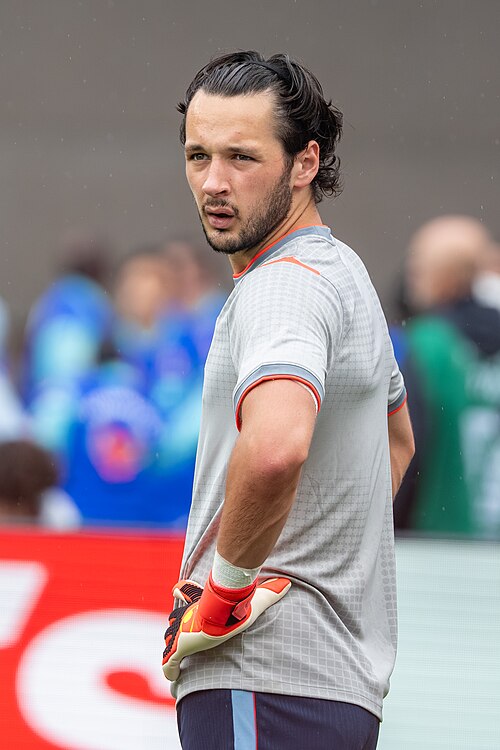
James Trafford at the 2026 World Cup. Photo: Bryan Berlin/WikiPortraits, CC BY-SA 4.0.James Trafford, Dean Henderson, James Beadle
Jordan Pickford has been England’s first-choice goalkeeper for so long that predicting a World Cup squad without him feels slightly unnatural.
By 2030, however, he will be 36. That certainly does not make him too old – goalkeepers have considerably more generous expiry dates than outfield players (David James was 39 in 2010) – but at some point England will have to move on.
James Trafford is the obvious candidate to take over.
Trafford went to the 2026 World Cup as England’s third-choice goalkeeper, having already established himself in the senior squad. At 27 in 2030, he should be approaching his peak. Of all the possible changes between now and then, Trafford replacing Pickford as England’s No.1 feels like one of the easier changes to predict.
Dean Henderson stays. He will be 33, but that is hardly ancient for a goalkeeper. He was part of England’s 2026 squad and finally made his World Cup debut in the third-place play-off. There is every chance he remains somewhere around the squad even if he never becomes the long-term No.1.
The third place is considerably less certain.
I have gone for James Beadle. He will be 26 and has been a regular throughout England’s youth system. Four years is more than enough time for the goalkeeping hierarchy beneath Trafford to change completely, so this is really a prediction that Beadle develops into a Premier League-level goalkeeper rather than a claim that he is currently England’s fourth-best option.
Aaron Ramsdale could still be around at 32. Pickford could quite easily still be there at 36. There will almost certainly be another goalkeeper who forces his way into the conversation.
But if England arrive in 2030 with Trafford as No.1, Henderson providing experience and somebody from the next generation taking the third spot, it would hardly be a surprise.
Defenders: The Reece James Gamble and a New Generation
Reece James, Tino Livramento, Marc Guéhi, Jarell Quansah, Levi Colwill, Josh Acheampong, Nico O’Reilly, Myles Lewis-Skelly
Predicting Reece James four years into the future requires the usual qualification: this assumes his various muscles and tendons agree with us.
If they do, there is no reason age should prevent him being there. James will only be 30 and played five times at his first World Cup in 2026. His ability to play at right-back, wing-back or in midfield makes him particularly useful in a tournament squad.
Tino Livramento takes the other full-back spot on the right. He was originally selected for the 2026 World Cup before injury forced his withdrawal, and at 27 he should be in his prime in 2030.
That means no Trent Alexander-Arnold.
He will only be 31, so this is not really an age prediction. It is a bet that England continue to have enough alternatives at right-back that a player who has never quite established himself as an automatic international starter remains outside the squad. It is also exactly the sort of prediction that could look ridiculous within about six months.
At centre-back, Marc Guéhi looks the safest choice. He was already one of England’s most experienced defenders by 2026 and will still only be 29 at the next World Cup. Jarell Quansah is a slightly bigger projection, although his inclusion in the 2026 squad at 23 gives him a considerable head start.
Levi Colwill returns to the picture after missing the 2026 World Cup, while Josh Acheampong is the more speculative selection. Acheampong will be 24 and offers the sort of versatility that tends to become increasingly useful when managers have only 26 places to cover an entire tournament.
Those four leave out several perfectly plausible options. Ezri Konsa will be 32. Trevoh Chalobah will be 30. Neither would be remotely surprising selections. But history tells us that some established defenders will be overtaken, and this is where I have allowed the younger generation through.
Left-back is even harder.
Nico O’Reilly went to the 2026 World Cup at 21 and played seven times. Four years later he will still only be 25. That makes him one of the strongest predictions in the squad.
Alongside him I have picked Myles Lewis-Skelly, who misses out on the 2026 World Cup but will still be just 23 in 2030.
The unfortunate casualty is Lewis Hall. He will be 25 and could quite easily be England’s starting left-back by then. If there is one defensive omission I am least comfortable with, it is probably him.
There is a broader theme here. James, Livramento, Acheampong, O’Reilly and Lewis-Skelly are all capable of covering more than one position. By 2030 the distinction between England’s full-backs, centre-backs and midfielders may be considerably less neat than the squad list suggests.
Midfielders: Too Many Good Players, Not Enough Places
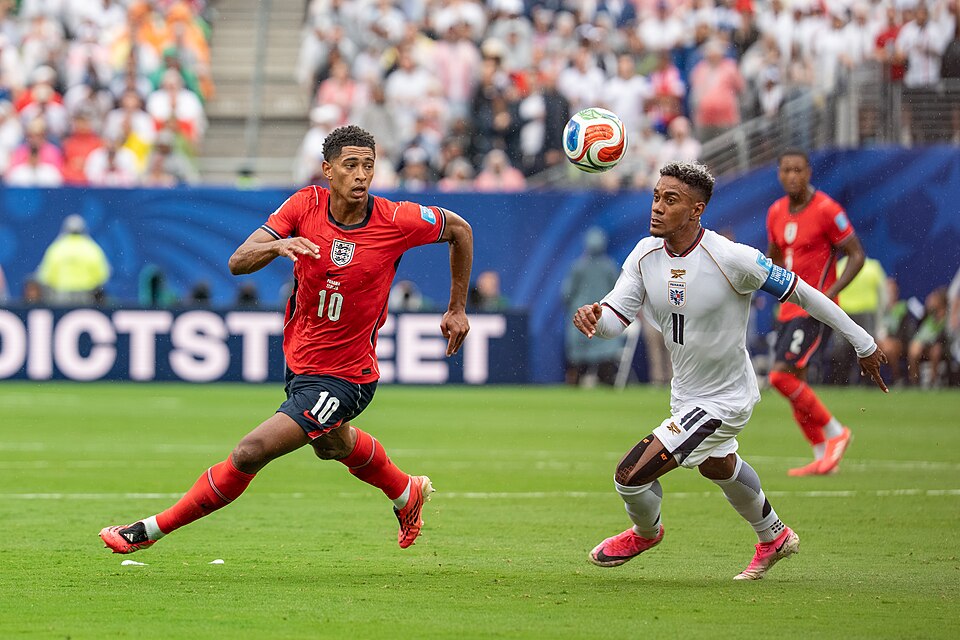
Jude Bellingham against Panama at the 2026 World Cup. Photo: Bryan Berlin/WikiPortraits, CC BY-SA 4.0.Declan Rice, Jude Bellingham, Elliot Anderson, Adam Wharton, Cole Palmer, Morgan Rogers, Ethan Nwaneri, Josh King
This is where predicting England becomes slightly absurd.
Declan Rice will be 31 in 2030. Before looking at the age profile of previous England squads, I was tempted to leave him out as one of the established players eventually overtaken by the next generation.
That would have been trying too hard.
Thirty-one is not particularly old for a World Cup midfielder, and there is currently little footballing reason to predict that one of England’s most important players will disappear. Unless his level drops significantly over the next four years, Rice should be there.
Jude Bellingham is easier still. He will be 26 for most of the tournament and should theoretically be at the absolute peak of his career. If we were ranking these 26 selections by confidence, only Bukayo Saka would have much chance of joining him at the top.
Elliot Anderson is not far behind. He started all eight of England’s matches at the 2026 World Cup and by 2030 will be 27. His emergence is precisely the sort of thing that makes four-year predictions difficult: before his senior England breakthrough he would have been nowhere near most attempts to predict the 2026 team.
Adam Wharton completes the more conventional central-midfield group. He missed the 2026 World Cup despite being in the senior picture earlier that year, but at 26 in 2030 he will have had another four seasons to establish himself. England will need somebody capable of controlling games rather than simply another attacking midfielder, which strengthens his case.
Then things become crowded.
Cole Palmer did not make England’s 2026 World Cup squad. Neither did Phil Foden. Both had been included in the senior squad only a few months earlier.
I am predicting Palmer comes back and Foden does not.
Foden will only be 30. This is not a prediction that he suddenly becomes a bad footballer. It is a prediction about competition. England could have Bellingham, Palmer, Rogers, Nwaneri and others competing for broadly similar attacking areas by 2030. Somebody very good is going to lose.
Morgan Rogers stays after establishing himself in the 2026 team. He made seven appearances at that World Cup and will be 27 in 2030. He also offers something slightly different physically from several of England’s smaller attacking midfielders.
Ethan Nwaneri is the first real bet on the next generation.
He will be 23, and the question is less whether he has enough talent than where exactly he fits into an England squad already overflowing with players who want the ball in similar positions.
Josh King is a bigger call.
He was invited into England’s pre-World Cup environment in 2026 and has started the new season strongly enough that a senior call-up already appears increasingly realistic. At 23 in 2030, he could have more than 150 senior club appearances behind him if his development continues on its current path.
And look at who that leaves out.
Phil Foden. Kobbie Mainoo. Curtis Jones. Conor Gallagher. Alex Scott. Archie Gray. Morgan Gibbs-White.
Mainoo is perhaps the most uncomfortable. He went to the 2026 World Cup at only 21 and is already responding strongly at club level after failing to play during the tournament. Four years from now he could easily be one of the first midfielders picked rather than one of the first left out.
There are worse problems than having to choose between so many midfielders. As difficult as finding places for all of them may be, finding somebody to stand in front of them and score the goals could be harder still.
The Young Bets: Who Could Force Their Way Into England’s 2030 Squad?
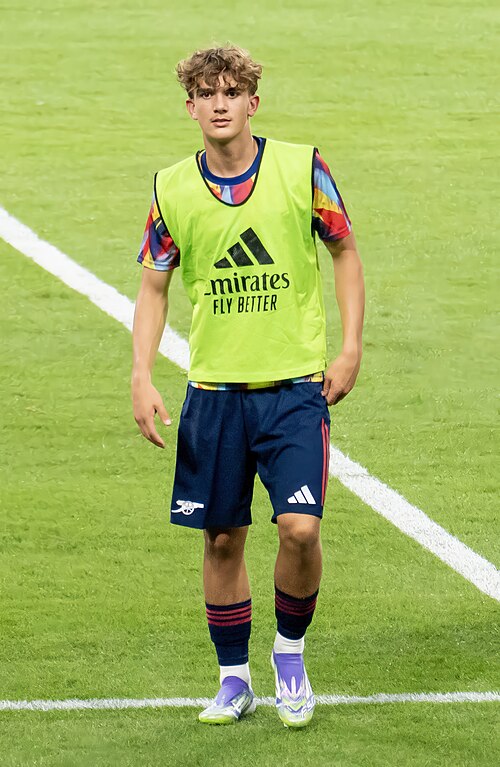
Max Dowman with Arsenal in 2025. Photo: Chensiyuan/Wikimedia Commons, CC BY-SA 4.0.Five players in this squad will be 23 or younger in 2030:
Myles Lewis-Skelly, Ethan Nwaneri, Josh King, Rio Ngumoha and Max Dowman.
Josh Acheampong, at 24, effectively belongs to the same generation.
That might initially look like a lot of projection. Historically, it really is not.
England have averaged 5.6 players aged 23 or younger across their last five World Cup squads. The difficult part is therefore not predicting that five or six young players will be there. It is identifying the right five or six four years in advance.
Lewis-Skelly and Nwaneri are the relatively conservative choices. Both already have substantial senior experience, and both have been around the England pathway.
King is somewhere in the middle. He is already playing regularly at senior level and trained with England before the 2026 World Cup. Thomas Tuchel has continued to watch him closely at the start of the new season.
Ngumoha requires considerably more imagination. He will be only 21 in 2030, but already has senior Premier League experience. If his development continues, four years is plenty of time to move from exciting prospect to England international.
Dowman is the real gamble.
He will be 20 at the World Cup. Predicting a player of his age four years ahead is inherently dangerous. There are dozens of examples of brilliant 16 year olds whose careers did not proceed in anything resembling a straight line.
But there are also players who develop so quickly that by 20 it would seem ridiculous to leave them out.
The wider point is that we are almost certainly missing somebody.
Four years before the 2026 World Cup, Elliot Anderson had never played a Premier League match. Nico O’Reilly had not made a senior appearance for Manchester City. By 2026 both were playing significant roles for England at a World Cup.
There is probably a player currently outside this entire exercise who will make the 2030 squad.
That is not a flaw in the prediction. It is what tends to happen.
Wide forwards: Saka is Easy. The Rest Is Not
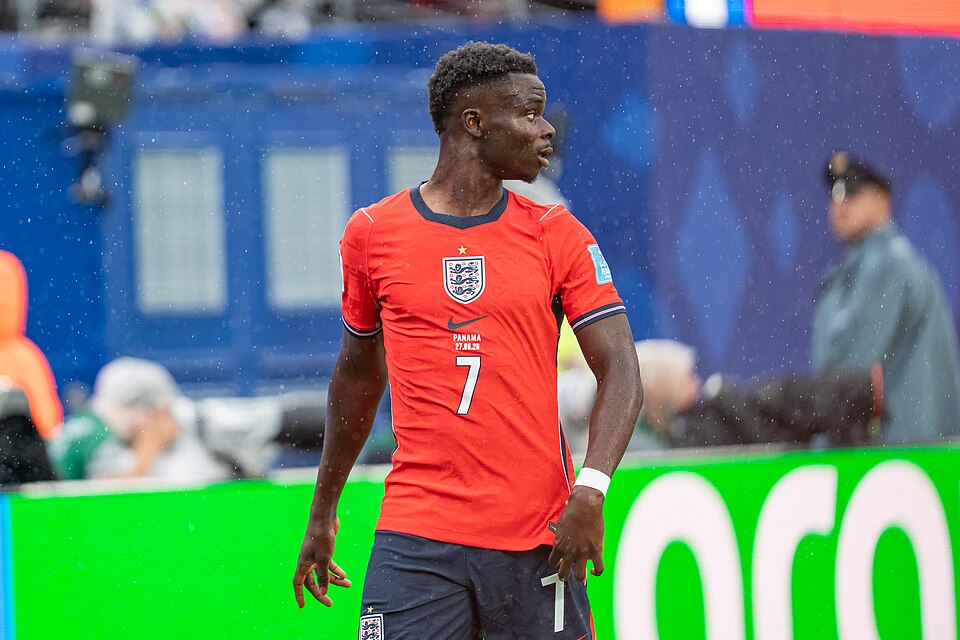
Bukayo Saka against Panama at the 2026 World Cup. Photo: Bryan Berlin/WikiPortraits, CC BY-SA 4.0.Bukayo Saka, Anthony Gordon, Jamie Gittens, Rio Ngumoha
Bukayo Saka is probably the easiest selection in the entire squad alongside Jude Bellingham.
He will be 28 in 2030, should still be in his prime and will already have enormous tournament experience. Unless injuries intervene, it is difficult to construct a plausible England squad without him.
Anthony Gordon is a less certain survivor from 2026, but I have kept him. He played six times at that World Cup and will be 29 in 2030. That makes him exactly the sort of player our turnover research tells us could disappear despite still being young enough, but his pace and ability to play naturally from the left give England something not all of their attacking midfielders provide.
Jamie Gittens is the prediction that a player outside the 2026 World Cup squad forces his way into the next one.
He will be 25, which is almost the perfect age for this exercise: young enough that there should still be considerable development ahead of him, old enough that by 2030 there will be no hiding behind potential.
Ngumoha is the more adventurous selection. At 21 he would be one of the youngest members of the squad, but England have consistently taken players of that age to major tournaments when their performances justify it.
There are also several players listed as midfielders who could play here. Palmer, Rogers, Nwaneri and Dowman all give England options across the attacking line.
That versatility is bad news for some very good players.
Noni Madueke went to the 2026 World Cup and played five times. He will only be 28 in 2030. I have nevertheless left him out, essentially predicting that the younger competition overtakes him.
Eberechi Eze will be 32. Marcus Rashford will also be 32. Tyler Dibling will be only 24.
Dibling in particular could make this selection look foolish. Four years is an enormous amount of development time for a player of his age.
But the basic problem remains the same. England cannot take every talented attacking player.
Which makes the shortage in the next position all the more striking.
The Harry Kane Problem: Who Replaces England’s No.9?
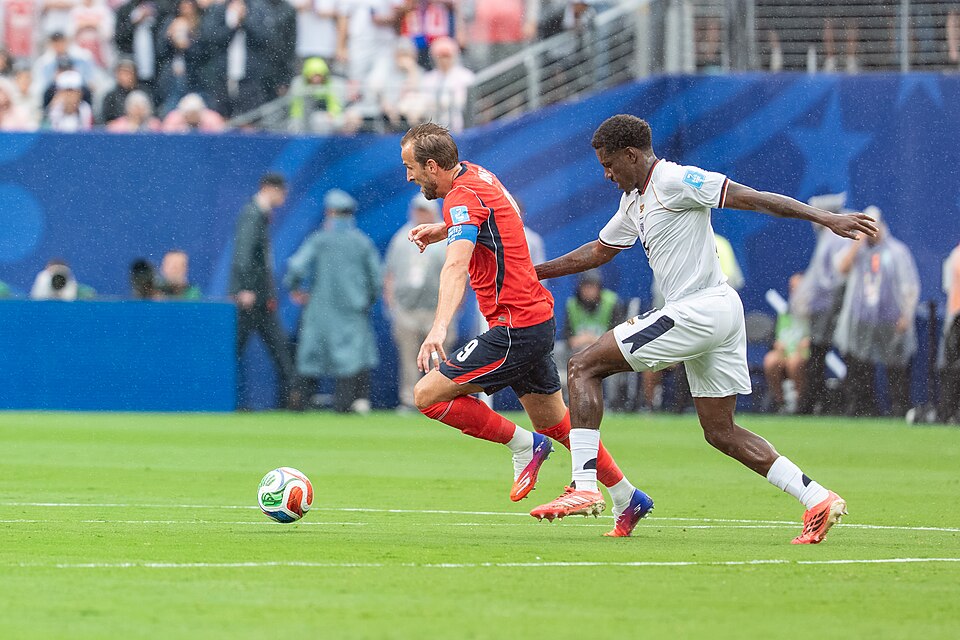
Harry Kane at the 2026 World Cup. Photo: Bryan Berlin/WikiPortraits, CC BY-SA 4.0.Harry Kane, Liam Delap
England could arrive at the 2030 World Cup with enough attacking midfielders to leave Phil Foden, Kobbie Mainoo and Noni Madueke at home.
They could also arrive wondering whether a 36 year old Harry Kane is still their best centre-forward.
That is the strangest imbalance in the entire squad.
Kane will be approaching his 37th birthday by the end of the summer of 2030. Predicting almost any other outfield player to survive that long would be optimistic in the extreme.
But Kane is not almost any other player.
He remains among the world’s leading forwards in 2026 and has just been named on the Ballon d’Or shortlist after another extraordinary goalscoring season.
More importantly for this exercise, England still do not have an obvious successor.
Ollie Watkins and Ivan Toney both went to the 2026 World Cup, but each will be 34 in 2030. Dominic Solanke will be 32. The age profile alone makes it unlikely that any of them represents the long-term answer. England’s shortage of younger orthodox No.9s is already conspicuous.
Liam Delap is therefore the obvious bet.
He will be 27 in 2030 and is already one of the relatively small group of English centre-forwards of the right age with substantial top-level experience. He has also started the 2026/27 season by moving further into the conversation, including scoring his first Nottingham Forest goal in September.
But Delap becoming a good Premier League striker and Delap becoming England’s undisputed No.9 are two very different predictions.
Behind him, things become much more speculative.
Perhaps Shumaira Mheuka develops into an international striker. Perhaps Reigan Heskey does. Perhaps somebody currently playing youth football emerges far more quickly than expected. It is almost impossible to predict. In 2013/14, the season Harry Kane turned 20, he made just ten Premier League appearances. If a 20-year-old had done that last season, we would barely have mentioned him in this article.
Perhaps England decide they do not need a conventional centre-forward at all.
With Bellingham, Palmer, Rogers, Saka, Nwaneri and potentially Dowman available, there is an obvious alternative: build the attack around the best players rather than desperately search for the next Kane. Bellingham or Rogers could play as a false nine. Palmer could operate centrally. The formation could change completely.
That gives England four plausible routes between now and 2030.
Delap develops into the answer. A younger striker emerges from nowhere. England convert one of their attacking midfielders. Or Kane simply refuses to go away.
For now, I am choosing a mixture of the first and fourth.
Delap is in the squad and, as things stand, would be my predicted starter.
Kane is there too.
It may look ridiculous to select a 36-year-old striker in a World Cup squad four years in advance. But leaving Harry Kane out requires answering a question that English football has so far conspicuously failed to answer:
Who replaces him?
The ten unluckiest omissions
If predicting the 26 players who will make England’s 2030 World Cup squad is difficult, predicting who will miss out may be even harder.
Several of the players below could comfortably be starters by 2030. Some will probably make this prediction look ridiculous considerably sooner than that.
Jordan Pickford
Pickford will be 36 in 2030, which sounds old until you remember we are talking about a goalkeeper rather than a winger.
David James started for England at the 2010 World Cup at 39. Going even further back, David Seaman was 38 in 2002 and Peter Shilton was 40 in 1990. So there is no reason Pickford has to be finished. I have simply made the call that, after three World Cups as England’s No.1, James Trafford will finally have taken over.
Pickford still being in the squad as an experienced No.2 would surprise nobody.
Trent Alexander-Arnold
Age is certainly not the problem here. Alexander-Arnold will be 31, comfortably young enough to go to another World Cup.
The problem is competition.
Reece James and Tino Livramento are my two choices on the right, while Josh Acheampong provides further cover. Alexander-Arnold has spent much of his England career caught between being one of the country’s most talented footballers and not quite fitting neatly into the team.
There is every chance a future England manager solves that problem. I am betting they do not.
Lewis Hall
Possibly the defensive omission I am least comfortable with.
Hall will be only 25 and could quite easily be England’s first-choice left-back by 2030. I have instead backed Nico O’Reilly, already part of the 2026 World Cup squad, and Myles Lewis-Skelly.
There probably will not be room for all three.
Ezri Konsa
Konsa will be 32. As the age analysis earlier in this article showed, that is not in itself a reason to leave somebody out.
This is instead a prediction that England’s younger centre-backs overtake him. Guéhi and Quansah survive from 2026, Colwill returns and Acheampong develops into a senior international.
Konsa could remain an England regular for most of the next four years and still lose out at the end.
Kobbie Mainoo
This one feels particularly dangerous.
Mainoo was only 21 at the 2026 World Cup. He will be 25 in 2030 and should, on age alone, be entering the best years of his career.
Unfortunately for him, central and attacking midfield is where England’s options become ridiculous.
Rice, Bellingham, Anderson and Wharton are my central options, with Palmer, Rogers, Nwaneri and King offering different possibilities further forward.
Mainoo has more than enough talent to make the squad. I simply cannot find him a place.
Phil Foden
Perhaps the biggest name missing.
Foden will be 30 in 2030. Again, age is not the issue.
The problem is that England could have Jude Bellingham, Cole Palmer, Morgan Rogers, Ethan Nwaneri and others competing for the areas in which Foden is most effective.
Leaving out a player of his quality feels extreme. But that is partly the point of this exercise. If England historically retain only around a third of their squad from one World Cup to the next, some players who currently appear obvious will disappear.
Foden is my biggest bet that one of them will.
Alex Scott
Scott will be 26 and should be entering his prime.
He also has the misfortune of belonging to perhaps the deepest generation of English midfielders in recent memory. There is a perfectly plausible version of the next four years in which Scott becomes a regular England international.
There is another in which he spends them permanently on the edge of squads because somebody slightly better always happens to be available.
I have gone for the latter.
Tyler Dibling
Dibling may be the omission most capable of looking stupid very quickly.
He will only be 24 in 2030, so almost all of his prime should still be ahead of him. If he develops as hoped over the next four seasons, leaving him out could become impossible.
For now, Saka owns one wide position and I have backed Gittens and Ngumoha to emerge around him, with Palmer, Rogers, Nwaneri and Dowman all capable of playing across the attack.
Something has to give.
Noni Madueke
Madueke has perhaps the strongest complaint of anyone on this list because he actually went to the 2026 World Cup and will still only be 28 four years later.
This is exactly the sort of selection where the historical turnover matters.
It would be easy to look at every young member of the 2026 squad and assume they will return. Previous England squads tell us that some will not.
I have backed younger wide players to overtake Madueke. He could make that decision look extremely harsh.
Eberechi Eze
Eze will be 32, making him one of the few omissions where age genuinely starts to count against him.
Thirty-two is hardly ancient, but when the competition includes Bellingham, Palmer, Rogers, Nwaneri and potentially several players who have not yet reached the senior England team, maintaining a place becomes much harder.
That is ultimately the theme running through this entire list.
There is no prediction here that Phil Foden, Kobbie Mainoo or Trent Alexander-Arnold will suddenly become bad footballers. There is no suggestion that Lewis Hall or Tyler Dibling will fail.
There simply are not enough places.
And if history tells us anything, at least one player we currently regard as indispensable will not be anywhere near England’s 2030 World Cup squad — while somebody I have not mentioned once in this article probably will be.
England’s Predicted Starting XI for the 2030 World Cup
Selecting 26 players is one thing. Trying to fit the best of them into an XI creates another set of problems.
This would be my England team for the opening game of the 2030 World Cup:
GK: James Trafford
RB: Reece James
CB: Jarell Quansah
CB: Marc Guéhi
LB: Nico O’Reilly
CM: Declan Rice
CM: Elliot Anderson
RW: Bukayo Saka
AM: Jude Bellingham
LW: Cole Palmer
ST: Liam Delap
There are several selections here that require very little explanation.
Trafford has replaced Pickford. Guéhi remains in central defence. Rice and Anderson provide the base of the midfield, while Saka and Bellingham should both be right in the middle of their primes.
Then it gets more difficult.
I have picked Quansah alongside Guéhi, although Colwill or Acheampong could easily have overtaken him by then. Reece James at right-back assumes four more years of relative physical cooperation from a body that has not always been especially accommodating.
The attack is harder still.
There is no Morgan Rogers. There is no Phil Foden. And Cole Palmer is playing from the left.
Welcome to England selection in 2030.
The reality is that positions may matter less by then than they do on the team sheet. Palmer would inevitably drift inside. Bellingham could move higher or deeper. Saka would provide genuine width from the right. O’Reilly could push forward from left-back while Rice dropped into the space behind him.
The biggest call is at centre-forward.
I have picked Delap ahead of Kane partly because, if England are still starting a 36 year old Kane in 2030, something fairly significant has either gone right for Kane or wrong for everybody else.
Delap is the prediction rather than the certainty.
And there is another possibility entirely.
Does England Even Need a Striker?
Perhaps we are asking the wrong question.
The obvious way to think about England after Harry Kane is to search for the next Harry Kane. Which young English centre-forward can score 25 goals a season, link the play, create chances and lead the line for a decade?
There may not be one.
That does not necessarily mean England have a problem.
By 2030, England could have Bellingham, Palmer, Rogers, Saka and Nwaneri available in the same squad. Dowman may have developed sufficiently to join them. Several can play centrally, several can score goals and almost all are comfortable moving between traditional attacking positions.
There is therefore a plausible England team that simply removes the conventional No.9.
For example:
Trafford
James — Quansah — Guéhi — O’Reilly
Rice — Anderson
Saka — Palmer — Rogers
Bellingham
Calling Bellingham the centre-forward would probably be misleading. He could drop into midfield, arrive late in the penalty area or interchange with Palmer and Rogers. Saka would remain the most conventional attacker in the team.
It would also allow England to put four of their best attacking players on the pitch without inventing a position for somebody.
There are obvious drawbacks. International tournament football has a habit of eventually requiring somebody to turn an ugly cross into a goal from six yards. False nines look rather less sophisticated when a team is 1–0 down with 15 minutes remaining and nobody is occupying the penalty area.
Kane has also provided England with something that is easy to take for granted precisely because he has done it for so long: goals.
Replacing those goals collectively may be possible. It is not automatically preferable.
That is why I have Delap starting in the conventional XI and Kane still in the squad.
But if no elite English centre-forward emerges over the next four years, England should not necessarily squeeze an inferior player into the team simply because the formation graphic requires somebody next to ST.
The solution to England’s shortage of strikers might be to stop worrying quite so much about having one.
How Wrong Will This Be?
Very.
That is perhaps the safest prediction in the entire article.
Four years before the 2026 World Cup, trying to predict players such as Elliot Anderson and Nico O’Reilly becoming important members of England’s tournament squad would have required considerably more imagination than including most of the established internationals they eventually displaced.
The same thing will happen before 2030.
Somebody in this squad will suffer injuries. Somebody will stop developing. Somebody currently regarded as an automatic England player will lose his place at club level. One of the teenagers I have backed will probably turn out not to be quite as exceptional as he currently appears.
The opposite will happen too.
There is almost certainly a future England international currently playing academy football who has barely featured in this article. There may be a 20-year-old Championship player who will be in the Premier League within two years and England’s squad within three.
That unpredictability is the point.
The historical numbers suggest that simply carrying most of the 2026 squad forward would be wrong. They also suggest that filling half the team with teenagers would be wrong.
In fact, even after deliberately building substantial turnover into this prediction, I have still retained 13 players from 2026. The historical average is fewer than eight.
The best we can do is identify the core that looks capable of surviving, leave enough room for players to emerge and accept that football will take care of making several predictions look stupid.
I look forward to discovering which ones.
Final Verdict
England should arrive at the 2030 World Cup with an extraordinary amount of talent.
Bellingham will be around 27. Saka will be 28. Palmer will be 28. Rice will be 31. Anderson and Rogers will be 27. Behind them could be another wave led by Nwaneri, Lewis-Skelly, Ngumoha and Dowman.
There is enough there to imagine an England team every bit as talented as the one that finished third in 2026.
But the interesting part is where that talent sits.
England may have so many attacking midfielders that players of the quality of Phil Foden cannot make the squad. They may have multiple options at both full-back positions and centre-back prospects emerging behind Guéhi and Quansah.
And they may still be wondering who scores the goals.
My prediction is that Liam Delap gets the first opportunity, while Harry Kane remains involved at 36. Perhaps one of England’s teenage strikers makes the entire discussion irrelevant. Perhaps Bellingham ends up playing as a false nine. Perhaps Kane is still starting.
Four years is a long time in international football.
If history is any guide, roughly half of this article will look surprisingly sensible in 2030 – but I have no idea which half.
FAQs
Who will play for England at the 2030 World Cup?
My predicted England squad for the 2030 World Cup includes established players such as Jude Bellingham, Bukayo Saka, Declan Rice, Cole Palmer and Morgan Rogers alongside younger prospects including Ethan Nwaneri, Myles Lewis-Skelly, Rio Ngumoha and Max Dowman.
Thirteen of my predicted 26 were members of England’s final 2026 World Cup squad.
What could England’s starting XI be at the 2030 World Cup?
My predicted England starting XI for 2030 is James Trafford; Reece James, Jarell Quansah, Marc Guéhi, Nico O’Reilly; Declan Rice, Elliot Anderson; Bukayo Saka, Jude Bellingham, Cole Palmer; Liam Delap.
There are several alternatives, particularly in attack, where Morgan Rogers, Ethan Nwaneri and potentially Harry Kane could all come into the team.
Will Harry Kane play at the 2030 World Cup?
Harry Kane will be 36 during the 2030 World Cup and approaching his 37th birthday.
That makes his participation uncertain, but there is plenty of precedent for elite players extending their international careers into their late thirties. More importantly, England still lack an obvious long-term replacement at centre-forward.
I have Kane in the 26-man squad but not the starting XI.
Who could replace Harry Kane for England?
Liam Delap is my current prediction to replace Harry Kane as England’s starting centre-forward by 2030.
There are younger possibilities who could emerge over the next four years, while England could also use Jude Bellingham, Morgan Rogers or another attacking midfielder as a false nine rather than selecting a conventional striker.
How old will Jude Bellingham be at the 2030 World Cup?
Jude Bellingham was born on 29 June 2003, meaning he will turn 27 during the summer of the 2030 World Cup.
He should therefore be entering what are normally considered a footballer’s peak years and is one of the safest selections in any attempt to predict England’s 2030 team.
How old will Bukayo Saka be at the 2030 World Cup?
Bukayo Saka was born on 5 September 2001, so he will be 28 during the 2030 World Cup.
Like Bellingham, he should be in his prime and would be expected to be one of England’s most experienced players by then.
Which young England players could make the 2030 World Cup squad?
Ethan Nwaneri, Myles Lewis-Skelly, Josh King, Rio Ngumoha and Max Dowman are the five players aged 23 or younger in my predicted England 2030 squad.
Josh Acheampong will be 24 and belongs to much the same generation. Other young players including Tyler Dibling, Archie Gray and several prospects currently in England’s youth teams could easily force their way into contention over the next four years.
How many players from England’s 2026 World Cup squad could still play in 2030?
I have predicted 13 of England’s final 2026 World Cup squad to return in 2030. That would be unusually high: across the four previous World Cup cycles, England retained an average of only 7.75 players from one tournament to the next.
 The Penwarden Review
Leave a comment