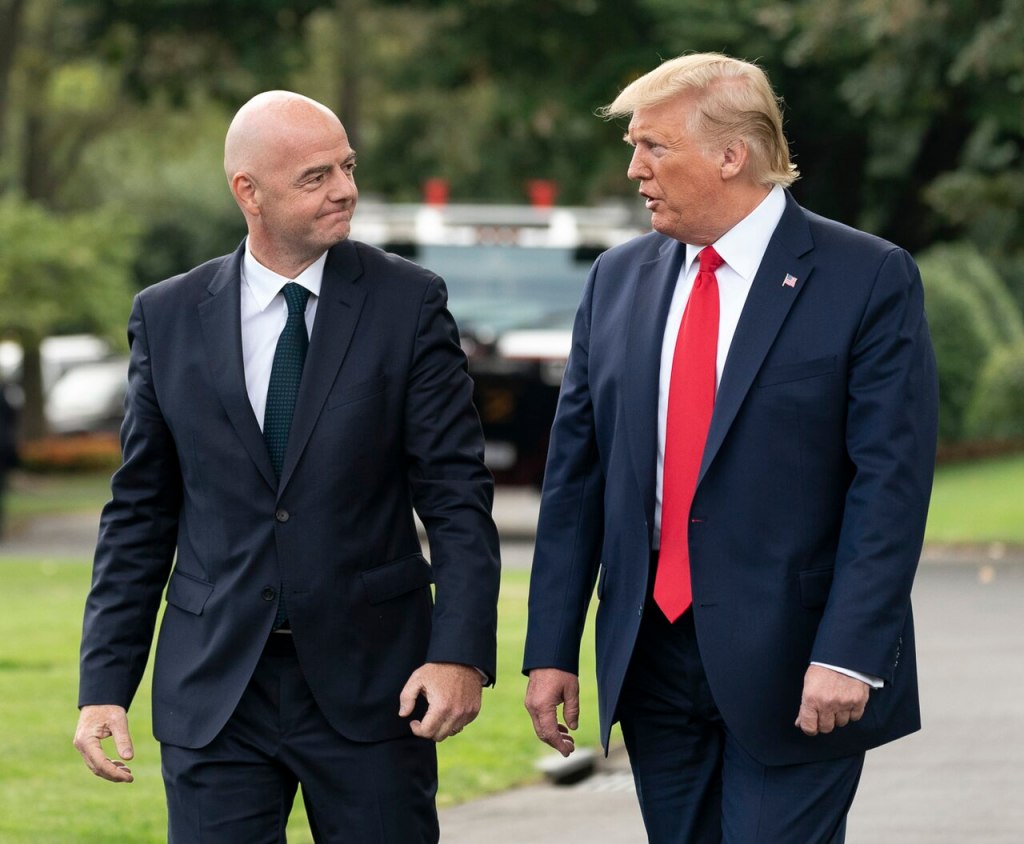
As the fallout from Gianni Infantino’s latest FIFA scandal continues, attention has understandably focused on the man himself: his conduct, his vanity and his increasingly Kim Jong Un-like supreme-leader energy. Less attention has been paid to the substance of what he was proposing—or, more accurately, trying to decree from on high.
Removing Infantino might solve the immediate problem. It would not solve the structural weakness that allowed him to devise the proposal in the first place: FIFA’s president controls enormous financial resources and can distribute them among the same 211 national associations that determine whether he remains in office.
What did Infantino actually want to do?
Infantino wanted to incorporate a new FIFA subsidiary called ‘Football Forward Enterprise’ (“FFE”) and transfer all of FIFA’s commercial activities into FFE, these would include:
- sponsorship and marketing rights;
- ticketing;
- hospitality;
- licensing and merchandising; and
- operational delivery of tournaments.
A $20 billion valuation was given to FFE, as FIFA intended to sell a 20% stake in the company to investors for $4 billion.
Following completion of the 20% sale, each of the 211 national football associations would receive an interest in FFE notionally worth $20 millon, which each nation could immediately sell ($20 million x 211 = ~$4.2 billion, around the size of the investor’s equity investment).
Each association would also receive $20 million of funding during the 2027-2030 cycle (versus the $8 million already planned).
Did it make financial sense?
When the plan was revealed by Martyn Ziegler in The Times, Andy Burnham reacted in a way that resonated with football fans around the world.
“The World Cup is not a product. It is the greatest competition in world sport, and it was never anyone’s to sell.”
Andy Burnham, 28 July 2026
But he isn’t quite right… the World Cup is a product, and FIFA is really an events business, largely existing to organise and commercialise its tournaments.
After selling its products, FIFA estimates a revenue of $15 billion during the four-year period up to the 2026 World Cup – a large increase from the 2019-2022 cycle mainly down to (i) the 2026 World Cup being predominantly held in the world’s most sophisticated sports market, with fans and commercial partners having the deepest of pockets; and (ii) to a lesser extent, the commercialisation of the new Club World Cup.
But what would be the commercial rationale for an organisation with ~$7 billion of liquid financial resources at the end of 2025 (an amount that will be significantly higher immediately after the 2026 World Cup) to sell 20% of its main commercial revenues FOREVER for ~$4 billon? Financially it is nonsensical – there is no sound business or financial logic to selling a portion of the family silver for a sum that is, in the grand scheme of things, not transformative for FIFA.
FIFA (or really, its great overlord, Gianni) was willing to give up 20% of its profits, distributions and future growth forever for an amount of money that is not even close to equal to its total net reserves following the 2026 World Cup!
It was a deal that Carlos Cordeiro, Infantino’s senior adviser and former Goldman Sachs vice-chairman, immediately dismissed (once he actually found out about it).
“I had no involvement in this proposal.”
“It is mortgaging football’s future without any compelling justification.”
“FIFA already has access to extraordinary financial resources. The organisation sits on billions of dollars in reserves and no debt.”
Carlos Cordeiro, 31 July 2026
Carlos was not quite right to say that Infantino was “mortgaging football’s future”, this would simply have been a sale of a prized asset at a distressed asset price – at the end of a mortgage term you own 100% of the house, FIFA would never have owned 100% of its business ever again.
Giving up revenue tomorrow (or, in this case, in perpetuity) is a tactic normally undertaken by ailing, cash-strapped companies who are desperate for short-term liquidity – the polar opposite to FIFA’s enviable position of no debt and plentiful cash.
Think of Barcelona and their chairman Joan Laporta pulling various ‘levers’ over the past couple of years in order to simply keep the lights on, selling (i) 25% of their La Liga income for 25 years for ~€500m; and (ii) some VIP seats in the revamped Camp Nou for up to 30 years for ~€100m. Barcelona were desperate for liquid cash but even their frantic measures did not involve giving up portions of revenue on a permanent basis.
If it made no financial sense, why did Infantino want to do it?
If the transaction cannot be legitimised on its commercial terms, it must be considered in political terms.
Infantino, a man resplendent with hubris after “the greatest FIFA World Cup of all time” (his words, but unarguable on a purely financial basis), appears to have wanted to use this investor cash to solidify his voter base as FIFA President, and maybe create a very well paid job for himself running FFE at the end of his time as President.
The large countries cannot be bribed with a few million here and there – increasing the four-year funding cycle amount from $8 million to $20 million would be a rounding error in the FA’s ~£500 million (~$675 million) annual turnover – but, more than half of the world’s national football associations can be bribed with these sums (remember, in a two-horse presidency race, Infantino would need at least 106 of the 211 nations to vote for him to secure a simple majority).
$20 million (the initial payment that would have been made to each football association upon sale of its interest in FFE) to the football association of Mongolia (ranked 190, $20 million being approximately six or seven times their annual budget) or Samoa (ranked 188, $20 million being approximately 10 to 13 times their annual budget) would be transformative – that’s a lot of 4G all-weather pitches, or, for you cynics out there, first-class flights for the association executives.
These ‘developmental’ payments that are modest in the context of FIFA’s significant cash reserves (even before any investor cash injection) can be far-reaching for a small association, so a FIFA President (Infantino or AN Other) can ingratiate themselves to large swathes of the voting bloc by promising larger payouts than an opponent.
Infantino’s plan amounted, at best, to an inducement and, at worst, to a bribe designed to purchase support: the associations voting on the permanent disposal of 20% of FIFA’s most valuable commercial assets would receive an immediate benefit worth $20 million.
What happens next?
Regardless of whether Infantino stays or goes, does the governance structure of FIFA need to change? FIFA’s system gives each country one vote. While instinctively democratic, this gives the Cook Islands (FIFA ranking 186, population less than 15,000) the same influence over football as Brazil (FIFA ranking 5, population more than 200 million); and Anguilla (FIFA ranking 210, population less than 15,000) the same influence as England (FIFA ranking 4, population more than 55 million).
Europe and South America together provide the vast majority of FIFA’s commercial value (which is why UEFA’s threat to boycott FIFA’s competitions was such a powerful tool) but together control 65 of the 211 votes (~30%).
The proposal exposed a basic tension in FIFA’s constitution. Equal voting rights protect football’s universality, but they also allow a president to distribute money generated largely by a relatively small number of commercial markets among the associations that decide whether he remains in office.
Could Europe and South America break away?
Without any changes to FIFA’s structure could Europe and South America break away from FIFA?
Such an act would be far from unprecedented in sport – think of all of the active darts world champions leaving the BDO in 1992 to set up what would become the PDC (a great success); LIV Golf forming in 2022 (a huge failure but a great success if you enjoy the Saudi sovereign wealth fund passing billions of dollars to a few golfers); and the Premier League forming in 1992.
The Premier League’s breakaway from the Football League offers the closest analogy. In 1992, the First Division clubs concluded that the organisations generating most of English football’s television value should not remain subordinate to a league in which the lower divisions collectively held a majority of the votes. So Manchester United had, in effect, no greater say over the Football League than Chester City – two clubs with completely different outlooks, needs and ambitions. Chester City were thinking about how they kept the lights on, and Manchester United were thinking about how they competed with Real Madrid.
Could this be the way forward for the top international football nations? You would imagine the smaller nations not part of the original breakaway group would soon want to join the rebels as a FIFA World Cup without Europe and South America would be worth pennies on the pound compared to what has come before (and therefore FIFA’s largesse to the smaller nations would come to a halt).
One possible replacement would resemble the ICC’s governance structure in cricket: 12 Full Members each elect a board member to the ICC Board, while the other approximately 90 Associate Members elect three board members between them.. Of course, this system would create a new argument around who the ‘full’ and ‘associate’ members are.
Another alternative would be the World Rugby weighted voting system, with countries sitting in tiers of voting power dependent on each country’s previous performance and administrative standing.
But could the nuclear option of a European and South American breakaway be unnecessary? The mere threat of a breakaway could neuter any FIFA president’s ego and prevent him from doing whatever serves him best; currying favour with smaller nations to strengthen his power base would have to stop.
This continuing holding of a metaphorical gun to the FIFA President’s head could allow the ‘one member, one vote’ system to continue, but on the unspoken but universally acknowledged basis that any worldwide vote would be a second stage to an initial thumbs up from UEFA and CONMEBOL. This would move football from a FIFA dominated world to a UEFA and CONMEBOL dominated world – replacing a constitutional government with a state of permanent brinkmanship. FIFA would remain notionally democratic while UEFA and CONMEBOL exercised an informal veto.
Would rule by the largest nations be any better?
Yet replacing FIFA’s universalism with governance by its richest and most powerful members would replace one set of problems with another.
India is the Infantino of cricket, and a small collection of nations are the Infantino of rugby. Think about Georgia’s rugby development being inevitably slowed by its exclusion from the Six/Seven Nations, and India dominating the cricket landscape via the IPL and Indian ownership of teams in all of the other major Twenty20 leagues (a domination that will only continue to grow as the BCCI receives 38.5% of ICC monies, with no other country receiving more than 6.9%).
While these systems of administering cricket and rugby give the largest slices of cake to the countries that provide the greatest number of ingredients, they also maybe go some way to explaining why these sports have, in comparison to football, very few nations at the top table and an entrenched competitive order – which would be more evenly matched, (i) a Brazil (ranked 5) v Ecuador (ranked 25) football match; or (ii) England (ranked 5) v Zimbabwe (ranked 25) rugby match?
Football’s major strength is the depth and breadth of its influence. It is not merely a sport in most countries of the world, it is ingrained in the culture. Outside of the Olympics it is the one sport that stages a true ‘world cup’. Therefore we should not rush to transfer power from the FIFA President to a small collective of the most powerful nations.
What should replace the current system?
A rotating presidency allocated among the six confederations—Europe, South America, North and Central America and the Caribbean, Africa, Asia and Oceania—might prevent one region from retaining control indefinitely. Each term could last four years and end with a World Cup hosted by that confederation, giving each region the opportunity to drive its own initiatives during its period in charge.
But rotation would not constrain an all-powerful president during any four-year term. Giving each confederation one vote, with the incumbent president’s confederation holding a casting vote in the event of a 3–3 deadlock, would also reproduce in a different form the same tension created by one member, one vote. Oceania—minus Australia, which is part of the Asian confederation—would sit as an equal of every other confederation, so the smallest nations in that part of the world would continue to enjoy voting power exceeding their footballing status.
A more durable settlement would combine a strict two-term limit, an independently constituted executive board, full disclosure of development payments, balanced representation for the six confederations and a supermajority requirement for any permanent disposal of FIFA’s principal commercial assets. Such a system could preserve universal membership while imposing meaningful restraints on presidential power.
There is no perfect structure. Giving greater power to football’s largest nations would entrench an elite; treating every association as identical allows a president to construct a majority through financial patronage. But the choice need not be between oligarchy and autocracy. Infantino may be the immediate problem. The greater problem is a constitution that allowed him to become so powerful—and would allow his successor to do exactly the same.
 The Penwarden Review
Leave a comment