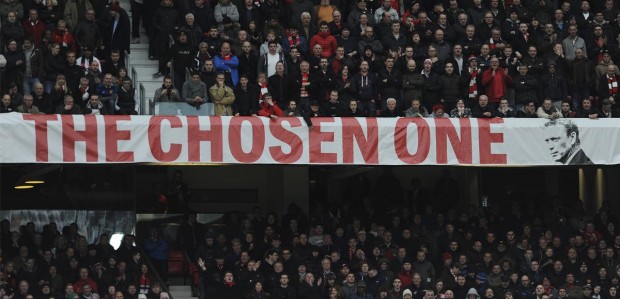
Manchester United are in grave danger of becoming the David Duval of football. In 2001, Duval reached the pinnacle of golf and won the Open Championship, he was a few months short of 30, approaching his golfing prime. Yet, instead of being part of golf’s big three with Woods and Mickelson for years to come he fell away with only the odd glimpses of the good old days ever being seen again. He finished 2001 as the world number 3, he finished 2003 as the world number 242. If Manchester United carry on the course they’ve set, you’ll be able to substitute Duval for Moyes, here.
“We’ve got a winner, that is really important for this club. To get a winner is the most important thing”
Ferguson on Moyes, 12th May 2013
When Sir Alex Ferguson met Joel Glazer in New York to discuss his successor, there was apparently instant unanimity; David Moyes was the Chosen One. Were United turning to man who’d enjoyed unbounded success, as Ferguson had stated? Unless the old Second Division Championship around the turn of the new millennium is where you get your nostalgic kicks, the answer is a resounding no.
In his autobiography, Ferguson chose much more simple terms to give credence to the anointed. Was Moyes a tactical trailblazer? A motivational speaker that made Martin Luther King look like Marlon King? Nope, he was a good Scottish lad. “Scottish dourness” and Scots being “serious about their labours“ was as far as Ferguson went, “David had some of these traits”.
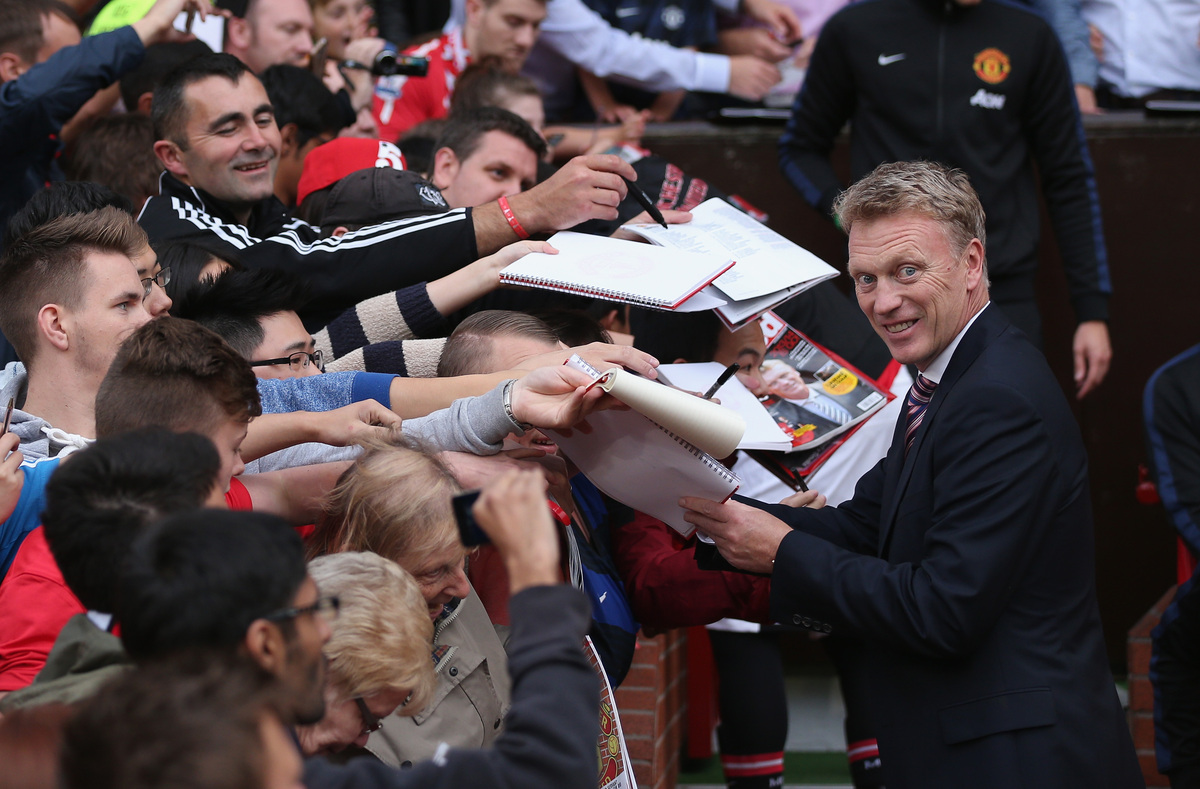
That’s where it began to go wrong for Moyes – being described as a man made in Ferguson’s image. But being Scottish is where the similarities begin and end. Moyes came to the Premier League defending champions with the old Second Division at the top of his CV and a 4-2 Champions League qualifying round aggregate loss to Villarreal just below it. Ferguson came to a relegation threatened club in 1986 with three Scottish Premier Divisions – breaking up the Old Firm monopoly with lowly Aberdeen, a European Cup Winners’ Cup after beating Real Madrid and a European Super Cup after beating Hamburg. The comparison begins and ends at being Scottish.
The six year contract given to Moyes showed United’s desire to promote continuity and patience, a legacy of Ferguson’s time. However, so many adhere to the principle that Ferguson was good because he was there a long time, this is true to an extent, but more truth is to be found in the thought that he was there a long time because he was good. If duration of tenure was as important as we’re lead to believe we’d be seeing Arsenal run away with the league this season and Chelsea scrapping in the bottom three, so much more goes into the mix than continuity.
The mention of high flying Chelsea leads nicely into the others that were out there on the day Moyes was appointed. In the index of Ferguson’s autobiography, José Mourinho sits directly above David Moyes, where he also sits in the management hierarchy. Sir Bobby Charlton may have had a point when he suggested Mourinho wasn’t exactly the potential deity that United should have in mind when appointing a manager, but I can’t remember Ferguson ever being up for the Nobel Peace Prize. Mourinho is a proven winner, not just in England but in Europe. Moyes came in talking of the enormity of the job, Mourinho would have hit the ground running, and you wouldn’t have found him awe struck by the task at hand. If Mourinho’s character references displeased Sir Bobby and co to such a great extent there was a plethora of other options out there, men who weren’t even afforded an interview. Klopp, Van Gaal, Simeone, de Boer, Laudrup, an appointment from within, I could go on, no one was given a look in.
Moyes has made errors from the word go. Replacing René Meulensteen, Mike Phelan and Eric Steele with coaches untested at the very highest level (or in Phil Neville’s case, untested, full stop), like a random cabinet re-shuffle from time to time, it made very little sense. In no other walk of life would someone come into a successful organisation and get rid of the team that were a pivotal part of that success. When Tim Cook became Apple CEO after Steve Jobs’ death he didn’t get rid of Apple’s senior management team, he just tried to pick up where Steve Jobs left off. Many of the Manchester United players had only ever known Ferguson as their boss, to then compound this upheaval by taking away the coaches they’d worked with every single day, year after year has been no help.
“People are aware there is a squad that is ageing, so I think it would have been a tough season for whoever was in charge of Manchester United this year.”
Moyes, this week
To go through a thirty-eight game league programme and win it in style with a great bunch of players… it’s a young squad, a lot of good young players. They’re going to get better, a lot of them, and the big test is can they win it three times in a row as we’ve done before? I hope the boys can do that.”
Sir Alex, during the 20th May 2013 title parade
The summer transfer policy also smacked of amateurism, however, in Moyes’ favour, how to apportion blame between him and Ed Woodward is unclear. The purchase of Fellaini at the 11th hour was the definition of a ‘panic buy’, after the public courting of Thiago, Fabregas, Herrera and any Spanish playmaker you care to mention, Fellaini was nothing more than a £27 million lampshade, I mean appeasement, for the Stretford End that came straight out of Neville Chamberlain’s book, and we all know how that ended. Moyes now promotes the idea of a long term project, the signing of Fellaini for £4 million more than was needed when his buyout clause was in operation is the complete antithesis of his ‘plan’.
The incumbent champions of England have reached nadir after nadir this season. Sadly, nadir isn’t another Spanish playmaker. Rather than any green shoots of recovery there’s been a steady but rapid decline. This season United have won 21 points at home, less than Hull City and Norwich City have managed, the 18 goals at home put them on a par with Cardiff City and Fulham. This would be disappointing for a Newcastle or a Stoke; it’s unbelievable for a team that won the league by 11 points last season.
“It’s difficult to explain it, I felt as if the players were in good shape and good fettle going into it, but we didn’t get to the standards required. I’ve seen confident players who are well motivated and hard-working and conscientious. I’d not seen that coming.”
Post 3-0 Liverpool loss
“I just keep doing the job because I know that we’re doing the right job. We’ll do the same things, we’ll make sure things are right – prepare the players well and things will change I have no doubt.”
Post 2-2 Fulham draw, complete with 81 crosses
The damning statistics and league position would be more palatable if one could see a development under Moyes, à la Brendan Rodgers’ Liverpool last year. But, Moyes appears to be clueless as to the problems that the club faces, with no discernable brand of football being instilled. Using Fellaini as a target man at Everton worked marvellously, but it was no preparation for the tactical nuances that are needed to step up to the very top table of European football. Moyes may eventually stumble across a way of accommodating Rooney, Mata, Van Persie and Januzaj into a slick, fast flowing Manchester United team but this is no place to learn on the job. Apprentices should come into the club to paint the walls and maintain the pitch (apart from 23 year old Kazakh’s in Cardiff), not to manage the club and learn on the job simultaneously.
Moyes keep on extolling the virtues of ‘hard work’; this is completely at odds with insipid performances, especially the recent losses against Liverpool and Manchester City. Each time hard work has appeared to be the answer, but doing the incorrect thing for 6 hours a day rather than 5 is a sign of insanity rather than improvement. Like a university law student saying they’ve been in the library for 37 hours a day, there reaches a stage where quality overtakes quantity. Moyes may have an enviable work ethic, but has he got that quality it takes to make a championship contending side? On the evidence, I don’t think so.
“They are coming to Old Trafford and we are going to make it as difficult for them as we possibly can”
On many occasions thus far Moyes has lived up to his humble beginnings. The above quote didn’t come as a reaction to drawing Bayern Munich in the Champions League, it came before playing Newcastle at home, a team Ferguson had described as a “wee club in the north east” less than 12 months before. A Manchester United manager should just want to swat away opposition at home, here Moyes displayed his Evertonian upbringing, keep it tight and see what happens. Manchester United 0 – 1 Newcastle United.
“I was due to take him off after 60/70 minutes but I think if I’d taken him off everybody would have said, ‘what are you doing?, but in truth Robin needed to come off after 70 minutes, maximum”
In the aftermath of the Newcastle game, Moyes again let slip his struggle to get on top of the challenge. He left Van Persie on the pitch, not for the sake of the game or Van Persie himself, but for the potential criticism that would have come his way had he taken him off. This decision came at the beginning of December, the pressure has been ratcheted up significantly since then, would he have the confidence to go against this decision today? Nothing suggests so.
United’s comeback against the workmanlike Olympiakos was nothing more than a Pyrrhic victory, one win papering over the cracks of 10 league losses and a lowly seventh place. It placated some fans and many newspapers but what was perceived as a potential turning point by the man himself was decimated by the performances against Liverpool and Manchester City.
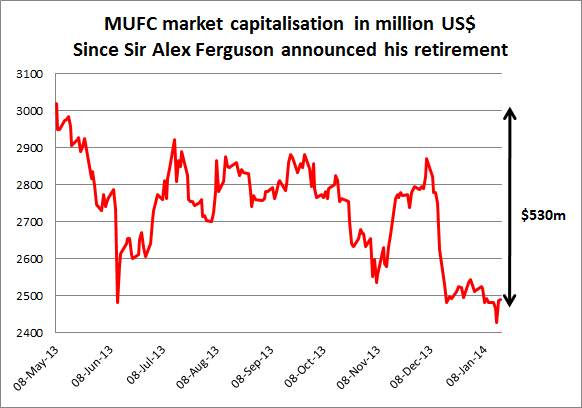
The Glazers may be motivated more by avarice than the beautiful game but the graph above shows why Manchester United are so willing to spend this summer. The current share price values the club at just over $3billion, a £150/200 million spend in the coming window is seen as an investment to maintain that value, rather than a huge capital outlay just for the sake of it. The fact that Manchester United have gone from a title winning team to a team in need of significant investment at a scale the club has never seen before speaks volumes for Moyes’ impact. The Glazers and Ed Woodward must feel uneasy at the thought of trusting a man who is rapidly losing the fans’ support with money that could buy his previous club outright. Moyes has spoken of “aspiring to be like City”, will Moyes plus £200 million reach Manchester City’s current level or allow United to reach the level City, Chelsea and Liverpool will be at after a summer of investment? On current form and evidence, even the former is unlikely.
Allowing for all these events, statistics and facts, however forthright Sir Alex and Sir Bobby are in public with their support for Moyes – what else are they supposed to say while Moyes is the manager? – in private they must, at the very least, be wavering. The performances, league position, fan unrest and the planned fly past before todays’ Aston Villa match must be playing on their mind. As the two ‘football people’ on the Board, if and when their support begins to falter, the Glazers will take note.

However unbecoming the ‘Wrong One – Moyes Out’ flypast is, it demonstrates the level that Moyes’ Manchester United have reached. If the act, rather than the sentiment, is unwelcomed by the 76,000 at Old Trafford the flypast may have a counter intuitive effect, being seen as a moment of support for Moyes by those in the stadium rather than disdain for the supporters who raised £850 for the flypast.
The embarrassing performances, lowest league position since 1989/1990, lack of passion and attacking, flowing football, growing supporter unrest and the need for unparalleled investment leaves Moyes needing a recovery akin to England at Headingly in 1981 , but Ian Botham isn’t coming over the horizon to save the day, a light aircraft is. Recent events have marked the beginning of the end.
 The Penwarden Review
Leave a comment