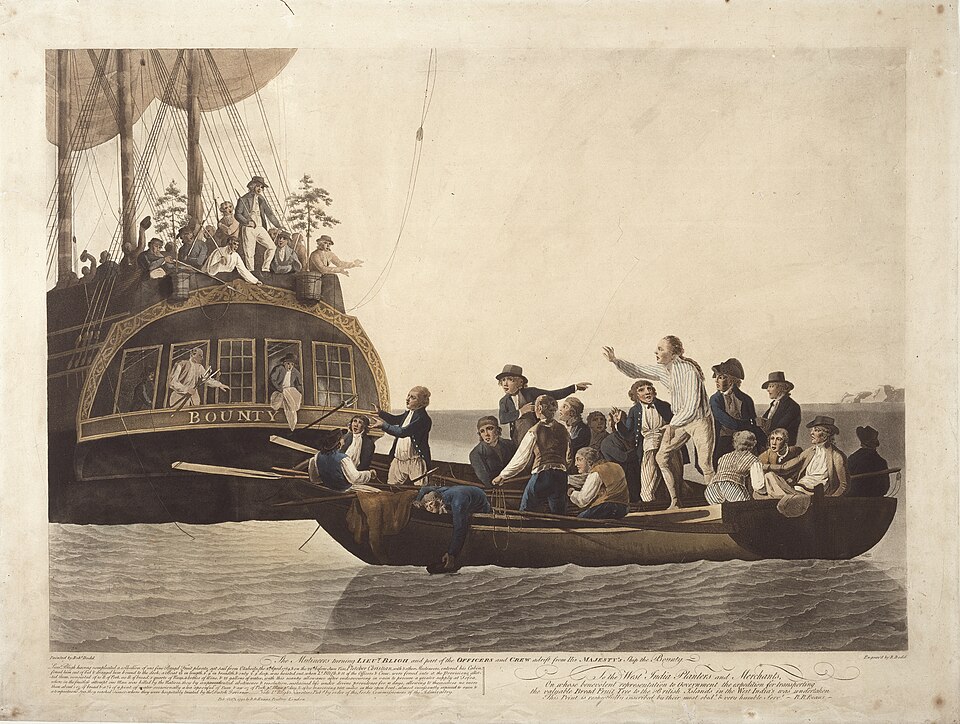
I cannot remember exactly when I first became fascinated by stories of extraordinary sea journeys (mainly as part of journeys into the unknown, north and south), but it is an interest that has stayed with me for years.
I remember watching the 1984 film, The Bounty, starring Anthony Hopkins as William Bligh and Mel Gibson as Fletcher Christian, and being drawn in by the story of the mutiny and what happened to Bligh afterwards.
I also watched the television series, The Terror, which took the story of the lost Franklin expedition, which departed Britain in 1845, and turned it into a psychological thriller with a hint of the supernatural. It was very good, but when you read about what really happened to Sir John Franklin and his crew, the story is so gruesome that there wasn’t really any need for the supernatural elements they added. The expedition consisted of two ships, HMS Terror and HMS Erebus, and Michael Palin has written a wonderful book charting the history of Erebus, a ship that ventured extraordinarily far both south and north.
I’ve also visited the Fram Museum in Oslo, which tells the stories of the great Norwegian polar explorers Fridtjof Nansen, Roald Amundsen and Otto Sverdrup, and houses the original ship that all three used on their expeditions (the Fram).
What I find particularly remarkable about these stories is the combination of courage, seamanship and navigation. Sailing across an ocean is quite an undertaking today, even with a modern boat, GPS, satellite communications and accurate weather forecasts. Imagine doing it in a small wooden boat, with little more than a compass and sextant to guide you and nothing to protect you from the elements, knowing that a navigational error of just a few degrees might mean missing your destination entirely.
Three journeys in particular stand out to me. Full disclosure, I knew a lot about the first and third that I write about here, but in thinking about a third I came across Mary Bryant. Researching what happened to her; her journey itself; and her place in the context of transportation to and the colonisation of Australia, might make hers the most extraordinary journey of the three.
All were undertaken in small boats, all involved extraordinary distances and all succeeded against seemingly impossible odds. Two involved experienced sailors attempting to save themselves and their companions, while Mary’s involved a group of convicts, including two very young children, attempting to escape from Australia.
William Bligh – 1789
On 23 December 1787, the Bounty, commanded by Lieutenant William Bligh, left England en route to Tahiti. The plan was to sail to Tahiti (via Cape Horn), collect breadfruit plants, transport them to the West Indies and then sail home. The whole endeavour – acting as a taxi service for some plants – was supposed to take somewhere between 18 months and two years.
The plants were intended to provide a cheap source of food for enslaved workers on the Caribbean sugar plantations, so there was a rather more serious economic purpose behind the exercise than simply introducing a new fruit to the West Indies.
The outward voyage, meant to take six months, took around ten. An initial attempt to round Cape Horn (the southern tip of South America) was abandoned after a month of trying. The ship and its crew had to head eastwards past South Africa and across the Indian Ocean instead, a diversion adding thousands of miles to an already enormous journey – quite the detour.
After five months on dry land in Tahiti, spending a little time collecting 1,015 breadfruit plants and a lot of time ‘getting to know’ the local women, the crew started what should have been another six-month sail to the West Indies. Today we have Deliveroo riders on mopeds; back then we had the Royal Navy in a wooden ship.
‘Your driver is on his way to pick up your order. The estimated delivery time is two years.’
The approximately 20,000-mile journey to the West Indies began on 4 April 1789. The Admiralty’s orders were to sail west from Tahiti, passing through the Torres Strait between Australia and New Guinea, continuing towards Java, crossing the Indian Ocean, rounding the Cape of Good Hope and then crossing the Atlantic to the Caribbean.
However, they only made it around 1,300 miles as a full crew – the six-month journey ended after less than a month.
On 28 April 1789, one of Bligh’s officers, Fletcher Christian, led a mutiny somewhere near Tonga. Bligh and 18 members of the crew who remained loyal to him were forced into a small, 23-foot boat intended primarily for transporting men and supplies between the Bounty and the shore, with limited food, water and navigational equipment.
Their first priority was to find somewhere to obtain food and fresh water, so Bligh headed for the nearby island of Tofua. His attempt to replenish supplies ended in disaster – his arrival was about as welcome as a mutiny on a Royal Navy vessel.
With the atmosphere heading south, Bligh attempted to leave after several days. As the islanders tried to drag the boat towards the shore, John Norton, Bligh’s quartermaster, attempted to free the rope holding it. He was set upon and killed.
19 men arrived on Tofua. 18 left.
The plan had been to obtain food and water on Tofua, then sail to Tongatapu to obtain sufficient supplies for a longer voyage. Even though Bligh knew the island’s king from a previous journey with Captain Cook (who had himself been killed by locals in Hawaii ten years earlier) and thought he might be able to rely on him for help, he decided this was now far too dangerous. A perfect example of once bitten, twice shy.
With limited provisions on board and a thoroughly shaken crew, the only option was a journey of more than 3,500 nautical miles to the Dutch settlement at Kupang, on the island of Timor.
Between them, the 18 men had approximately 150 pounds of bread, 28 gallons of water, a little pork and some alcohol. Their rations had to be extraordinarily small, at times consisting of just a 25th of a pound of bread and a quarter-pint of water at each of three daily meals, with the bread allowance subsequently reduced even further.
The Bounty was just over 90 feet long, with full rigging and an enclosed lower deck. Bligh’s launch was just 23 feet long and less than seven feet wide. There was no enclosed cabin, nowhere comfortable to sleep and virtually no protection from the weather. Fully laden with its men and supplies, the sides reportedly rose only a few inches above the waterline.
One of the men’s main occupations was constantly bailing water to prevent the boat from sinking. As their provisions dwindled, they became increasingly weak, with swollen limbs and little strength to do anything other than keep the boat afloat. On one occasion, they managed to catch a small seabird, which Bligh divided into 18 portions, including its entrails. Every man received his share and ate it, bones and all.
The most extraordinary aspect of the journey was not simply that all 18 men who left Tofua survived, but that Bligh actually managed to navigate the boat towards their destination.
The mutineers had refused to give him his charts, leaving him with a compass, a quadrant, some basic navigational information and his own knowledge of the Pacific. He had to establish his position whenever the weather allowed and otherwise estimate his progress from the boat’s speed and direction.
On 29 May, more than a month after the mutiny, the exhausted sailors reached a small island off the Australian coast, which Bligh named Restoration Island. They were finally able to obtain some fresh food before continuing through the dangerous waters of the Great Barrier Reef and Torres Strait, eventually emerging into the seas north of Australia.
On 12 June, they sighted Timor. Two days later, on 14 June 1789, they finally reached Kupang. In the 47 days since being cast adrift, Bligh had navigated approximately 3,618 nautical miles (4,164 miles). He described his men in his 1790 account: “Our bodies were nothing but skin and bones, our limbs were full of sores, and we were cloathed in rags.” Whatever Bligh did or did not do that caused the mutiny, his achievement as a navigator and leader of men in reaching Kupang was extraordinary.
Bligh eventually made it back to England on 14 March 1790 – two years and almost three months after he’d left.
Later that year, he was court-martialled and honourably acquitted. You would have thought that Bligh would have been quietly pensioned off and never heard from again – if this happened today, we could assume that his HR claim would be 28,000 pages long.
But no. Having survived the mutiny and crossed more than 4,000 miles of ocean in an open boat, Bligh was sent back to Tahiti in 1791 to try again. This time he successfully delivered the breadfruit plants to the West Indies. The Royal Navy’s botanical delivery service had finally completed its order.
Mary Bryant – 1791
In 1789 Mary Bryant must have received a WhatsApp message from one of her friends:
‘Long time no speak. Have seen what that fella in the Navy has just done?! 4,000 miles in a little boat – six weeks without a scroll on Instagram – can you imagine!? Why don’t you do something like that? You always say how bored you are in Australia!’
Less than two years after Bligh arrived in Timor, Mary Bryant and ten companions completed an equally remarkable journey, arriving at exactly the same destination. But, unlike Bligh, who had the considerable advantage of being one of the finest navigators in the Royal Navy, Mary was a young Cornish woman who had been transported to Australia for assault and robbery.
In March 1786, aged just 21, Mary Broad (as she was then known) had been sentenced to death. She had been convicted of highway robbery, stealing, among some other things, a silk bonnet.
Her sentence was subsequently commuted to seven years’ transportation, but a seven-year transportation sentence wasn’t the same as a seven-year prison sentence in Britain. At the end of your seven years, you were free to leave Australia and come home – but actually doing so was another matter entirely. The British government wasn’t going to help you, very few ships sailed between Sydney and Britain, and the fare for passage on those that did was enormous. Most former convicts stayed in Australia, as they simply had no real choice.
Britain had been transporting criminals to its overseas colonies since the early seventeenth century, initially sending them to America. Unfortunately for the British government, the Americans decided they had had enough of being ruled from London and stopped accepting British convicts. Britain’s prisons quickly became overcrowded, so the government came up with a solution: send them somewhere even further away.
In 1787, 17 years after Captain Cook first reached Botany Bay, the First Fleet departed for Australia, carrying more than 700 convicts, including Mary.
Mary arrived in Sydney in January 1788, 12 days before the colony of New South Wales was officially proclaimed. I always wonder, had Cook seen a New South Wales (maybe something in the distance made him think of Caerphilly Castle) or a new, south Wales? He originally recorded the area as ‘New Wales’ in his 1770 journal entry – maybe he cleared up the confusion with his dying breath as those islanders on Hawaii clubbed him to death. His Endeavour ship replica at the Australian National Maritime Museum in Sydney is fantastic – I had a very interesting chat with a volunteer on the ship whose ancestor had been transported from Old South Wales.
Anyway, back to Mary. During the voyage she had given birth to a daughter, and shortly after arriving in Australia she married another Cornish convict, William Bryant, an experienced fisherman. In April 1790, they had a son, Emanuel.
By March 1791, the Bryants had apparently decided that life in Britain’s newest penal colony was not for them – I think this was probably like when you book that week at an all-inclusive three star hotel and tell yourself it will be fine, but you turn up and it’s a shit hole. Food would have been scarce and conditions dreadful – it wouldn’t have been much better in Sydney either.

On the night of 28 March 1791, Mary and William, their two young children and seven other convicts stole a six-oared cutter belonging to Governor Arthur Phillip and sailed out of Sydney Harbour. I’ve crossed the opening of Sydney Harbour while on a ferry to Manly – I nearly got blown away (and laughed heartily when a couple canoodling on the bow got drenched by a wave), so god knows how Mary and her fellow passengers felt in 1791 on a small open cutter.
The seven other convicts were:
- William Morton – an experienced navigator who played an important role in sailing the boat; he had also been transported for seven years;
- William Allen – a former Royal Navy sailor, transported for life;
- James Martin – an Irish-born convict; a fellow First Fleet convict transported for seven years, like Mary;
- James Cox – a convict transported for life, also known as James Rolt;
- Nathaniel Lillie – a convict transported for life;
- Samuel Bird – a fellow First Fleet convict transported for seven years, like Mary; also known as John Simms; and
- Samuel Broom – a Second Fleet convict sentenced to seven years; also known as John Butcher.
Mary and her three-year-old daughter were the only females onboard. All nine adults had been transported as convicts. Morton, Allen and Mary’s husband William were the three men with the most relevant maritime experience.
The rag-tag group’s intended destination was the Dutch settlement at Kupang on Timor, more than 3,000 miles away. Remarkably, this was exactly the same settlement that William Bligh and his companions had reached in June 1789, less than two years earlier.
The party had managed to obtain a compass, a quadrant, a map, approximately 100 pounds each of flour and rice, 14 pounds of pork and eight gallons of drinking water. They also had fishing equipment and firearms.
Unlike Bligh, who had been forced into his predicament, the Bryants and their companions had deliberately chosen to make the journey. Their route took them north along Australia’s eastern coastline, through the dangerous waters of the Great Barrier Reef and Torres Strait, and eventually westwards across the seas north of Australia towards Timor.
The journey was anything but straightforward. They encountered severe storms, struggled to obtain drinking water and regularly had to bail water out of the boat to prevent it from sinking. At one point, conditions became so desperate that they threw their clothes overboard to lighten the vessel.
One of the convicts, James Martin, subsequently wrote an account of the voyage, describing how the group struggled to find places to land, sometimes going days without being able to obtain fresh provisions. On one island, they found an abundance of turtles, providing a rare opportunity to eat properly and replenish their supplies.
The difficulties were particularly severe for Mary and her two children. Martin recorded that the woman and the two babies were in a terrible condition, although all three somehow endured the journey.
On 5 June 1791, 69 days after leaving Sydney, all eleven people arrived at Kupang alive, having travelled approximately 3,254 miles in a small open boat. Unfortunately, their freedom was short-lived. The escapees told the Dutch authorities that they were survivors of a shipwreck and were initially welcomed, fed and accommodated. However, their true identities eventually became known, and they were imprisoned.
In September 1791, Captain Edward Edwards (what a name) arrived in Kupang. In another extraordinary coincidence, Edwards had been sent to the Pacific to hunt down Fletcher Christian and the mutineers from the Bounty. He had subsequently lost his own ship, HMS Pandora, on the Great Barrier Reef. Edwards took charge of the escaped convicts, who were to be returned to England.
For Mary, the return journey was considerably worse than the escape itself. Her son Emanuel died of illness in Batavia (modern-day Jakarta) on 1 December 1791, aged just 20 months. Her husband William died three weeks later. Two other convicts died during the return journey, while another disappeared overboard. Mary’s four-year-old daughter Charlotte survived almost all the way back to England before dying at sea on 6 May 1792.
Having successfully transported her entire family more than 3,000 miles in an open boat, Mary had lost her husband and both children before reaching home.
There is one final connection between Mary Bryant and William Bligh. Bligh subsequently learned about the escape during his second (much more successful) breadfruit expedition and recorded his admiration for the remarkable achievement, observing that “the Woman and Children bore the fatigue wonderfully well and not one person died”.
Having completed almost exactly the same journey himself in a very similar boat, he was probably better placed than anyone to appreciate just how remarkable it was.
Ernest Shackleton – 1916
After my visit to the Fram Museum I started to read more about the age of polar exploration.
Stephen R. Bown’s magnificent book, The Last Viking: The Life of Roald Amundsen, was the gateway drug that led me to read more about British expeditions to the South Pole. Namely the Discovery expedition led by Captain Robert Scott in 1901-1904 (Shackleton accompanied him); Shackleton’s 1907-1909 Nimrod expedition; Amundsen’s 1910-1912 Fram expedition, when he became the first man to reach the South Pole; Scott’s 1910-1913 Terra Nova expedition, where he reached the South Pole 34 days after Amundsen and then died on the walk out; and Shackleton’s 1914-1917 Imperial Trans-Antarctic expedition. The final name is a bit of a misnomer, as he never reached the Antarctic land mass and therefore didn’t traverse anything other than ice and sea.
Alfred Lansing’s incredible 1959 book, Endurance: Shackleton’s Incredible Voyage, told me the almost unbelievable story of that 1914-1917 expedition; and Sir Ranulph Fiennes’ equally incredible biography, Shackleton, told me his wider story.

Shackleton’s third Antarctic expedition was even more of a disaster than his previous two.
During his first visit, in 1902, he accompanied Scott, along with Edward Wilson in an attempt to travel further south than anyone had previously reached. On 30 December 1902, they reached 82°17′S, setting a new record, before turning back. All three became increasingly ill on the return journey (no surprise there) but Shackleton became particularly unwell. He developed severe breathlessness, coughed up blood and eventually was unable to help pull the sledges.
In 1907 he set off on his own expedition, and came within 97 geographic miles of becoming the first man to reach the South Pole in 1909 – he turned back rather than risk the lives of his companions.
As Amundsen reached the pole on 14 December 1911 Shackleton needed a new and bigger challenge, and decided that being the first person to cross the entire Antarctic continent would do nicely – that would cement his place in the history books.
In August 1914, just four days after Britain declared war on Germany, the Endurance (an apt name, now knowing what we was about to endure) set off southwards towards Argentina, and then Antarctica. Unfortunately, the expedition did not get off to a particularly promising start.
On 19 January 1915, the Endurance, became trapped in pack ice in the Weddell Sea, just off Antarctica. The plan was to wait for the ice to break up, allowing the ship to continue its journey. Instead, the ice carried the ship further away from its destination, eventually crushing its wooden hull under enormous pressure.
On 27 October 1915, after more than nine months trapped in the ice, Shackleton ordered his 27 companions to abandon ship. The Endurance finally sank on 21 November, seemingly lost forever – until the wreck was discovered on 5 March 2022. There is a very good Dan Snow presented documentary on the mission to find the ship.
Shackleton and his 27 companions, including a Welsh stowaway who had hidden aboard the ship for several days after leaving Buenos Aires, were stranded on a vast sheet of floating ice, hundreds of miles from the nearest inhabited land. They also had one cat (a male called Mrs Chippy) and 49 dogs, having originally set off with 69.
As Shackleton foolishly did not live stream his adventure on TikTok there was no possibility of calling for help. No satellite phone, no radio communication and no passing ships. In fact, with the First World War raging in Europe, the outside world had little idea (or maybe even interest) in what had happened to Shackleton and his men.
For the next five months, the 28 men lived on the drifting ice (first at ‘Ocean Camp’, then at ‘Patience Camp’), surviving on their remaining provisions and whatever seals and penguins they could catch.
Eventually, in April 1916, the ice began to break up and the men were forced to take to the three lifeboats they had salvaged from the Endurance. After a desperate journey through freezing seas, they reached Elephant Island on 15 April 1916. For the first time in almost 500 days, the men, all of whom were still alive 18 months after leaving the UK, were standing on solid ground. The fact I’m skipping over this incredible journey in one paragraph shows that much bigger things were to come.

Unfortunately, Elephant Island is not exactly a holiday destination. It is a small, mountainous and uninhabited island, surrounded by some of the most dangerous seas in the world, with no regular shipping routes, virtually no prospect of rescue with not an elephant to be seen anywhere.
Shackleton, knowing that by staying on Elephant Island they were just waiting to die, realised that there was only one realistic solution: someone would have to sail to South Georgia, where there were Norwegian whaling stations that could provide assistance.
There was just one rather significant problem. South Georgia was approximately 800 nautical miles (920 miles) away, across the Southern Ocean, and the largest boat they possessed was just 22 feet and six inches long.
The boat was called the James Caird (named after one of the sponsors of the expedition), and Shackleton’s carpenter, Harry McNish, set about making it as seaworthy as possible. He raised its sides and constructed a makeshift deck to provide some protection from the waves, using whatever materials could be salvaged from the expedition’s equipment.

On 24 April 1916, Shackleton set off with five companions: Frank Worsley, Tom Crean, Harry McNish, Timothy McCarthy and John Vincent. The remaining 22 men stayed on Elephant Island, under the command of Frank Wild, with no way of knowing whether they would ever see Shackleton again.
The conditions faced by the six men were almost unimaginable. They were sailing across one of the roughest stretches of ocean on Earth, in a boat that was barely longer than a modern family car, at the beginning of the Antarctic winter. The boat was repeatedly battered by enormous waves, with freezing seawater pouring over its sides. The men were permanently wet, their clothes froze around them and ice accumulated on the boat in such quantities that they had to chip it away to prevent the additional weight from capsizing them.
They took turns sailing, bailing water and attempting to rest in the tiny covered section of the boat. There was barely enough room for the six men, let alone their equipment and provisions.
Yet, just as with Bligh’s extraordinary voyage 127 years earlier, the greatest challenge was arguably not staying alive but navigating towards the destination. South Georgia is approximately 100 miles long and 20 miles wide. That might sound like a reasonably large target, but after travelling 800 nautical miles across open ocean using only the wind, a relatively small navigational error could have resulted in the boat missing the island entirely and being swept out into the South Atlantic.
The responsibility for finding it fell to Frank Worsley, the captain of the Endurance, who was an exceptionally skilled navigator. Worsley had a sextant, but using one in a tiny boat being thrown around by enormous waves, with the sun generally hidden behind clouds, was rather more difficult than taking observations from the deck of a large ship.
On the rare occasions when the sun appeared, two of the other men sometimes had to hold Worsley steady while he attempted to take a reading. He then had to calculate their position using navigational tables and a pencil, all while the boat continued to pitch and roll.
During the entire voyage, Worsley managed to obtain just four useful observations of the sun. For most of the journey he had to estimate their position from the boat’s direction, speed and the distance they believed they had travelled.
On 8 May 1916, after two weeks at sea, the men finally sighted South Georgia. Remarkably, Worsley had found their destination.
Unfortunately, reaching the island and actually landing on it were two entirely different problems. Violent weather prevented the men from coming ashore for another two days, and there was a very real possibility that their boat would be smashed against the rocks.
Finally, on 10 May, 16 days after leaving the island without any elephants, the six men managed to land at King Haakon Bay, on the western side of South Georgia. They had successfully travelled approximately 800 nautical miles through some of the most dangerous seas in the world, in a boat little more than 22 feet long, without losing a single man.
That was when they faced their next problem – the whaling stations were on the other side of the island.
Having survived the voyage, the men now faced a choice between attempting to sail around the island’s dangerous coastline or crossing its mountainous, glacier-covered interior – a choice between the frying pan and the fire.
Three of the men were in no condition to continue, so Shackleton decided to leave them behind and attempt the crossing on foot with Worsley and Crean.
The interior of South Georgia had never previously been crossed, and the three men had virtually no mountaineering equipment. They used screws taken from the James Caird as crampons in their boots and set off with enough food for just three days.
One of the best parts of Fiennes’ biography is the description of the three men finding themselves at a height of 4,500 feet, with the whaling stations down at sea-level below. Darkness was approaching, and remaining at that altitude overnight without tents or sleeping bags could have been fatal. Their solution was to sit on coiled ropes and slide down the mountain on their backsides, despite having no idea whether the slope ended in a gentle valley or a sheer cliff. In two or three minutes, they descended approximately 900 feet, arriving safely at the bottom. Shackleton later remarked that it was probably not the sort of thing they should make a habit of doing.

After approximately 36 hours of almost continuous walking, climbing and descending across glaciers and mountains, the three men finally reached the whaling station at Stromness on 20 May 1916. They must have been quite a sight. Their clothes were filthy and torn, their faces blackened by months of exposure to the elements, and they had not seen civilisation for well over a year. On arrival, Shackleton presented himself to the manager of the whaling station, Thoralf Sørlle, a man he’d met on the outward journey. One account from another whaler who was present said that Sørlle said ‘who the hell are you?’. In his 1919 book, South, Shackelton stated that he’d said ‘don’t you know me?’ to Sørlle.
Shackleton had finally reached safety, but with twenty-two men still stranded on Elephant Island, his ordeal was not over. He had to abandon three rescue attempts due to sea ice and the weather. But, on 30 August 1916, more than four months after leaving his companions behind, Shackleton finally reached Elephant Island aboard a Chilean naval vessel, after a number of failed attempts due to the conditions.
All 22 men were still alive.
Shackleton had failed miserably in his original ambition to become the first person to cross Antarctica. In fact, he had never even managed to set foot on the Antarctic mainland during the expedition.
Shackleton’s return with all 27 of his companions from the Endurance was a victory in the same way that Dunkirk was a victory for Britain in the Second World War. However badly the expedition had gone on paper, the story of survival was an extraordinary achievement, and one which arguably did more for Shackleton’s reputation than successfully completing the original expedition ever could have done.
Conclusion
I find it difficult to decide which of these three journeys was the most extraordinary. Bligh travelled the furthest, Bryant and her companions had less experience of maritime expeditions and two very young children aboard, and Shackleton and his men faced some of the most dangerous seas in the world.
What I find almost impossible to comprehend is how any of them had the confidence to set off in the first place, with any expectation that they would achieve their aim. Today, we can follow their journeys on a map in a matter of seconds. They had to navigate thousands of miles, knowing that a relatively small mistake could mean missing their destination and almost certain death.
All three journeys were remarkable achievements of courage, endurance and navigation. I am not sure I would have fancied any of them.
Other Articles to read
- From the Great Pyramid to the Burj Khalifa: A History of Building Higher
- Has James Bond Become the World’s Slowest Secret Agent?
- The Traitors is Brilliant Television. But it Might be a Terrible Game

Leave a Reply