The final score of the 2026 Presidents Cup (USA 17 – 13 Internationals) tells you next to nothing about how the event went, for both teams. The USA scoring 17 points is like me scoring a par at the first hole at Medinah; but after hitting my drive into the out of bounds fence and watching it bounce back into the middle of the fairway, topping my approach 30 yards down the fairway, pitching to 90 feet, and then holing the putt.
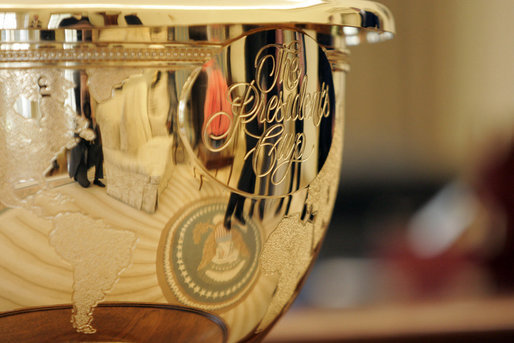
The Presidents Cup was full of drama and intrigue. The true winner yesterday was the Cup itself. The Internationals lost because, well, they lost. The USA lost because they played all of their greatest hits, showing that the issues that have been there for them in team competitions in the recent past are, if anything, worse than ever.
The USA have now won 11 Presidents Cups in a row. On the face of it, it sounds like we are in a 1977 Ryder Cup position, where the event needs to change in order to keep the public (and players) interested. But this weekend was fantastic. Just look at the last five Presidents Cups versus the last five Ryder Cups. Yes, this result was a US victory (again), but the USA have been beating the Internationals by no greater margin than the winner of the Ryder Cup has managed recently.
Stumbling at the Finish Line
The Internationals, with a big lead, could not get the job done on Sunday.
This is not a new story. In 2019, they started Sunday with a 10-8 lead – that became a 14-16 loss.
In 2003, they started Sunday with a 12.5 – 9.5 lead – that became a 17-17 tie (the only tie in the event’s history).
The only time they have hung on was in 1998. A 14.5 – 5.5 lead turned into a 20.5 – 11.5 win.
A 9.5 – 2.5 singles loss this year was the event’s biggest Sunday thrashing – outdoing two 8-4 results in favour of the USA in 1994 and 2019.
As we’ll see later on in this article, the Internationals turned up to the singles in the Wright Flyer while the USA turned up in a B-2, but the Internationals really did not help themselves late on Sunday – the USA won 20 holes on the back nine, 11 of those were won with par.
When the Internationals had to raise their shield, it crumbled in front of their eyes.
Foursomes
The USA will want to forget Friday afternoon in a hurry – five foursomes matches, five losses for the USA (exactly the same as Friday in 2024).
The USA now have to stand up and admit, foursomes are a big problem.
| Event | Foursomes Score |
| 2026 Presidents Cup | 2-7 |
| 2025 Ryder Cup | 2-6 |
| 2024 Presidents Cup | 3-6 |
| 2023 Ryder Cup | 1-7 |
| TOTAL | 8-26 |
The pattern has been brewing for some time.
In the 21st-century Ryder Cup the fourballs score is 49-47 to Europe. The singles? 73.5-70.5 to Europe.
Foursomes, I hear you ask? 56-40 to Europe.
There are 240 points in our sample if you combine fourballs and singles and, across all of them, Europe have outscored the United States by just five. There have been only 96 foursomes points available over the same period, yet Europe have created a 16-point advantage from them. That is a fairly extraordinary concentration of success in one part of the competition.
The USA’s performance in the Presidents Cup Sunday singles has papered over the cracks that form on Thursday, Friday and Saturday.
The USA edged past a team of players that, man for man, was significantly inferior by any statistical measure. Any European team would be better at the top and bottom of their team than the Internationals were, the USA could not perform like this in the 2027 Ryder Cup and win.
(Lack of) Strength in Depth
When you sit back and look at the two teams, it appears to be a miracle (at Medinah) that the Internationals put up such a good fight.
They were incredible over the first three days, when they had nothing to lose. But they did not play in the same way on Sunday when suddenly they had everything to lose – but what were we to expect?
How many International players would get into a USA team today? If Christiaan Bezuidenhout was born in South Carolina rather than South Africa, how many Americans would have to be injured before he made the team?
Bezuidenhout is ranked 102 in the world today. There are 54 Americans ranked higher than him. On a world rankings basis alone, he would be somewhere in the middle of the USA’s fifth team.
On Sunday, the Internationals had the higher ranked player in only one of the 12 matches. But, you could even form an argument that their one world ranking advantage was misleading. Si Woo Kim (ranked 14th) played Jackson Koivun (ranked 58th). As Koivun only turned professional 20 minutes ago he only has 15 events scoring him points. But, like everyone else, he is subject to the minimum 40 event divisor. If his world ranking was calculated purely on his 15 events his OWGR average would be 5.36271 – and he would be 6th in the world.
| International | OWGR | Results | OWGR | United States |
| Hisatsune | 67 | 3 & 2 | 3 | Young |
| T. Kim | 32 | 3 & 2 | 5 | Clark |
| Conners | 56 | 5 & 3 | 26 | Thomas |
| Echavarría | 61 | 2 & 1 | 1 | Scheffler |
| Im | 60 | 3 & 1 | 8 | Burns |
| Bezuidenhout | 102 | 1 up | 7 | Gotterup |
| Matsuyama | 27 | 1 up | 11 | Morikawa |
| Scott | 44 | 2 & 1 | 28 | Cantlay |
| S. W. Kim | 14 | 2 up | 58 | Koivun |
| Lee | 31 | 1 up | 20 | Bridgeman |
| Taylor | 85 | Tied | 6 | Henley |
| Fox | 23 | 2 & 1 | 10 | Schauffele |
| 2.5 | Singles | 9.5 |
Where do the Internationals go from here?
Looking for silver linings around the Sunday singles cloud, the Internationals do have some things to be positive about.
First are the Kims, Si Woo and Tom. They beat Chris Gotterup and Patrick Cantlay on Thursday, and Cantlay and Xander Schauffele on Friday. They went to 3-0 on Saturday morning when beating Collin Morikawa and Wyndham Clark. Cantlay and Schauffele managed to return the favour on Saturday afternoon. Tom also won his singles match.
Si Woo is 31 and Tom is 24, so they should hopefully be able to keep forming their partnership for years to come. Si Woo was fourth in strokes gained over the event and Tom was sixth.
Sungjae Im was the other impressive International team member. He was second in strokes gained, only behind Cameron Young. Unusually, he played all four pairs matches with three different partners (Min Woo Lee (twice), Hideki Matsuyama and Adam Scott). Finding 28 year old Im a partner must be one of the International team’s top priorities.
But what next? Getting some LIV players back (assuming that they won’t be joining Bryson DeChambeau’s YouTube invitational events) and hoping some youngsters make the step up are the two hopes.
Joaquín Niemann and Lucas Herbert would have made a difference. The International team’s historic problem has been strength at the bottom of the roster – they routinely have players outside the world’s top 50 in their team, the USA rarely have this problem. Koivun was the first USA Presidents Cup player ranked outside the top 30 in the world since Jim Furyk and Tiger Woods were captain’s picks in 2011.
What new faces could they have in 2028? A group of South African youngsters could arrive. Christiaan Bezuidenhout has been the sole South African representative at the past three Presidents Cups – we are a long way from the days of Ernie Els, Retief Goosen, Louis Oosthuizen and Charl Schwartzel.
Casey Jarvis has won twice on the DP World Tour this year and will only be 25 in 2028. He should also earn a PGA Tour card through his Race to Dubai ranking for 2027.
Aldrich Potgieter is a year younger than Jarvis. The big-hitting youngster was the Korn Ferry Tour’s youngest ever winner when he won in January 2024 and he has also won once on the PGA Tour.
Jayden Schaper is the third and final South African in the world’s top 100 today (these three are all above Bezuidenhout). Like Jarvis, he has also won twice in this year’s DP World Tour season (events at the end of 2025) and should earn his 2027 PGA Tour card.
I could include Garrick Higgo here but he just cannot be trusted to turn up on time (or is two minutes late, on time?).
Ryo Hisatsune is only 24 today, as are Tom Kim and Elvis Smylie. Keita Nakajima, the man who spent 87 weeks as the world amateur No. 1, is only 26..
Kota Kaneko is another 24 year old who is on the up, he won on the DP World Tour in May.
Finally, Sudarshan Yellamaraju is 25 years old and is solidifying his place on the PGA Tour (he finished one place above Corey Conners in the FedEx Cup this year). He’s not yet won on the PGA Tour but did finish T5 at this year’s Players Championship.
While none of these players are world beaters today, the International team cupboard is not bare.
The next Presidents Cup is at Kingston Heath near Melbourne. The LIV Golf events in Australia have shown how passionate Australians golf crowds can be, so the Internationals will not lack support. Five Australians played in 1994, 1996, 2003, 2005 and 2011 – could it happen again in 2028? An 82 year old Adam Scott, Min Woo Lee, Lucas Herbert, Jason Day, Cameron Smith and Elvis Smylie are all realistic candidates.
What next for the USA?
We know all about the USA’s team golf problem – did they make any progress in solving this issue?
Priority number one is finding some reliable partnerships (In the entire history of the Ryder Cup, the USA have had only six pairs who have played at least five matches together and won more than 50% of the available points).
They may have stumbled into a partnership with potential on Saturday. Cameron Young (29 years old) and Chris Gotterup (27 years old) beat Nick Taylor and Corey Conners in the morning and Adam Scott and Sungjae Im in the afternoon. They both won their singles matches.
They have to play together at the 2027 Ryder Cup.
Individually, Young topped the strokes gained statistics, Wyndham Clark was third and Scottie Scheffler was fifth. Scheffler, the world’s best player by an OWGR margin not seen since a certain Tiger Woods, was left out of the Saturday afternoon foursomes. On what planet was he not one of the USA’s eight best players?!
As part of the partnerships priority, finding Scheffler a partner is 1A on that list. Across the Ryder Cup and Presidents Cup, Scheffler’s record is now 6-10-3 in pairs and 3-2-1 in singles. The USA cannot afford for him to turn into Woods (9-19-1 in Ryder Cups pairs, 4-2-2 in singles). Woods never found a long-term partner (be that in the Ryder Cup or in life) – he played with 14 partners and half of those only once. Scheffler needs to find the Gardner Dickinson to his Arnold Palmer (five wins in five pairs matches together).
Outside of Young and Gotterup, 21 year old Jackson Koivun was a major plus. On Sunday, when the heat was on, he played the Internationals’ highest ranked player and won. He didn’t lose all week, with one win and one tie in the fourballs. His success shows the opportunity for some evolution in the team (or maybe a revolution). Jacob Bridgeman (who also made his debut), Ben James, Ryan Gerard, Michael Brennan, Michael Thorbjornsen, Akshay Bhatia and Blades Brown are a number of twenty-somethings that could be part of future teams.
The issue is really that it is nigh on impossible to know which of these players would be good pairs players, professional golfers just do not play in pairs (excluding the Zurich Classic) and very rarely play match play golf.
Whatever happens, the US golfers’ individual ability trumped Brandt Snedeker’s tactical blunders – the US cannot get away with it in a Ryder Cup and one day soon will not get away with it in a Presidents Cup either.
The End
Perhaps that is the strange conclusion to draw from a Presidents Cup that ended with another American victory. The Internationals should probably feel better about their future than a run of 11 consecutive defeats suggests, while the USA should feel considerably less comfortable than 11 consecutive wins would imply. One team needs more depth; the other needs to work out how to turn far greater individual talent into a functioning team. If both can solve those problems before Kingston Heath in 2028, the Presidents Cup may finally be becoming the competition it has always threatened to be.


Leave a comment