Indian cricket has never had much difficulty producing batsmen. The slightly more difficult part is working out which ones are actually going to play for India.
When I ranked the 30 best young Indian cricketers in 2026 earlier this month, the batting bias was impossible to miss. The list contained established India players, IPL stars, prolific Ranji Trophy batsmen and teenagers who had already begun doing fairly ridiculous things against senior bowlers.
That presented a rather different problem to the one I encountered when ranking the 20 best young Indian fast bowlers in 2026.
Finding 20 interesting batsmen for this article was the easy bit – getting the list down to 20 was not.
At the top is a 15-year-old who scored 776 IPL runs in a season. Behind him is a World Cup-winning India international who is somehow still only 23. There are Test centurions, India A players, Ranji Trophy run machines and several cricketers who have already demonstrated that they can attack international-quality bowling in the IPL.
It is also a much deeper list than the equivalent exercise I did when ranking the 20 best young English batsmen in 2026. That does not necessarily mean all 20 Indians are going to become better players, but it does mean that India simply has a rather larger production line.
How have the players been ranked?
This is not simply a table of the players who have scored the most runs.
Senior performances matter most. Runs in Test cricket count for more than runs at Under-19 level, while succeeding in the IPL against international bowlers tells us rather more than dominating a state age-group competition.
The Ranji Trophy matters too. It would be slightly strange to produce a ranking of India’s future batsmen in which somebody averaging 80 in first-class cricket loses out simply because another player attracted a larger IPL auction bid.
Age is also important. A 19-year-old already scoring heavily in senior cricket gets more credit than a 23-year-old producing identical numbers, because the younger player has four additional years of development ahead of him.
India, India A and Duleep Trophy selection provide useful evidence of where players currently sit in the pathway, although they are not rankings in themselves.
Wicketkeepers and all-rounders are eligible, but only their batting counts here. Nitish Kumar Reddy receives no additional credit for taking wickets and Musheer Khan’s slow left-arm bowling does not move him above somebody simply because he offers a second skill.
That distinction matters.
This is a ranking of India’s best young batsmen, not its best young cricketers.
The 20 Best Young Indian Batsmen in 2026
| Rank | Player | Age | Domestic team | Role |
| 1 | Vaibhav Sooryavanshi | 15 | Bihar | Left-handed opener |
| 2 | Tilak Varma | 23 | Hyderabad | Left-handed batter |
| 3 | Nitish Kumar Reddy | 23 | Andhra | Right-handed batter/all-rounder |
| 4 | Angkrish Raghuvanshi | 21 | Mumbai | Right-handed top-order batter |
| 5 | Kumar Kushagra | 21 | Jharkhand | Right-handed wicketkeeper-batter |
| 6 | Ayush Mhatre | 19 | Mumbai | Right-handed opener |
| 7 | Ravichandran Smaran | 23 | Karnataka | Left-handed middle-order batter |
| 8 | Shaik Rasheed | 22 | Andhra | Right-handed top-order batter |
| 9 | Kartik Sharma | 20 | Rajasthan | Right-handed wicketkeeper-batter |
| 10 | Musheer Khan | 21 | Mumbai | Right-handed batter |
| 11 | Ayush Pandey | 23 | Chhattisgarh | Left-handed opener |
| 12 | Yash Dhull | 23 | Delhi | Right-handed top-order batter |
| 13 | Sameer Rizvi | 22 | Uttar Pradesh | Right-handed middle-order batter |
| 14 | Abishek Porel | 23 | Bengal | Left-handed wicketkeeper-batter |
| 15 | Shikhar Mohan | 21 | Jharkhand | Left-handed top-order batter |
| 16 | Uday Saharan | 22 | Punjab | Right-handed middle-order batter |
| 17 | Arshin Kulkarni | 21 | Maharashtra | Right-handed top-order batter |
| 18 | C. Andre Siddarth | 20 | Tamil Nadu | Right-handed batter |
| 19 | Danish Malewar | 22 | Vidarbha | Right-handed batter |
| 20 | Salil Arora | 23 | Punjab | Right-handed wicketkeeper-batter |
The difficulty starts fairly quickly. There are players outside this 20 who have already represented India and who will go on to play dozens of Tests and white ball international cricket, while several inside it have barely been discussed outside domestic cricket and will never be an India regular – such is the Indian batting depth in 2026.
20. Salil Arora — Punjab
Age: 23 • Right-handed wicketkeeper-batter
- Scored 358 runs at 71.60 in the 2025 Syed Mushtaq Ali Trophy, at a strike rate of 198.89.
- Followed that with 156 IPL runs at a strike rate of 159.18 in 2026.
- His first 19 senior T20 matches produced 454 runs at 41.27 and a strike rate of 188.38.
Salil Arora takes the final place because it is becoming increasingly difficult to dismiss what he has done as one spectacular domestic T20 competition.
A strike rate close to 200 over eight SMAT innings gets your attention. Doing it while averaging above 70 gets rather more of it. Arora then went into the IPL and continued scoring at comfortably above a run and a half per ball.
The sample is still relatively small and there are batsmen just outside this list with substantially greater first-class records. That is why he is 20th rather than tenth.
But India is hardly short of batsmen who can accumulate runs. A player who might be able to score them this quickly is rather more interesting.
19. Danish Malewar — Vidarbha
Age: 22 • Right-handed batter
- Scored 783 Ranji Trophy runs at 52.20 in his breakthrough 2024/25 season.
- Made 153 and 73 in the Ranji Trophy final as Vidarbha won the title.
- Then scored 352 Duleep Trophy runs at 70.40, including 203 on his Central Zone debut.
Danish Malewar is a useful reminder that future Indian Test batsmen do not have to become IPL stars first. This is a man more in the mould of Rahul Dravid, than Verinder Sehwag.
There is something reassuringly uncomplicated about his case. He has made a lot of first-class runs, scored a hundred in a Ranji final and then made a double hundred when promoted to Duleep Trophy cricket.
Those are generally good things for a young batsman to do.
Malewar could easily be considerably higher. The reason he is not is less about anything he has done wrong and more about the ridiculous amount of evidence accumulated by the players above him.
If he averages somewhere near 50 again next season, 19th will start looking silly fairly quickly.
18. C. Andre Siddarth — Tamil Nadu
Age: 20 • Right-handed batter
- Scored 612 Ranji Trophy runs at 68.00 in his debut season in 2024/25.
- Passed 35 in each of the first eight innings of his first-class career.
- Added another 409 Ranji runs in 2025/26, including a century and three fifties.
Andre Siddarth’s age does a lot of work here.
There are players outside the 20 with bigger individual seasons, but very few 20-year-olds can already point to more than 1,000 runs across their first two Ranji campaigns.
The consistency at the start of his career was particularly striking. Young batsmen often announce themselves with one spectacular hundred before discovering that senior bowlers are capable of adjusting. Siddarth instead kept making useful scores.
He is not yet an IPL star and has not reached India A.
There is plenty of time for both.
17. Arshin Kulkarni — Maharashtra
Age: 21 • Right-handed top-order batter
- Scored 403 Ranji Trophy runs in 2025/26.
- Added 287 Vijay Hazare Trophy runs and 225 in the Syed Mushtaq Ali Trophy — 915 across the three competitions.
- Was selected for India A’s one-day programme in 2026.
Kulkarni appeared higher when I ranked India’s best young cricketers because the seam bowling added to the package
It does not help him here. Fortunately, the batting alone is becoming strong enough.
What stands out is not one absurd tournament. It is the breadth. Kulkarni has made runs with the red ball, the 50-over white ball and the T20 one, which makes him rather easier to project than a young player whose reputation depends entirely on one format.
If the bowling eventually becomes genuinely useful, his overall India case will improve considerably.
For this ranking, 915 senior domestic runs across the three main competitions is quite enough.
16. Uday Saharan — Punjab
Age: 22 • Right-handed middle-order batter
- Scored 655 Ranji Trophy runs at 54.58 in his first full season.
- Made two hundreds and two fifties during that campaign.
- Was the leading run-scorer at the 2024 U19 World Cup with 397 runs.
We already knew Uday Saharan was good at Under-19 cricket The more important development is that he has now started being good at adult cricket.
Youth tournaments are useful because they identify talent early, but every promising batsman eventually reaches the point where scoring against other teenagers tells us less than scoring against experienced professionals.
Saharan has crossed that line.
A first serious Ranji season of 655 runs at an average above 50 is exactly the evidence you want to see from somebody whose reputation was built around youth cricket.
The next jump is harder, but that is also true of almost everybody on this list.
15. Shikhar Mohan — Jharkhand
Age: 21 • Left-handed top-order batter
- Scored 613 runs at 55.73 in his debut Ranji Trophy season.
- Made two centuries, including a career-best 207.
- Then scored 85 in the first innings of the 2026 Duleep Trophy final.
Shikhar Mohan might be the least famous player in the top 15, but his runs appear unconcerned about that.
There is a slightly old-fashioned appeal to Mohan’s route. He did not need an enormous IPL auction price or a viral Under-19 innings. He went into the Ranji Trophy and started scoring hundreds.
He then moved up to the Duleep Trophy and continued making runs.
If he keeps doing that, selectors eventually have to pay attention. Indian cricket may be increasingly dominated by the IPL in public discussion, but the route to a Test batting place has not suddenly stopped running through first-class cricket.
Mohan appears quite happy to use it.
14. Abishek Porel — Bengal
Age: 23 • Left-handed wicketkeeper-batter
- Has already scored 769 IPL runs from 35 matches at a strike rate of 145.37.
- Averages 43.84 in List A cricket, with two centuries and a highest score of 170.
- Scored 225 runs at a strike rate of 175.78 in the 2025 SMAT.
Porel is difficult to rank because his 2026 IPL season was considerably quieter than the two that preceded it. That does not make the earlier evidence disappear.
He has already played 35 IPL matches, scored almost 800 runs and built a good List A record. For a 23-year-old wicketkeeper, that is a substantial amount of senior cricket.
The keeping does not earn him any additional points here – just as it did not when I separated batting from glovework in my ranking of England’s best young wicketkeepers – but it does matter to his eventual career prospects.
Porel now needs another jump.
He has moved beyond being merely promising. The question is whether he becomes good enough to separate himself from a rather crowded group.
13. Sameer Rizvi — Uttar Pradesh
Age: 22 • Right-handed middle-order batter
- Scored 491 runs in the 2025 UP T20 League at a strike rate of 161.51.
- Made 252 IPL runs in 2026 at a strike rate of 147.37.
- Also scored 238 Vijay Hazare Trophy runs at a strike rate of 112.26.
Sameer Rizvi first became interesting because he could hit a cricket ball an unusually long way.
What now makes him more interesting is the growing evidence that there is a proper middle-order batsman underneath the power.
India already has plenty of technically excellent top-order players. What every white-ball team wants is somebody capable of arriving later, facing fewer balls and immediately changing the scoring rate.
Rizvi has demonstrated that skill repeatedly.
The challenge will be doing it often enough at IPL level that he stops being considered an exciting hitter and starts being considered an obvious international option.
12. Yash Dhull — Delhi
Age: 23 • Right-handed top-order batter
- Already has close to 3,000 first-class runs at an average comfortably above 40.
- Made centuries in both innings of his first Ranji Trophy match.
- Captained India to the 2022 U19 World Cup title.
Yash Dhull is an unusual name to find outside the top ten because four years ago he looked like one of the most obvious future India batsmen in the country.
Cricket development is rarely that tidy.
Dhull captained India to an Under-19 World Cup and then scored hundreds in both innings of his Ranji debut. At that stage the interesting question appeared to be when he would play for India, not whether he would.
It has taken longer than expected.
But there is a danger of overcorrecting. Dhull is still only 23 and remains a productive first-class batsman. The arrival of newer, shinier prospects does not somehow make the runs he has already scored disappear.
India’s conveyor belt simply moves very quickly.
11. Ayush Pandey — Chhattisgarh
Age: 23 • Left-handed opening batter
- Scored 744 Ranji Trophy runs at 67.64 in 2024/25.
- Followed that with another 573 runs at 57.30 in 2025/26.
- Those back-to-back seasons earned him selection for India A in 2026.
Ayush Pandey was the biggest omission from my original longlist. That was useful – whenever a player can be missed completely and then end up 11th after the numbers are properly checked, the research has probably done its job.
Pandey’s case is based on sustained first-class production rather than one extraordinary innings. He has scored heavily across multiple seasons and already shown the ability to occupy the crease against strong attacks.
There are more spectacular players below him. But there are fewer who have made such a convincing habit of scoring first-class runs.
10. Musheer Khan — Mumbai
Age: 21 • Right-handed batter
- Scored 360 runs at the 2024 U19 World Cup.
- Became Mumbai’s youngest Ranji Trophy final centurion in 2024.
- Made 446 Ranji Trophy runs and 245 Vijay Hazare Trophy runs in 2025/26.
Musheer Khan has been described as a future India player for long enough that it is easy to forget he is only 21.
He has moved from dominating age-group cricket to making major innings for Mumbai, including becoming their youngest Ranji final centurion, and has continued accumulating senior runs.
His left-arm spin makes him an even more interesting overall cricketer, but that is somebody else’s problem for the purposes of this ranking.
Even if Musheer never bowled another delivery, there is enough batting ability here to make him one of India’s ten most exciting young batsmen.
If the bowling develops too, his route to India becomes rather easier.
9. Kartik Sharma — Rajasthan
Age: 20 • Right-handed wicketkeeper-batter
- Scored 295 runs at 32.78 in his first IPL season in 2026.
- Made 445 Vijay Hazare Trophy runs at 55.63 and a strike rate of 118.04.
- Added 331 Ranji Trophy runs in 2025/26, including two centuries.
Kartik Sharma almost escaped the first version of this ranking altogether – he now sits ninth.
That tells you something about how strong the evidence became once I put the formats next to each other.
At 20, Sharma has already scored significant runs in the Ranji Trophy, Vijay Hazare Trophy and IPL. He can accumulate, he can attack and he has already faced international-quality bowling in a franchise competition.
The ₹14.2 crore Chennai Super Kings paid for him attracted rather more attention than his domestic statistics. The statistics are more interesting.
8. Shaik Rasheed — Andhra
Age: 22 • Right-handed top-order batter
- Scored 627 Ranji Trophy runs at 89.57 in 2025/26.
- Made three centuries during that campaign.
- Has progressed from vice-captaining India’s 2022 U19 World Cup winners to India A cricket.
At some point an average close to 90 makes much of the argument for you.
Rasheed has been considered a major prospect since his Under-19 days, but reputations earned at 17 can linger long after the evidence has stopped supporting them.
That is not what has happened here – his senior performances have caught up with the hype.
The India A progression matters because there is an enormous gap between being one of hundreds of talented young Indian batsmen and being close enough to the national team for selectors to start testing you against stronger opposition.
Rasheed is now on the correct side of that divide.
7. Ravichandran Smaran — Karnataka
Age: 23 • Left-handed middle-order batter
- Led the 2025/26 Ranji Trophy with 950 runs at an average of 86.36.
- Scored four centuries during the competition.
- His season included a career-best unbeaten 227.
There is a point at which domestic numbers become too large to dismiss. Smaran reached it when averaging more than 70 in his first 19 first-class matches.
His age stops him being higher because a ranking like this contains some projection. A 23-year-old averaging 86 in a season is nearer to the finished product than a teenager already succeeding in the IPL.
That cuts both ways.
He is also probably closer to being ready.
Smaran’s brief IPL experience did not go especially well, but four innings of T20 cricket should not outweigh an entire season of dominating India’s premier first-class competition.
Nobody scored more Ranji Trophy runs – that seems quite relevant in an article about batsmen.
6. Ayush Mhatre — Mumbai
Age: 19 • Right-handed opening batter
- Scored 201 IPL runs in 2026 at a strike rate of 177.88.
- Made 317 runs at a strike rate of 164.25 in the 2025 SMAT.
- Added 214 runs at the 2026 U19 World Cup.
Ayush Mhatre has already achieved the sort of things normally used to identify a future international batsman – then you remember he is 19.
The IPL performance matters most. Age-group runs tell us that a player is talented. Scoring rapidly against senior franchise attacks demonstrates that the talent survives contact with much better bowlers (we must remember that Sooryavanshi has made T20 strike rates look like telephone numbers – Mhatre striking at 177.88 in the 2026 IPL should not be underestimated).
There is also conventional batting pedigree underneath the aggression. Mhatre has made big scores in longer-form cricket and is not simply a teenage T20 hitter.
He could quite plausibly be in the top three of this list in two years. He could also already be playing for India.
5. Kumar Kushagra — Jharkhand
Age: 21 • Right-handed wicketkeeper-batter
- Scored 572 Ranji Trophy runs at 47.67 in 2025/26.
- Made 422 SMAT runs at a strike rate of 161.69.
- Scored 101 in the 2026 Duleep Trophy final after progressing into the India A pathway.
Kumar Kushagra may have the most complete recent domestic batting résumé in this ranking.
Red ball, 50-over cricket, T20 cricket – there is increasingly nowhere to hide.
That matters because it removes one of the easiest objections to make about a prospect. A prolific Ranji batsman may not score quickly enough for international white-ball cricket. A destructive T20 player may not have the technique or patience for the longer game.
Kushagra has started answering both questions.
Keeping wicket provides another route to international selection, although it earns him nothing here.
The batting is good enough without it.
4. Angkrish Raghuvanshi — Mumbai
Age: 21 • Right-handed top-order batter
- Scored 422 IPL runs in 2026 at an average of 42.20.
- Those runs came at a strike rate of 146.53.
- Already has 885 IPL runs from 35 matches despite being only 21.
There is less red-ball evidence for Raghuvanshi than for several batsmen below him. There is also considerably less need to wonder whether he can score against international-quality bowling.
He has spent the last couple of IPL seasons doing it. Averaging over 30 after his first 50 T20 matches cannot be ignored.
That is why I have him fourth.
A young player can make thousands of domestic runs before discovering that the jump in pace, skill and analysis at the highest level is enormous. Raghuvanshi has already been exposed to much of that environment and continued scoring.
He now needs to broaden the résumé.
But if India required a young white-ball batsman tomorrow, there are not many on this list I would trust more.
3. Nitish Kumar Reddy — Andhra
Age: 23 • Right-handed batter/all-rounder
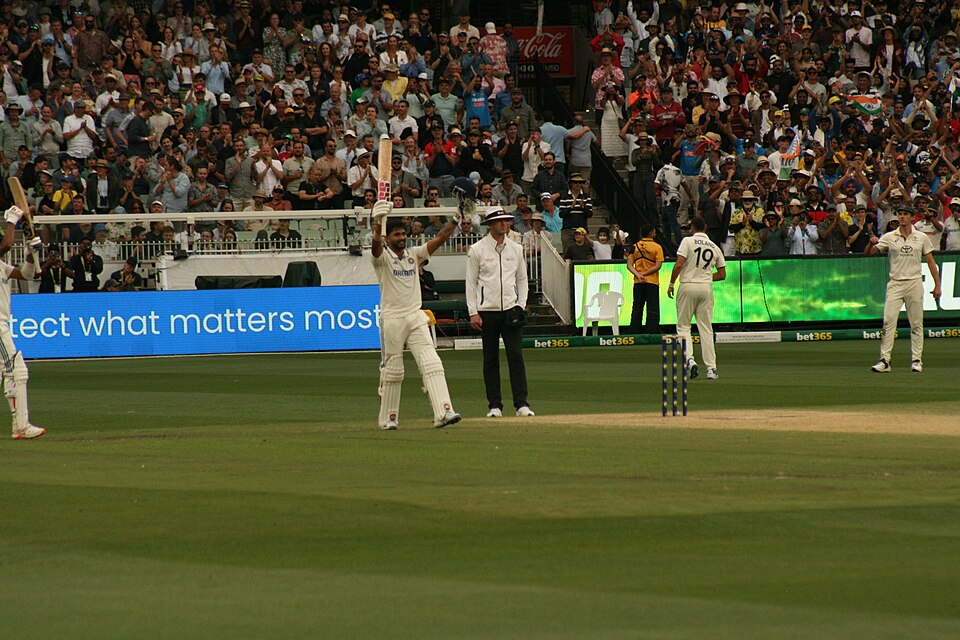
- Scored 114 at the MCG in December 2024, becoming the first Indian to make a Test hundred from No.8 in Australia.
- Made 302 IPL runs in 2026 at a strike rate of 171.59.
- Has already represented India in Tests, ODIs and T20Is.
Nitish Kumar Reddy is the first player in the ranking for whom the word “prospect” starts feeling slightly misleading.
He has already made a Test hundred in Australia – that should probably count for something.
The bowling makes Reddy more valuable overall – I ranked him 12th when looking specifically at India’s best young fast bowlers – but he does not need it to justify third place here.
A young batsman who has scored a Test century at the MCG and then returned to the IPL to strike at above 170 has already demonstrated an unusual ability to adapt between formats.
The remaining question is not really whether he can play international cricket.
It is how good an international batsman he becomes.
2. Tilak Varma — Hyderabad
Age: 23 • Left-handed batter
- Scored 207 runs at the 2026 T20 World Cup at a strike rate of 154.48.
- Made another 359 IPL runs in 2026 at a strike rate of 145.93.
- Already has 1,858 IPL runs despite still qualifying for this ranking.
In almost any normal year Tilak Varma would be No.1.
He is an established international batsman, has performed in a World Cup, has nearly 2,000 IPL runs and is still only 23. There is very little projection required.
That makes Tilak fundamentally different from most of the players below him. We are not asking whether he will be good enough to play for India – he, without doubt, already is.
We are asking whether he becomes one of India’s most important batsmen across the next decade – I would not bet against it.
Unfortunately for Tilak, normal rules become slightly less useful when the player above him is 15.
1. Vaibhav Sooryavanshi — Bihar
Age: 15 • Left-handed opening batter
- Scored 776 IPL runs in 2026 at an average of 48.50 and a strike rate of 237.31, hitting 72 sixes.
- Made 439 runs at the 2026 U19 World Cup and scored 175 from 80 balls in the final – the highest score ever in an U19 World Cup final.
- Has already progressed to senior international cricket while still only 15.
There is no sensible way to put anybody else first.
Normally I would be uncomfortable ranking a 15-year-old above an established India international. There are too many things that can happen between extraordinary teenage talent and a great senior career.
Sooryavanshi has made the normal caveats increasingly difficult to maintain.
He is not merely dominating boys his own age. In fact, boys his own age are probably rather relieved not to bowl at him very often.
The 2026 IPL season changes everything. Seven hundred and seventy-six runs would have been an extraordinary year for an experienced international opener. Doing it at 15 while striking at 237 belongs in a different category entirely.
Then there is the Under-19 World Cup final. Sooryavanshi made 175 from 80 balls, hit 15 sixes and broke the record for the highest score in an U19 World Cup final. India scored 411 and won the tournament.
There are still no guarantees, of course.
He is fifteen, he could appear in this list of players 23 and under until 2034 (that is not a typo).
His technique will be analysed, bowlers will adjust and the level of scrutiny surrounding him will become ridiculous. The next five years may be more difficult than the last two.
But rankings like this are partly about identifying ceilings – the world has no idea where Sooryavanshi’s is.
That is precisely why he is No.1.
Just missed out
The most difficult omission is Suryansh Shedge.
Shedge has already played T20I cricket for India and scored 158 IPL runs at a strike rate above 175 in 2026. If this were a ranking of the best young Indian cricketers, his seam bowling and overall white-ball value would probably put him comfortably inside the 20.
This is batting only.
Mukul Choudhary was also extremely close after striking at almost 200 during his breakthrough SMAT campaign and then making his IPL debut, while Vimal Khumar has an excellent red-ball case after scoring 412 Ranji Trophy runs at 68.67.
Aman Rao Perala, Parth Vats and Nishant Sindhu were all seriously considered too. Sindhu would rank considerably higher in a broader all-rounder list; Aman Rao’s sample is simply still small; and another season of senior runs could move Vats sharply upwards.
The nice thing about Indian prospect rankings is that leaving out six good players normally means another six will have emerged before I have finished writing the explanation.
What does the list tell us about Indian batting?
The most striking thing is that there is no single pathway.
Sooryavanshi, Mhatre and Raghuvanshi have already shown their quality in the IPL at extremely young ages.
Smaran, Rasheed, Pandey, Mohan and Malewar have built much of their case through first-class cricket.
Kushagra and Kartik Sharma increasingly sit somewhere in the middle, producing meaningful performances across formats.
That is important – the IPL has not replaced the Ranji Trophy as a development route, it has added another one.
A player such as Raghuvanshi can now demonstrate at 21 that he is capable of attacking international bowlers in front of enormous crowds. At the same time, a batsman such as Smaran can score 950 first-class runs and force his way into the conversation through sheer weight of production.
India needs both.
The depth is the obvious strength and also the obvious problem. When I put together my wider ranking of India’s best young cricketers, I kept finding good batsmen and wondering where they were supposed to play.
I still do.
Tilak Varma and Nitish Kumar Reddy are already internationals. Sooryavanshi appears to be ignoring the conventional development timetable entirely. Behind them are five or six players who could reasonably expect India A cricket now and another group who may be pushing for it within a year.
Some of them will inevitably stall, a couple will probably disappear and somebody currently outside the top 20 will almost certainly make this ranking look foolish.
That is not a weakness in the list, it is simply the strongest evidence of how deep Indian batting currently is.
FAQs
Who is the best young Indian batsman in 2026?
I rank Vaibhav Sooryavanshi as the best Indian batsman aged 23 or under.
His 776 IPL runs at an average of 48.50 and a strike rate of 237.31 in 2026 would be extraordinary at any age. Doing it at 15, alongside a record-breaking Under-19 World Cup, makes him the clear No.1.
Who are India’s best young batsmen?
My top five are:
Vaibhav Sooryavanshi, Tilak Varma, Nitish Kumar Reddy, Angkrish Raghuvanshi and Kumar Kushagra.
They are quite different players. Tilak and Reddy are already established internationals, Raghuvanshi has considerable IPL evidence, Kushagra has produced across several domestic formats and Sooryavanshi appears to be operating on an entirely different timetable.
Who is India’s best teenage batsman?
Vaibhav Sooryavanshi is the clear answer.
Ayush Mhatre is the other teenager in the top ten and has already shown that he can score extremely quickly against IPL attacks, but nobody in Indian cricket — and arguably very few players anywhere in cricket history — has produced senior numbers comparable to Sooryavanshi’s at 15.
Who is India’s best young Test batting prospect?
Nitish Kumar Reddy has already made a Test century, so he is beyond being merely a Test prospect.
Among the uncapped players, Ravichandran Smaran, Shaik Rasheed, Ayush Pandey, Shikhar Mohan and Danish Malewar have particularly strong recent first-class records.
Who is India’s best young T20 batting prospect?
Sooryavanshi’s 2026 IPL season puts him first.
Tilak Varma is already an established India T20I batsman, while Angkrish Raghuvanshi, Ayush Mhatre, Sameer Rizvi and Salil Arora have all demonstrated the ability to score rapidly against senior bowling.
Why aren’t Yashasvi Jaiswal and Sai Sudharsan included?
The cutoff for this ranking is 23 or younger on 28 September 2026.
Jaiswal and Sudharsan are already older than the eligibility limit.
Are wicketkeepers included?
Yes.
Kumar Kushagra, Kartik Sharma, Abishek Porel and Salil Arora all keep wicket, but their wicketkeeping has not been considered when deciding the ranking.
Only their batting counts.
Is this the same as ranking India’s best young cricketers?
No.
Bowling and wicketkeeping are deliberately excluded here, which changes the order significantly from my wider ranking of the 30 best young Indian cricketers in 2026.
For the same reason, Nitish Kumar Reddy ranks much higher here than he does in my separate piece on the 20 best young Indian fast bowlers in 2026.


Leave a comment