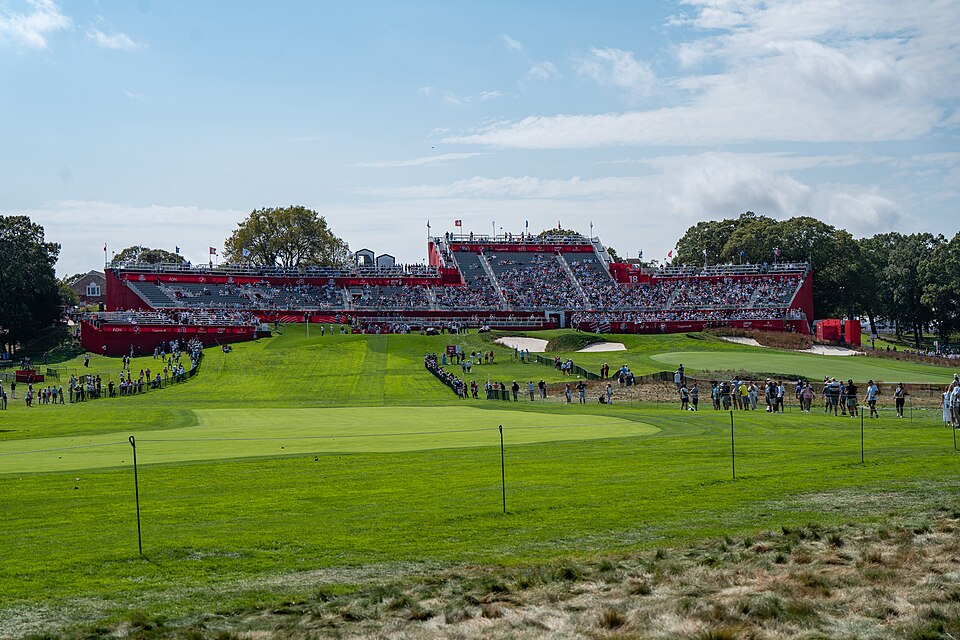
Europe’s Ryder Cup team has not exactly been crying out for new blood.
Eleven of the 12 players who won at Marco Simone in 2023 returned to defend the trophy at Bethpage Black two years later, with Rasmus Højgaard replacing his twin brother Nicolai as the only change. Across two Ryder Cups, therefore, Europe used just 13 different golfers.
It has been an extraordinary period of continuity, but it cannot last forever. Rory McIlroy, Justin Rose and Shane Lowry will eventually disappear from the team, others will lose form, and over the next three, five or seven years a new generation will have to take their places.
The obvious way to identify that next generation would be to look for the best golfers in Europe aged 20, 21 or 22, find the ones with the most impressive amateur records and assume that, given enough time, some combination of them will end up wearing blue.
The problem is that this is not really how European Ryder Cup teams have historically been built.
Go back through every European rookie since 2002 and the average debutant has been roughly 29 years old. Some of the great Ryder Cup careers of this century did start extraordinarily early — Rory McIlroy was 21, Jon Rahm 23 and Viktor Hovland 24 — but plenty did not. Luke Donald was 26, Paul Casey 27, Tommy Fleetwood 27, Ian Poulter 28, Justin Rose 28, Graeme McDowell 29, Henrik Stenson 30 and Shane Lowry 34.
And when you look not simply at when those players arrived, but at what happened to them afterwards and how well they actually performed in their first Ryder Cup, the pattern becomes even more interesting.
This is not, therefore, a ranking of Europe’s best under-23 golfers. It is an attempt to identify the 20 players who, from where we stand today, have the best chance of becoming European Ryder Cup players in 2027, 2029, 2031 or beyond.
History suggests that we should not be frightened of putting a 27 or 28-year-old established professional ahead of a 20-year-old prodigy.
The search has already begun: Luke Donald took several potential rookies, including Eugenio Chacarra, Ángel Ayora, Kristoffer Reitan and Alex Fitzpatrick, to Adare Manor for Europe’s September 2026 scouting trip.
I have already looked in detail at the 30 contenders for Europe’s 2027 Ryder Cup team, but this article takes a longer view, looking not just at Adare Manor but at 2029, 2031 and beyond.
What does a European Ryder Cup rookie actually look like?
I went back through every European player to make his Ryder Cup debut from 2002 onwards and divided them into four age groups.
I then asked two questions. First, did that player ever make another Ryder Cup team? Second, how well did he actually perform on debut?
Because Rasmus Højgaard made his first appearance in 2025, he has obviously not yet had the opportunity to return, so he is excluded from the repeat-appearance calculation.
| Age at first Ryder Cup | Debutants | Played another Ryder Cup | Return rate |
| Under 25 | 8 | 5 | 62.5% |
| 25-27 | 7 | 7 | 100% |
| 28-31 | 16 | 6 | 37.5% |
| 32 and over | 12 | 4 | 33.3% |
The standout number is obvious.
Every European golfer this century who made his Ryder Cup debut between the ages of 25 and 27 went on to play in another one.
That group consists of Martin Kaymer, Luke Donald, Paul Casey, Francesco Molinari, Tommy Fleetwood, Tyrrell Hatton and Robert MacIntyre. It is only seven players, so I am not suggesting that turning 25 suddenly unlocks some Ryder Cup superpower, but it does rather destroy the idea that a golfer approaching his late 20s has somehow missed his window.
If anything, 25 to 27 looks suspiciously like the sweet spot.
But the repeat-appearance numbers are only half of it.
Which age group actually performed best on debut?
For every rookie, I calculated the percentage of the points available to him that he won in his first Ryder Cup.
I then compared that with the collective performance of his teammates in the same Ryder Cup, using the same era-adjusted method I have used elsewhere when comparing Ryder Cup players from different teams and eras.
The aim here is try to standardise performance in order to compare players fairly across Ryder Cups. Europe won the 2006 Ryder Cup 18½–9½ – and it would have been 19–9 had Paul McGinley not conceded J.J. Henry’s roughly 25-foot putt on the 18th – before losing 16½–11½ in 2008. To me, a European achieving, say, 3 points out of 4 in 2008 is far more impressive than doing the same in 2006.
An era-adjusted score of 100 means a player or group performed exactly as well as the teammates around them. A score of 120 means they performed 20% better; a score of 80 means they performed 20% worse.
| Age at first Ryder Cup | Debut points won | Debut points % | Teammates’ points % | Era-adjusted score |
| Under 25 | 13/31 | 41.9% | 51.1% | 82 |
| 25-27 | 14/24 | 58.3% | 61.1% | 95 |
| 28-31 | 18/45 | 40% | 51.9% | 77 |
| 32 and over | 14/35 | 40% | 52.5% | 76 |
Once again, the 25–27 group stands out.
Those seven players won 58.3% of the points available to them in their first Ryder Cup. Their more experienced teammates won 61.1%, meaning the rookies were already performing at 95% of the level of the rest of their team.
None of the other age groups comes particularly close.
Under-25 rookies won 41.9% of their available points. Those debuting from 28 to 31 and those aged 32 or over both won exactly 40%.
So the 25–27 group has not simply been unusually likely to come back. It has also been the group most ready to contribute immediately.
There are individual exceptions everywhere, of course. Tommy Fleetwood was magnificent on debut in Paris, taking four points from five matches at 27, whereas Francesco Molinari took only half a point from three matches at the same age in 2010 before later becoming the first European ever to go 5–0 in a Ryder Cup.
The usefulness is in the group, rather than pretending that one Ryder Cup tells us everything about an individual player.
And that becomes particularly clear when we separate the players who came back from those who did not.
Does a good debut tell us who will become a Ryder Cup regular?
Not always.
In fact, among the youngest players, almost the opposite has happened.
| Age at first Ryder Cup | Played another Ryder Cup? | Debut points % | Teammates’ points % | Era-adjusted score |
| Under 25 | Yes | 33.3% | 50.8% | 66 |
| Under 25 | No | 63.6% | 49.3% | 129 |
| 25-27 | Yes | 58.3% | 61.1% | 95 |
| 28-31 | Yes | 55.6% | 54.1% | 103 |
| 28-31 | No | 29.6% | 50.4% | 59 |
| 32 and over | Yes | 33.3% | 52.4% | 64 |
| 32 and over | No | 43.5% | 52.5% | 83 |
The under-25 numbers are almost comically counter-intuitive.
The young rookies who never returned actually played brilliantly. Victor Dubuisson took 2½ points from three matches in 2014, Thomas Pieters went 4–1 at Hazeltine two years later and Nicolai Højgaard took a point from three matches in Rome.
Collectively, those three won 63.6% of their available points and performed 29% better than their teammates.
The five under-25 rookies who did return – McIlroy, Fitzpatrick, Rahm, Hovland and Åberg – won only 33.3% of their points on debut.
Matt Fitzpatrick started his Ryder Cup career 0–2. Jon Rahm took one point from three matches in Paris. Viktor Hovland won only one point from five at Whistling Straits.
All three came back.
Thomas Pieters, despite taking four points from five matches in one of the best rookie performances of modern times, did not.
The lesson is fairly obvious: three days of match play can tell us only so much about a young golfer’s future.
World ranking tells us something different
This is where the world rankings at the time of their first Ryder Cup become particularly useful.
| Age at first Ryder Cup | Played another Ryder Cup? | Average debut OWGR | Median debut OWGR |
| Under 25 | Yes | 31 | 14 |
| Under 25 | No | 49 | 42 |
| 25-27 | Yes | 27.7 | 27 |
| 28-31 | Yes | 29.3 | 27 |
| 28-31 | No | 38.2 | 33.5 |
| 32 and over | Yes | 47.5 | 41.5 |
| 32 and over | No | 46.8 | 38 |
Suddenly the strange under-25 result makes much more sense.
The young golfers who became repeat Ryder Cup players had a median world ranking of 14 when they first made the team. The young one-and-done players had a median ranking of 42.
In other words, Pieters and Dubuisson may have played brilliantly for three days, but the group containing McIlroy, Rahm and Hovland was much stronger in the much larger body of evidence provided by world golf.
That is particularly relevant when trying to identify future players.
If somebody is 20 or 21, simply being an exciting prospect is not enough. The under-25 players who developed into Ryder Cup regulars were, in general, already exceptional golfers.
McIlroy was ninth in the world on debut. Rahm was eighth. Hovland was 14th.
Ludvig Åberg is the obvious exception – he was still only 80th when Luke Donald picked him for Rome. But Åberg was a slightly misleading World No.80 because he had only recently turned professional; the OWGR’s minimum-events divisor was still suppressing his ranking – basically, he was not the 80th best player in the world at the time.
The most interesting split may be 28–31
There is another result in these numbers that I think is just as useful.
Among rookies aged 28 to 31, the six who eventually returned for another Ryder Cup won 55.6% of their available points on debut. Their teammates won 54.1%.
In other words, the rookies who became repeat players actually performed fractionally better than the established golfers around them.
The ten players in the same age group who never returned won only 29.6% of the points available to them.
Their era-adjusted score was just 59.
That is a huge gap.
Justin Rose took three points from four matches when he debuted at 28. Graeme McDowell took 2½ from four at 29. Henrik Stenson won a point and a half from three matches at 30.
At the other end, Danny Willett went 0–3 on debut, Andy Sullivan 0–2 and Pierre Fulke 0–3.
There are exceptions again – Ian Poulter took only one point from two matches in 2004 and subsequently became Ian Poulter – but collectively the distinction is striking.
By the time somebody is approaching 30, perhaps there is simply less development left to come. Players who arrive and immediately look as though they belong are more likely to remain part of the team; those who struggle are more likely to have made their one appearance at the absolute peak of their career.
And after 32, time starts to win
The oldest group tells a different story again.
Players aged 32 or over who eventually returned actually performed worse on debut than those who did not. Rafa Cabrera-Bello, Jamie Donaldson and Alex Norén all had excellent first Ryder Cups and never made another European team.
By that age, one brilliant week is simply not enough to guarantee another opportunity two years later.
That helps explain why the return rate drops to a third.
So what does all of this tell us about finding the next Ryder Cup players?
I think there are four useful conclusions.
The first is the simplest: do not just look at 20-year-olds.
The average European debutant this century has been around 29. Players aged 25 to 27 have an extraordinary record: seven debutants, seven repeat appearances, and collectively they won 58.3% of their available points in their first Ryder Cup.
Second, youth is most valuable when it is accompanied by evidence that the player is already extremely good.
McIlroy, Rahm and Hovland were not interesting because they were young. They were interesting because they were young and already among the best golfers in the world.
Third, somebody aged 27, 28 or 29 should not be marked down simply because a 21-year-old has more theoretical upside. If the older player is already winning on the DP World Tour, competing on the PGA Tour and approaching the world’s top 50, history suggests he may be much closer to the normal Ryder Cup development curve.
And fourth, the further somebody gets towards his 30s without reaching the required level, the more important his current performance becomes. There is less time for projection.
Those findings have influenced this ranking quite significantly.
A 21-year-old amateur with enormous potential is fascinating, but there is still a huge amount that has to go right before he becomes one of Europe’s best 12 golfers. A 27-year-old who is already winning on the DP World Tour may have less theoretical runway, but history suggests that he might actually be arriving at exactly the right time.
How I ranked the 20
I have therefore tried to balance four things: how good each player is now, how high his ceiling appears to be, how old he will be across the next three Ryder Cups, and how realistic his route into the European team is.
This is not a ranking of current ability. If it were, several of the amateurs would not get close. Nor is it a ranking of long-term ceiling. If it were, players like Connor Graham would be considerably higher.
The question is much narrower: which 20 European golfers who have never played in the Ryder Cup have the best chance of eventually doing so?
Adare Manor hosts the next Ryder Cup in September 2027, with Hazeltine following in 2029 and Camiral in Spain in 2031.
From players who could conceivably be in Luke Donald’s team next year to amateurs who might not seriously enter the conversation until the next decade, these are my 20.
The 20 future European Ryder Cup players
| Rank | Player | Country | Age now | Age in 2027 | Best Ryder Cup debut window |
| 20 | Jack Whaley | England | 22 | 23 | 2029-31 |
| 19 | Tim Wiedemeyer | Germany | 21 | 22 | 2029-31 |
| 18 | Tyler Weaver | England | 21 | 22 | 2029-31 |
| 17 | Maxence Giboudot | France | 22 | 23 | 2029-31 |
| 16 | Matti Schmid | Germany | 28 | 29 | 2027-29 |
| 15 | Joshua Berry | England | 21 | 22 | 2029-31 |
| 14 | Sami Välimäki | Finland | 28 | 29 | 2027-29 |
| 13 | Daniel Rodrigues | Portugal | 24 | 25 | 2027-29 |
| 12 | Josele Ballester | Spain | 23 | 24 | 2029-31 |
| 11 | Oihan Guillamoundeguy | France | 21 | 22 | 2029-31 |
| 10 | Jacob Skov Olesen | Denmark | 27 | 28 | 2027-29 |
| 9 | Tom McKibbin | Northern Ireland | 23 | 24 | 2027-29 |
| 8 | David Puig | Spain | 24 | 25 | 2027-29 |
| 7 | Martin Couvra | France | 23 | 24 | 2027-29 |
| 6 | Alex Fitzpatrick | England | 27 | 28 | 2027-29 |
| 5 | Marco Penge | England | 28 | 29 | 2027-29 |
| 4 | Ángel Ayora | Spain | 21 | 22 | 2027-29 |
| 3 | Kristoffer Reitan | Norway | 28 | 29 | 2027-29 |
| 2 | Rasmus Neergaard-Petersen | Denmark | 27 | 28 | 2027-29 |
| 1 | Eugenio Chacarra | Spain | 26 | 27 | 2027-29 |
20. Jack Whaley — England
Age in 2027: 23 | Age in 2029: 25
There are worse ways of forcing yourself into an article about future Ryder Cup players than winning the U.S. Amateur.
Whaley did exactly that at Merion in August, becoming only the third Englishman to win one of amateur golf’s biggest titles. His standing changed almost overnight, and victory also opened doors into the biggest championships in golf.
That does not make him a likely Ryder Cup player yet. Plenty of elite amateurs never make the transition to the highest level of professional golf, and Whaley is competing here against players who are already winning on the PGA and DP World Tours. But if you are searching for somebody who could look dramatically under-ranked two years from now, a 22-year-old U.S. Amateur champion seems a reasonable place to start.
19. Tim Wiedemeyer — Germany
Age in 2027: 22 | Age in 2029: 24
Only Bernhard Langer and Martin Kaymer have been German Ryder Cup players, but Wiedemeyer has already assembled the sort of amateur résumé that makes him worth following very closely.
The 21-year-old won the European Amateur Championship in Finland this summer and sits near the top of the PGA Tour University rankings after an excellent college career.
The difficulty with placing him any higher is simple: everything from here is projection. We have seen elite amateurs make professional golf look absurdly easy and we have seen others disappear into the enormous gap between being one of the world’s best amateurs and one of the world’s best professionals.
For now, Wiedemeyer has done enough to make the list. What happens when he starts playing for money will decide whether he races up it.
18. Tyler Weaver — England
Age in 2027: 22 | Age in 2029: 24
Of all the amateurs in this ranking, Weaver might have the strongest statistical case.
He finished the 2026 European amateur season as the continent’s top-ranked male player, has won in American college golf and sits near the very top of the PGA Tour University standings. Even an injury-interrupted summer did little to damage his position among Europe’s best amateurs.
The Ryder Cup question is obviously some distance away, but the age curve is almost perfect. Weaver will still only be 24 when Europe travel to Hazeltine in 2029 and 26 when the Ryder Cup reaches Spain in 2031.
If he converts his current amateur standing into a quick route through professional golf, those dates suddenly stop looking quite so distant.
17. Maxence Giboudot — France
Age in 2027: 23 | Age in 2029: 25
Giboudot is precisely the sort of player I wanted this article to find: young enough that 2031 is entirely realistic, but far enough into professional golf that we have something more meaningful than junior results on which to judge him.
The Frenchman (bidding to join Jean van de Velde, Thomas Levet and Victor Dubuisson and become the fourth French Ryder Cup player) has been one of the strongest young players on the HotelPlanner Tour this season, with several high finishes putting him firmly in the battle for DP World Tour promotion.
If he earns that card, he could arrive on the DP World Tour at 22 and potentially have two full seasons there before the 2029 qualification race becomes serious.
That is an extremely attractive development curve.
16. Matti Schmid — Germany
Age in 2027: 29 | Age in 2029: 31
Schmid is where the historical work at the beginning of this article really starts to matter.
At 28, he would never make a conventional list of Europe’s most exciting “young golfers”, but he will be 29 at Adare Manor, which is almost exactly the age of the typical European Ryder Cup rookie this century.
More importantly, unlike the players immediately below him, there is no need to imagine what his game might look like against the world’s best players. We have already seen it.
Schmid has produced strong PGA Tour results and has been competitive in Major Championship golf (T4 at the 2026 PGA Championship and low amateur at the 2021 Open Championship – the only professional golf tournament that I have attended!). He definitely needs another jump to become a Ryder Cup player and 2027 is clearly his strongest window, but dismissing him because he is approaching 30 would be to ignore the entire point of the first half of this article.
15. Joshua Berry — England
Age in 2027: 22 | Age in 2029: 24
Berry took a rather different route from many of Britain’s best young golfers. Instead of heading to an American university, he stayed at Doncaster Golf Club and threw himself into professional golf while still a teenager.
It worked quickly. He came through all three stages of DP World Tour Qualifying School, won on the HotelPlanner Tour while still a teenager and eventually earned promotion to the DP World Tour.
His first season back at the higher level has not yet produced a similar breakthrough, which is why I have him below some of Europe’s other young professionals, but Berry is still only 21.
If his career feels as though it has already had several chapters, that is because he started writing them earlier than almost everyone else.
14. Sami Välimäki — Finland
Age in 2027: 29 | Age in 2029: 31
Finland has never produced a Ryder Cup player and, as I have written previously, I think it is the most likely country to provide Europe’s next new Ryder Cup nation. Välimäki has already achieved something most players in this ranking have not: he has proved capable of winning at an extremely high professional level.
His more recent form has been less convincing, which prevents him being higher, but there is far less projection involved here than with many of the names below him.
Välimäki has already demonstrated that his best golf is good enough to put him in the sort of company from which Ryder Cup players emerge.
At 29 in 2027, his age should not be considered a problem. The question is whether he can rediscover his best form at exactly the right time.
13. Daniel Rodrigues — Portugal
Age in 2027: 25 | Age in 2029: 27
Portugal has never had a Ryder Cup player, which makes Rodrigues particularly interesting after the country’s long wait for somebody capable of establishing himself at the top end of European golf.
The former Texas A&M player earned his DP World Tour card through Qualifying School and has immediately looked competitive as a rookie, including putting himself into contention for a maiden title.
The age might be the most appealing part.
Rodrigues will be 25 at Adare Manor and 27 at Hazeltine. According to almost everything we have just discovered about European rookies, those are not ages at which we should be asking whether he is running out of time.
They are almost exactly when we should start paying attention.
12. Josele Ballester — Spain
Age in 2027: 24 | Age in 2029: 26
Spain producing another Ryder Cup player would hardly be a shock. The intriguing question is which member of this remarkable young generation gets there first.
Ballester won the U.S. Amateur before turning professional and has already produced enough good golf against professionals to suggest that the amateur reputation was justified.
The complication is his pathway. Talent alone does not put somebody into a European Ryder Cup team, and Ballester will need to ensure that his professional route leaves him eligible for selection.
From a pure golfing perspective, however, a U.S. Amateur champion who will be 26 in 2029 is impossible to leave out.
11. Oihan Guillamoundeguy — France
Age in 2027: 22 | Age in 2029: 24
If you have not heard much about Guillamoundeguy yet, that may not remain the case for long.
The Frenchman was winning professional events at 17, progressed through the HotelPlanner Tour and is already competing on the DP World Tour at an age when most players are still trying to work out how to obtain a tour card.
There is a long way between establishing yourself on the DP World Tour and playing in a Ryder Cup, of course, but that is precisely why his age matters.
He could spend another three years developing and still arrive at Hazeltine at only 24.
10. Jacob Skov Olesen — Denmark
Age in 2027: 28 | Age in 2029: 30
Denmark has gone from producing the occasional Ryder Cup player (Thomas Bjørn started that ball rolling in 1997) to producing candidates almost faster than Europe can use them, and Olesen looks increasingly capable of joining the queue.
He became the first Dane to win The Amateur Championship in 2024, turned professional and established himself quickly on the DP World Tour. His 2026 season has represented another significant step forward, with repeated high finishes pushing him towards the top end of the Race to Dubai.
Olesen will be 28 at Adare Manor.
Again, that is not remotely too old. Justin Rose, Ian Poulter and several others had not played a Ryder Cup by the same age.
If anything, Olesen is now entering the most important two years of his career.
9. Tom McKibbin — Northern Ireland
Age in 2027: 24 | Age in 2029: 26
McKibbin has been labelled as a future Ryder Cup player for so long that it is easy to forget he is still only 23.
His move to LIV complicated what had previously looked like a fairly straightforward path into the European side, although he has remained connected to the DP World Tour and therefore to the broader Ryder Cup conversation.
On the course, there have continued to be signs of the talent that made him one of Europe’s most highly regarded young professionals in the first place.
At Adare Manor he will be 24. At Hazeltine he will be 26.
Even if 2027 comes slightly too soon, there is an enormous amount of Ryder Cup runway left.
8. David Puig — Spain
Age in 2027: 25 | Age in 2029: 27
If we ignored qualification complications entirely and ranked these players purely on ability, Puig might be higher.
He has already won multiple professional tournaments, has shown he can compete against very strong fields and possesses the sort of power that makes his ceiling obvious.
Like McKibbin, his route into the Ryder Cup has not always been as straightforward as that of a full-time DP World Tour player, but from a golfing perspective his case is extremely strong.
He will be 25 in 2027 and 27 in 2029.
If we were designing a Ryder Cup prospect in a laboratory using the historical data from the first half of this article, those are almost exactly the numbers we would choose.
7. Martin Couvra — France
Age in 2027: 24 | Age in 2029: 26
French golf suddenly has a fascinating group of young players, but Couvra has already assembled the most convincing professional résumé among them.
He won during his rookie DP World Tour season in 2025, recorded a string of high finishes and was named the Tour’s Rookie of the Year.
His 2026 season has been quieter, which is why I have resisted pushing him into the top five, but Couvra will be 24 in 2027, 26 in 2029 and 28 in 2031.
There may not be a player on this list whose age fits all three future Ryder Cups quite so neatly.
6. Alex Fitzpatrick — England
Age in 2027: 28 | Age in 2029: 30
For several years Alex Fitzpatrick was inevitably introduced as Matt Fitzpatrick’s younger brother.
That introduction is becoming increasingly unnecessary.
He has made a major step forward during 2026, winning on the DP World Tour, succeeding alongside Matt in America and producing strong results against elite PGA Tour fields.
Fitzpatrick will be 28 at Adare Manor.
That might initially look less exciting than Ayora being 22, but it is almost exactly the age at which many successful European Ryder Cup careers have begun.
Unlike most players below him, Fitzpatrick does not need three years of development to reach the required level. He is already very close and was invited to attend Europe’s practice day at Adare Manor after the Irish Open.
5. Marco Penge — England
Age in 2027: 29 | Age in 2029: 31
Penge is probably the best example of why I did the historical age analysis before constructing this list.
If this were simply “20 best European golfers under 25”, he would not qualify. If the question is who is most likely to become a Ryder Cup player, leaving him out would make very little sense.
Penge won three times on the DP World Tour in 2025, finished second on the Race to Dubai and earned PGA Tour membership for 2026.
He will be 29 at Adare Manor.
That is not a weakness in his case. It is almost the definition of a normal European Ryder Cup rookie.
4. Ángel Ayora — Spain
Age in 2027: 22 | Age in 2029: 24
Now we get to a player for whom the age really is extraordinary and the player on this list who I think is most likely to play in multiple Ryder Cups.
Ayora was barely into his 20s when he began regularly appearing near the top of DP World Tour leaderboards, having already excelled on the HotelPlanner Tour.
That combination is rare.
Plenty of 21-year-olds have huge potential. Far fewer have already spent multiple seasons proving that they can contend against established tour professionals.
Ayora will be just 22 at Adare Manor. Even if he does not make the 2027 team, he would still be only 24 at Hazeltine and 26 at Camiral.
Of everyone in this ranking, he may have the best combination of proven professional performance and absurd amounts of time.
3. Kristoffer Reitan — Norway
Age in 2027: 29 | Age in 2029: 31
After waiting 42 years for a Ryder Cup debutant (Viktor Hovland in 2021) Norway are not likely to wait another 42 years for their second player.
Reitan may already have produced the single strongest result of anybody on this list, winning a PGA Tour Signature Event against elite opposition.
That breakthrough followed an excellent DP World Tour season and a successful transition to the PGA Tour.
Reitan will be 29 at Adare Manor.
Given everything we now know about the age of European rookies, there is no reason whatsoever for that to count against him.
His case is unusually straightforward: unlike the amateurs and younger prospects further down this list, we do not have to imagine whether Reitan could one day become good enough to beat the best players in the world.
He already has.
2. Rasmus Neergaard-Petersen — Denmark
Age in 2027: 28 | Age in 2029: 30
Neergaard-Petersen’s rise has been almost relentlessly tidy.
He won three times on the HotelPlanner Tour, immediately established himself on the DP World Tour, earned PGA Tour membership and then added a DP World Tour title.
The progression has been rapid without ever feeling particularly surprising.
He was playing Challenge Tour golf only a few years ago. He is now a PGA Tour member, a DP World Tour winner and somebody who already belongs in serious conversations about the 2027 European side.
At 28 in 2027, his age is almost perfect.
More importantly, there are very few remaining steps between where Neergaard-Petersen is now and the level required to make the team.
1. Eugenio Chacarra — Spain
Age in 2027: 27 | Age in 2029: 29
There are players on this list with more long-term upside. There are younger players, players with better amateur records and players who have already produced bigger results on the PGA Tour.
But if I had to choose one golfer today who has never played in a Ryder Cup and ask whether he will eventually represent Europe, I would choose Eugenio Chacarra.
The Spaniard reached second in the World Amateur Golf Ranking before turning professional, won early in his professional career and has subsequently built a much stronger route through European golf.
He has now won repeatedly on the DP World Tour and established himself towards the top of the Race to Dubai.
Most importantly for this exercise, he will be 27 at Adare Manor.
Remember the statistic from the beginning of this article.
Every European player since 2002 who made his Ryder Cup debut aged between 25 and 27 and has subsequently had the opportunity to return has done so.
Collectively, those players won 58.3% of their points on debut, performing almost as well as their experienced teammates from the moment they arrived.
That does not mean Chacarra will automatically make the team, never mind become a Ryder Cup regular.
It does mean that no player on this list currently combines age, professional performance, winning experience and Ryder Cup timing quite as convincingly – and, as Jon Rahm and Sergio García only crossed over for one Ryder Cup in 2021, it allows the romantic in me to imagine another Seve Ballesteros / José María Olazábal type partnership being formed between him and Jon Rahm.

Who could actually make the 2027 Ryder Cup?
The danger with an article like this is that talking about 2029 and 2031 makes 2027 sound further away than it is.
If I were separating the 20 into those who could realistically be at Adare Manor and those for whom this remains primarily a future projection, the strongest immediate candidates would be Chacarra, Neergaard-Petersen, Reitan, Penge and Alex Fitzpatrick, with Ayora, Couvra, Puig, McKibbin and Skov Olesen capable of joining them if the next year goes particularly well.
There is also a useful reality check.
Europe does not need ten rookies. It may not need five.
Eleven members of the 2023 team returned in 2025, and most of Europe’s established core will still be available in 2027. The next Ryder Cup team might contain only two or three new faces.
That is why this is about more than Adare Manor.
For a deeper look at the immediate picture, I have ranked 30 contenders for Europe’s 2027 Ryder Cup team separately.
2029 may be the real changing of the guard
Move forward another two years and the profile of this group becomes much more interesting.
Ayora and Guillamoundeguy would be 24. Couvra, McKibbin and Ballester would be 26. Puig and Rodrigues would be 27. Giboudot and Whaley would be 25. Weaver and Wiedemeyer would still be only 24.
In other words, a large proportion of this list would arrive at Hazeltine at almost exactly the age at which European Ryder Cup careers have historically begun.
At the same time, Europe’s current core will inevitably be older.
The extraordinary continuity of the 2023 and 2025 teams cannot last forever.
The 2029 side could look very different indeed.
Five who just missed out
The hardest omission was Connor Graham, who has already played three Walker Cups despite still being a teenager. If I were ranking these players purely by their ceiling in 2031 or 2033, he might already be inside the 20.
Niall Shiels Donegan and Luke Poulter both have excellent amateur and college records and credible routes into professional golf, while Cameron Adam already has DP World Tour experience and Frederik Kjettrup has produced winning professional golf.
There will inevitably be somebody outside this 20 who makes the Ryder Cup before most of the players inside it.
That is rather the point of trying to predict golf several years in advance.
How many of these 20 will actually play in a Ryder Cup?
Certainly not all of them.
The European team contains only 12 players every two years, and recent teams have shown how difficult it is to displace an established core.
Some of these players will fail to develop as expected, some will lose form at exactly the wrong moment, some will run into injuries and others may become very good professional golfers without ever quite being one of the 12 Europeans required at the right time.
But the historical numbers also tell us not to give up on players too quickly.
A golfer does not need to be a Ryder Cup player at 22 to become an important Ryder Cup player at 27.
In fact, the evidence from this century suggests that the mid-to-late 20s are much closer to the normal entry point than we might instinctively imagine.
That is why this list contains Matti Schmid alongside Tyler Weaver, Marco Penge alongside Ángel Ayora, and Kristoffer Reitan alongside Jack Whaley.
The future of the European Ryder Cup team is not simply a search for the youngest golfers on the continent.
It is a search for the players who will be good enough when their moment arrives.
And for many of them, that moment may still be several years away.
FAQs
Who are the best young European golfers who have not played in the Ryder Cup?
Eugenio Chacarra, Rasmus Neergaard-Petersen, Kristoffer Reitan, Ángel Ayora, Marco Penge and Alex Fitzpatrick are among the leading European golfers yet to make a Ryder Cup appearance, while younger players including Martin Couvra, David Puig, Tom McKibbin, Josele Ballester and Oihan Guillamoundeguy have significant long-term potential.
Who could make Europe’s 2027 Ryder Cup team?
Chacarra, Neergaard-Petersen, Reitan, Penge and Fitzpatrick appear among the strongest potential European rookies for the 2027 Ryder Cup at Adare Manor, although much can change before the team is finalised.
How old is the average European Ryder Cup rookie?
European Ryder Cup debutants since 2002 have been roughly 29 years old on average. Ryder Cup players therefore tend to emerge considerably later than the 20 or 21-year-old “wonderkid” stereotype might suggest.
What is the best age to make a Ryder Cup debut?
There is no single ideal age, but European players debuting between 25 and 27 have had an extraordinary record since 2002. All seven who have had the opportunity to play another Ryder Cup subsequently did so, while collectively they won 58.3% of their available points on debut.
Do Ryder Cup rookies normally perform well?
European rookies aged 25 to 27 have performed particularly strongly, winning 58.3% of their available debut points. Rookies aged under 25 won 41.9%, those aged 28 to 31 won 40.0%, and those aged 32 or over also won 40.0%.
Does a good first Ryder Cup mean a player will return?
Not necessarily. Among under-25 European rookies since 2002, the players who never returned actually won 63.6% of their available points on debut, compared with only 33.3% for those who later played another Ryder Cup. At younger ages, wider evidence of a player’s quality appears much more useful than a three-day sample of match play.
Where will the next three Ryder Cups be played?
The 2027 Ryder Cup will be held at Adare Manor in County Limerick, Ireland. Hazeltine National Golf Club in Minnesota will host in 2029, before the competition returns to Europe at Camiral in Catalonia, Spain, in 2031.


Leave a comment