If Ryder Cups were decided simply on paper or by assembling the best individual golfers in the world, the USA should have dominated the modern era. The Americans who have played in the competition since 2002 have won 65 major championships between them, compared with 27 for their European counterparts, while across the 12 Ryder Cups from 2002 to 2025 the average American team member was ranked 17.5 in the world compared with 27.2 for Europe. The USA had the better average world ranking in ten of those 12 Ryder Cups.
As we are about to see, that has not translated into the USA having stronger historic partnerships than Great Britain & Ireland or Europe. You will not see the names Woods (9-19-1 in pairs) or Scheffler (after 2025, 1-6-2 in pairs) anywhere near any of the illustrative tables below.
In an article I will publish in the coming days you will see that the difference between Europe and the USA in the 21st century has been in foursomes. Since 2002, singles (73.5 – 70.5 to Europe) and fourballs (49 – 47 to Europe) are basically a tie. There are 240 points in our sample if you combine fourballs and singles and, across all of them, Europe have outscored the USA by just five.
Foursomes?
56 – 40 to Europe.
A 16 point advantage in 96 matches.
Europe have an aggregate 21-point advantage, and 76.2% of that advantage comes from foursomes, the ultimate pairs game.
How Do We Decide the Best Ryder Cup Partnership Ever?
There is an immediate problem with ranking Ryder Cup partnerships: what exactly are we trying to measure?
The pair who have accumulated the most points together are not necessarily the pair who were most dominant when selected. Five wins from five matches is perfect, but is it better than collecting 12 points from 15 matches over four different Ryder Cups? Then there is the problem of era. Winning 60% of your points for a dominant American side in the 1960s is not necessarily the same achievement as winning 60% while playing for Great Britain & Ireland against an American team that was routinely expected to win.
I have therefore looked at the partnerships in three ways:
- total points won;
- percentage of available points won; and
- an era-adjusted performance measure.
A partnership must also have played at least five Ryder Cup matches together to qualify. Four matches can essentially amount to one extraordinary weekend – as Francesco Molinari and Tommy Fleetwood demonstrated in Paris in 2018 – whereas five gives us a little more evidence that we are looking at a genuine Ryder Cup partnership.
That leaves 30 qualifying partnerships.
Which Ryder Cup Partnership Has Won the Most Points?
We will start with the simplest measure.
| Partnership | Team | Matches | Record | Points | Points % | |
| 1 | Seve Ballesteros / José María Olazábal | Europe | 15 | 11-2-2 | 12.0 | 80.0% |
| 2 | Darren Clarke / Lee Westwood | Europe | 8 | 6-2-0 | 6.0 | 75.0% |
| 2 | Justin Rose / Henrik Stenson | Europe | 8 | 6-2-0 | 6.0 | 75.0% |
| 2 | Nick Faldo / Ian Woosnam | Europe | 10 | 5-3-2 | 6.0 | 60.0% |
| 5 | Bernhard Langer / Colin Montgomerie | Europe | 7 | 5-1-1 | 5.5 | 78.6% |
| 5 | Brian Barnes / Bernard Gallacher | GB&I / Europe | 10 | 5-4-1 | 5.5 | 55.0% |
| 5 | Peter Alliss / Christy O’Connor Sr | GB&I | 12 | 5-6-1 | 5.5 | 45.8% |
| 8 | Gardner Dickinson / Arnold Palmer | USA | 5 | 5-0-0 | 5.0 | 100.0% |
| 8 | Sergio García / Luke Donald | Europe | 6 | 5-1-0 | 5.0 | 83.3% |
| 8 | Sergio García / Lee Westwood | Europe | 7 | 4-1-2 | 5.0 | 71.4% |
| 8 | Patrick Reed / Jordan Spieth | USA | 7 | 4-1-2 | 5.0 | 71.4% |
| 12 | Jon Rahm / Tyrrell Hatton | Europe | 5 | 4-0-1 | 4.5 | 90.0% |
| 12 | Jordan Spieth / Justin Thomas | USA | 9 | 4-4-1 | 4.5 | 50.0% |
| 14 | Keegan Bradley / Phil Mickelson | USA | 5 | 4-1-0 | 4.0 | 80.0% |
| 14 | Justin Rose / Ian Poulter | Europe | 5 | 4-1-0 | 4.0 | 80.0% |
| 14 | Larry Nelson / Lanny Wadkins | USA | 6 | 4-2-0 | 4.0 | 66.7% |
| 14 | Tony Jacklin / Peter Oosterhuis | GB&I | 7 | 3-2-2 | 4.0 | 57.1% |
Ballesteros and Olazábal did not just set the record. They obliterated it.
The Spanish pair won 12 points together from 15 matches, twice as many as any other partnership has managed. They played together across four Ryder Cups from 1987 to 1993 and went 11-2-2.
Clarke and Westwood were outstanding. Rose and Stenson equally so. Faldo and Woosnam played ten matches together and accumulated six points.
Ballesteros and Olazábal won as many points as any two of those partnerships combined.
It is little surprise that both also feature prominently in my All-Time European Ryder Cup Team, but what is remarkable here is the scale of the gap between their partnership and everyone else.
Perhaps more revealing is the balance of the table. Of the 17 partnerships shown, 12 are European or GB&I combinations and only five are American.
Which Ryder Cup Partnership Has the Best Points Percentage?
Total points rewards longevity. Our second measure asks a simpler question: when these two players were sent out together, how often did they deliver?
| Partnership | Team | Matches | Record | Points | Points % | |
| 1 | Gardner Dickinson / Arnold Palmer | USA | 5 | 5-0-0 | 5.0 | 100.0% |
| 2 | Jon Rahm / Tyrrell Hatton | Europe | 5 | 4-0-1 | 4.5 | 90.0% |
| 3 | Sergio García / Luke Donald | Europe | 6 | 5-1-0 | 5.0 | 83.3% |
| 4 | Seve Ballesteros / José María Olazábal | Europe | 15 | 11-2-2 | 12.0 | 80.0% |
| 4 | Justin Rose / Ian Poulter | Europe | 5 | 4-1-0 | 4.0 | 80.0% |
| 4 | Keegan Bradley / Phil Mickelson | USA | 5 | 4-1-0 | 4.0 | 80.0% |
| 7 | Bernhard Langer / Colin Montgomerie | Europe | 7 | 5-1-1 | 5.5 | 78.6% |
| 8 | Darren Clarke / Lee Westwood | Europe | 8 | 6-2-0 | 6.0 | 75.0% |
| 8 | Justin Rose / Henrik Stenson | Europe | 8 | 6-2-0 | 6.0 | 75.0% |
| 10 | Sergio García / Lee Westwood | Europe | 7 | 4-1-2 | 5.0 | 71.4% |
| 10 | Patrick Reed / Jordan Spieth | USA | 7 | 4-1-2 | 5.0 | 71.4% |
| 12 | Julius Boros / Tony Lema | USA | 5 | 3-1-1 | 3.5 | 70.0% |
| 13 | Larry Nelson / Lanny Wadkins | USA | 6 | 4-2-0 | 4.0 | 66.7% |
| 14 | Nick Faldo / Ian Woosnam | Europe | 10 | 5-3-2 | 6.0 | 60.0% |
| 14 | Colin Montgomerie / Pádraig Harrington | Europe | 5 | 3-2-0 | 3.0 | 60.0% |
Only one qualifying partnership has never dropped even half a point.
Gardner Dickinson and Arnold Palmer played together five times, across the 1967 and 1971 Ryder Cups, and won all five. Dickinson was never a player of Palmer’s stature, but he clearly gelled with him. Tiger Woods never found his Dickinson, and captain Jim Furyk’s number one priority in 2027 should be finding Scottie Scheffler his Dickinson.
Rahm and Hatton are only fractionally behind at 90%, but perhaps the most impressive number remains Ballesteros and Olazábal’s 80%. There is a considerable difference between producing that rate across the five-match minimum and maintaining it over 15 matches, four Ryder Cups and six years.
Which Ryder Cup Partnership Was Best Relative to Its Era?
The first two tables still have one substantial weakness.
Ryder Cups have not always been equally competitive.
For much of the event’s history, the United States were considerably stronger than Great Britain & Ireland. Conversely, an American pair could compile a good record while surrounded by teammates doing much the same thing.
For my previous Ryder Cup articles I have therefore used an era-adjusted measure, and we can apply the same principle here.
A partnership’s points percentage is divided by its team’s overall points percentage across the Ryder Cups in which that partnership played together, and then multiplied by 100.
A score of 100 means the partnership collected points at the same rate as its team. A score of 150 means it collected points at 1.5 times the rate of the team around it.
| Partnership | Matches | Raw points % | Team baseline | Era-adjusted score | |
| 1 | Jon Rahm / Tyrrell Hatton | 5 | 90.0% | 48.2% | 186.7 |
| 2 | Keegan Bradley / Phil Mickelson | 5 | 80.0% | 44.6% | 179.2 |
| 3 | Justin Rose / Ian Poulter | 5 | 80.0% | 46.4% | 172.3 |
| 4 | Seve Ballesteros / José María Olazábal | 15 | 80.0% | 49.6% | 161.4 |
| 5 | Phil Mickelson / David Toms | 6 | 58.3% | 37.5% | 155.6 |
| 6 | Tony Jacklin / Peter Oosterhuis | 7 | 57.1% | 37.5% | 152.4 |
| 6 | Gardner Dickinson / Arnold Palmer | 5 | 100.0% | 65.6% | 152.4 |
| 8 | Bernhard Langer / Colin Montgomerie | 7 | 78.6% | 51.8% | 151.7 |
| 9 | Brian Barnes / Bernard Gallacher | 10 | 55.0% | 37.9% | 144.9 |
| 10 | Patrick Reed / Jordan Spieth | 7 | 71.4% | 50.9% | 140.4 |
| 11 | Justin Rose / Henrik Stenson | 8 | 75.0% | 53.6% | 140.0 |
| 12 | Sergio García / Luke Donald | 6 | 83.3% | 61.3% | 135.9 |
| 13 | Neil Coles / Christy O’Connor Sr | 7 | 50.0% | 37.0% | 135.2 |
| 14 | Sergio García / Lee Westwood | 7 | 71.4% | 54.2% | 131.9 |
| 15 | Peter Alliss / Christy O’Connor Sr | 12 | 45.8% | 36.0% | 127.4 |
This changes the picture considerably.
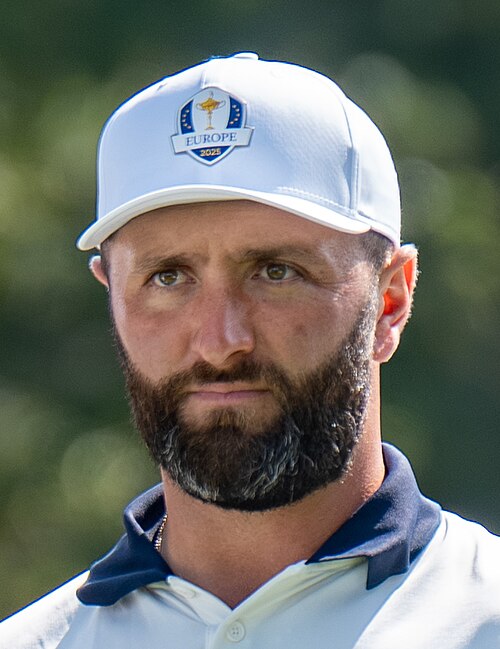
Rahm and Hatton rise to the top because their 90% record was compiled while Europe as a whole took only 48.2% of the available points in the Ryder Cups in which they played together. That figure may look surprisingly low after European wins in 2023 and 2025, but their partnership began in the 19-9 defeat at Whistling Straits in 2021.
Keegan Bradley and Phil Mickelson receive a similar boost. Their 4-1 record came in 2012 and 2014, two Ryder Cups the Americans lost, while the US teams around them took only 44.6% of the available points.
Then there is perhaps the strangest name in any of our tables: Phil Mickelson and David Toms.
A 3-2-1 record does not immediately scream all-time partnership, but they played together during 2002, 2004 and 2006, when Europe won all three Ryder Cups and twice inflicted an 18.5 – 9.5 defeat. While those US teams collectively took only 37.5% of the available points, Mickelson and Toms managed 58.3%.
Suddenly 3-2-1 looks rather different.
The Old GB&I Partnerships Deserve More Credit
The era adjustment also helps some older partnerships whose raw records look fairly ordinary.
Tony Jacklin and Peter Oosterhuis were 3-2-2 together. Brian Barnes and Bernard Gallacher were 5-4-1. Neil Coles and Christy O’Connor Sr won exactly half of the points available to them.
But their team baselines were 37.5%, 37.9% and 37% respectively.
The point is not that 3-2-2 suddenly becomes better than 5-0. It is that Ryder Cup records cannot sensibly be viewed entirely in isolation from the teams in which they were accumulated.
Europe Has Produced More of the Great Partnerships
Now we can return to the question raised at the beginning.
Among the 17 combinations in the total-points table, 12 are European or GB&I partnerships and five are American. Among the top 15 for points percentage, it is 10 to five. After the era adjustment, it is 11 to four.
That does not prove that Europe possess some mysterious inherent ability to play team golf, and we do not need to resort to the usual clichés about Americans being individuals and Europeans caring more.
There is, however, a measurable difference on the golf course.
Europe’s overwhelming 21st-century advantage has been in foursomes, the format in which two golfers literally have to operate as one player, and successful European combinations have often been retained across several Cups.
Ballesteros and Olazábal played 15 times together. García played seven times with Westwood and six with Donald. Rose and Stenson played eight. Clarke and Westwood played eight.
Those were established partnerships rather than one-off experiments.
Being a Great Golfer and Being a Great Ryder Cup Partner Are Not the Same Thing
Tiger Woods is perhaps the clearest demonstration.
Woods finished his Ryder Cup career 13-21-3 overall. In singles he was 4-2-2, collecting 62.5% of the available points.
In pairs?
9-19-1.
That is only 9.5 points from 29 matches, or 32.8%.
Scottie Scheffler provides a more recent example. After three Ryder Cups he is 1-6-2 in pairs but unbeaten in singles, including an 0-4 career record in foursomes.
Contrast that with Jack Nicklaus.
Nicklaus went 13-4-1 in pairs, collecting 75% of the available points, compared with 50% in singles. His foursomes record alone was 8-1.
Individual greatness does not automatically translate into great partnership golf.
Finding the right combinations will therefore be just as important as identifying the talent itself as the Americans build towards future Ryder Cups.
What About the Great Partnerships That Played Fewer Than Five Matches?
There is one obvious objection to our minimum-match rule.
Where are Francesco Molinari and Tommy Fleetwood?
They are excluded because they played only four matches together.
Unfortunately for the Americans, they won all four.
Molinari and Fleetwood were paired in all four sessions across the first two days at Le Golf National in 2018 and became the first European partnership to win four matches together at a single Ryder Cup. They did not play together again as Molinari has not been near a European team as a player ever since.
Rory McIlroy and Tommy Fleetwood are another obvious omission, having gone 4-0 together in foursomes across 2023 and 2025.
But that is why I like the five-match rule. This article is trying to identify the greatest partnerships, rather than the best single-week performances.
The 10 Greatest Ryder Cup Partnerships Ever
We now have three different measures, and they do not produce exactly the same answer.
I do not think simply adding together the three ranking positions gives us a mathematically perfect solution. Total points, points percentage and era-adjusted performance measure different things, and the relative importance of longevity and peak performance is ultimately a judgement.
Taking all three into account:
10. Sergio García and Lee Westwood
Record: 4-1-2 | Matches: 7 | Points: 5 | Points percentage: 71.4% | Era-adjusted score: 131.9
García appears twice in this top ten, which probably tells us something about why he became the highest points scorer in Ryder Cup history.
His seven matches alongside Westwood yielded five points. The partnership was not quite as spectacular as García’s record with Luke Donald, but very few golfers have formed elite Ryder Cup combinations with different teammates as successfully as García.
9. Patrick Reed and Jordan Spieth
Record: 4-1-2 | Matches: 7 | Points: 5 | Points percentage: 71.4% | Era-adjusted score: 140.4
For a period, this looked capable of becoming the American answer to Europe’s great modern partnerships.
Reed and Spieth took 2.5 points together in 2014 and another 2.5 in 2016, while their era-adjusted score of 140.4 places them tenth among all qualifying partnerships.
8. Keegan Bradley and Phil Mickelson
Record: 4-1-0 | Matches: 5 | Points: 4 | Points percentage: 80.0% | Era-adjusted score: 179.2
Their raw total is lower than several pairs outside this top ten, but Bradley and Mickelson took 80% of the points available to them while the American teams around them managed only 44.6%.
Their era-adjusted score of 179.2 is second only to Rahm and Hatton.
7. Gardner Dickinson and Arnold Palmer
Record: 5-0-0 | Matches: 5 | Points: 5 | Points percentage: 100% | Era-adjusted score: 152.4
Perfection has to count for something.
Dickinson and Palmer are the only qualifying partnership to play at least five times together without surrendering even half a point.
Five matches. Five wins.
6. Darren Clarke and Lee Westwood
Record: 6-2-0 | Matches: 8 | Points: 6 | Points percentage: 75.0% | Era-adjusted score: 124.8
Clarke and Westwood are tied for second on the all-time list for partnership points and combined that volume with an excellent 75% success rate.
Six points from eight matches – and two from two in the 2006 Ryder Cup just weeks after Clarke’s wife had died – is formidable.
5. Justin Rose and Henrik Stenson
Record: 6-2-0 | Matches: 8 | Points: 6 | Points percentage: 75.0% | Era-adjusted score: 140.0
Rose and Stenson have exactly the same overall numbers as Clarke and Westwood, but their era-adjusted score of 140.0 also puts them comfortably among the leading combinations by that measure.
Six points is tied for second in Ryder Cup history, while a 75% return across eight matches leaves them behind very few pairs with a comparable sample.
4. Bernhard Langer and Colin Montgomerie
Record: 5-1-1 | Matches: 7 | Points: 5.5 | Points percentage: 78.6% | Era-adjusted score: 151.7
There is very little weakness in this record.
Langer and Montgomerie rank joint fifth in total points, seventh in raw points percentage and eighth after the era adjustment. They lost only once in seven matches.
3. Sergio García and Luke Donald
Record: 5-1-0 | Matches: 6 | Points: 5 | Points percentage: 83.3% | Era-adjusted score: 135.9
Five wins from six is an extraordinary record.
Their 83.3% points rate is third among every qualifying partnership, behind only Dickinson/Palmer and Rahm/Hatton, and they did enough together to show that it was more than one extraordinary weekend.
2. Jon Rahm and Tyrrell Hatton
Record: 4-0-1 | Matches: 5 | Points: 4.5 | Points percentage: 90.0% | Era-adjusted score: 186.7
The sample is smaller than most of the other leading partnerships, which is the main thing keeping them from first.
Rahm and Hatton have never lost together, have won 90% of the available points and have done so while Europe collectively took only 48.2% of the points available in those Ryder Cups.
Their era-adjusted score of 186.7 is the highest of any qualifying partnership.
1. Seve Ballesteros and José María Olazábal
Record: 11-2-2 | Matches: 15 | Points: 12 | Points percentage: 80.0% | Era-adjusted score: 161.4
In the end, this is not particularly close.
Ballesteros and Olazábal have twice as many partnership points as anyone else in Ryder Cup history. They played together 15 times, more than any other pair, yet still won 80% of the points available.
Only three qualifying partnerships have a higher percentage, and each played either five or six matches rather than 15.
Then we adjust for era and they are still fourth.
No other partnership combines historic longevity, elite efficiency and outstanding performance relative to the teams around them in quite the same way.
Their longevity is particularly striking in a competition where even making successive teams cannot be taken for granted, something I explored in my analysis of [how many Ryder Cup players actually come back two years later].
What Makes a Great Ryder Cup Partnership?
There probably is not one answer.
Some of the great partnerships joined two superstars. Others paired players with different personalities or styles. Some lasted for several Ryder Cups and others burned brightly for a much shorter period.
What the numbers do suggest is that partnership golf is a genuine Ryder Cup skill in its own right.
Tiger Woods could dominate individual golf and still collect less than one-third of the points available to him in Ryder Cup pairs matches. Scottie Scheffler has so far found foursomes and fourballs considerably less straightforward than singles. At the other extreme, players such as García, Westwood, Rose and Montgomerie repeatedly produced outstanding records alongside the right teammate.
Perhaps that takes us back to where we started.
Since 2002, the USA have generally had more major champions and the higher-ranked team. In singles, there has barely been anything between the two sides. In fourballs, the difference has also been tiny.
Then when two golfers have to share one ball Europe lead 56-40.
It is difficult to look at the history of the Ryder Cup’s greatest partnerships and believe that is entirely a coincidence.


Leave a comment