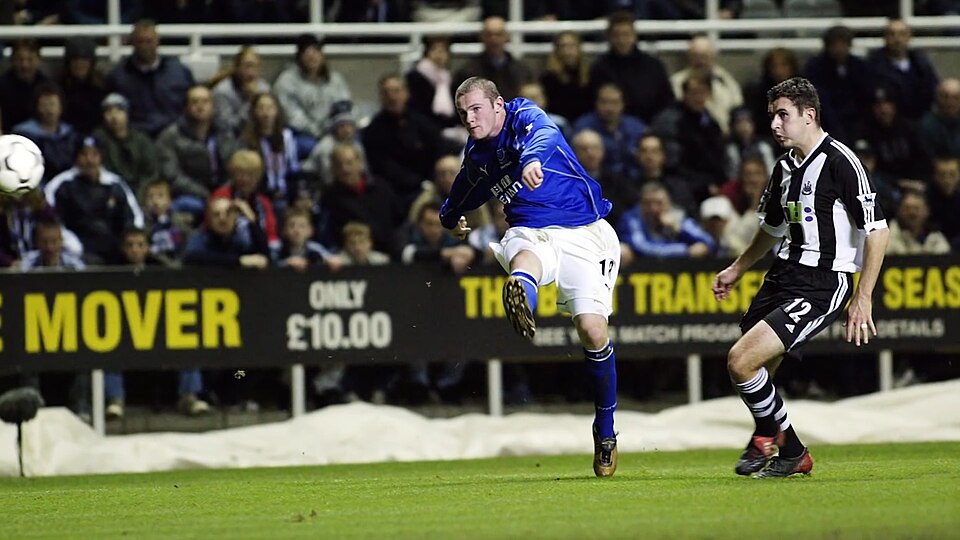
For the first 30 seasons of the Premier League, no 15-year-old played a single minute in the competition.
There were plenty of extraordinary teenage breakthroughs during that time. Wayne Rooney was already scoring against Arsenal at 16, James Milner became a Premier League goalscorer before his 17th birthday, while Aaron Lennon, Jack Wilshere and James Vaughan all played at an age when most footballers are still several years away from the first team
Then Ethan Nwaneri came on for Arsenal against Brentford in September 2022 at the age of just 15 years and 181 days. Less than three years later, Jeremy Monga became the second 15-year-old to play in the Premier League for Leicester City. Only four months after that, Max Dowman became the third.
For three decades, playing in the Premier League at 15 had seemed almost impossible. Suddenly, three players had done it.
Nwaneri remains the youngest player in Premier League history, while Dowman has subsequently become its youngest goalscorer and youngest starter. The list of the competition’s youngest players is also becoming increasingly dominated by footballers whose careers have barely started.
Does making your Premier League debut at 15 or 16 actually tell us anything about how good a player is going to become?
Looking back at the players who came before them, the answer appears to be: not as much as you might think.
The 20 youngest Premier League players ever
As of 28 September 2026, these are the 20 youngest players to appear in the Premier League.
| Rank | Player | Debut club | Age on debut | Career PL apps* | What happened next? |
| 1 | Ethan Nwaneri | Arsenal | 15y 181d | 34 | Established first-team player while still a teenager |
| 2 | Max Dowman | Arsenal | 15y 235d | 7 | Still only 16 |
| 3 | Jeremy Monga | Leicester City | 15y 271d | 7 | Now at Manchester City; far too early to judge |
| 4 | Harvey Elliott | Fulham | 16y 30d | 99 | Established top-five-league player |
| 5 | Matthew Briggs | Fulham | 16y 68d | 13 | Limited Premier League career |
| 6 | Izzy Brown | West Bromwich Albion | 16y 117d | 15 | Limited Premier League career |
| 7 | Aaron Lennon | Leeds United | 16y 129d | 416 | Long Premier League and England career |
| 8 | José Baxter | Everton | 16y 191d | 7 | Long professional career, but little PL football |
| 9 | Joél Drakes-Thomas | Crystal Palace | 16y 194d | 2 | Too early to judge |
| 10 | Rushian Hepburn-Murphy | Aston Villa | 16y 198d | 2 | Limited Premier League career |
| 11 | Gary McSheffrey | Coventry City | 16y 198d | 41 | Long Football League career |
| 12 | Jake Evans | Leicester City | 16y 234d | 4 | Too early to judge |
| 13 | Reece Oxford | West Ham United | 16y 236d | 8 | Established himself in the Bundesliga |
| 14 | Jerome Abbey | Wolves | 16y 250d | 1 | Too early to judge |
| 15 | Jack Robinson | Liverpool | 16y 250d | 54 | Established senior career |
| 16 | Mahdi Nicoll-Jazuli | Chelsea | 16y 255d | 1 | Too early to judge |
| 17 | Jack Wilshere | Arsenal | 16y 256d | 182 | England international and established PL player |
| 18 | Angel Gomes | Manchester United | 16y 263d | 17 | England international and established in Ligue 1 |
| 19 | Mark Platts | Sheffield Wednesday | 16y 263d | 2 | Limited top-flight career |
| 20 | James Vaughan | Everton | 16y 270d | 52 | Long professional career |
*Premier League appearances as of 28 September 2026 for active players.

Even before doing any deeper analysis, the range of outcomes is enormous.
Aaron Lennon played 416 Premier League matches and represented England 21 times. Jack Wilshere reached 182 league appearances and won 34 England caps despite the injuries which repeatedly interrupted his career. Harvey Elliott has already built a substantial top-flight career.
At the other extreme, Mark Platts (who?!) and Rushian Hepburn-Murphy (who?!) made two Premier League appearances each. José Baxter made seven. Matthew Briggs, who held the Premier League’s youngest-player record for more than a decade, finished with 13.
Reece Oxford is perhaps the most useful example of why the question needs a little nuance. He famously started for West Ham at Arsenal aged 16 and appeared to have made one of the most convincing teenage breakthroughs the league had seen. He reached five Premier League appearances while still 17, but ultimately played only eight times in the competition.
That does not mean Oxford had an unsuccessful career. He subsequently established himself in the Bundesliga and played more than 80 league matches in Germany.

The first appearance may be the least important one
There are seven players in the current top 20 whose careers remain too young to assess sensibly: Nwaneri, Dowman, Monga, Drakes-Thomas, Evans, Abbey and Nicoll-Jazuli.
That leaves 13 players whose subsequent careers give us something meaningful to analyse.
At first, I looked at whether being selected again quickly after the debut was important – it wasn’t particularly.
Some players were back on the pitch within days and went on to have enormous careers. Others were also selected again almost immediately and barely played in the Premier League afterwards. Nwaneri, meanwhile, had a long gap between his first and second league appearances because Arsenal had given him his debut at the almost absurd age of 15.
The fifth appearance is a little more useful, but even that produces false dawns. Oxford reached five before his 18th birthday and stopped at eight Premier League appearances. Baxter accumulated several Everton appearances while still extremely young but never reached ten.
It is the tenth appearance where the historical group suddenly begins to separate – among the 13 mature players in the top 20, only four reached ten Premier League appearances before turning 20.

| Player | Age at 10th PL appearance | Career PL appearances |
| Aaron Lennon | 16y 9m | 416 |
| Jack Wilshere | 18y 2m | 182 |
| James Vaughan | 18y 7m | 52 |
| Harvey Elliott | 19y 1m | 99 |
Every one of them subsequently reached at least 50 Premier League appearances. Their median career total is 140.5 appearances.
The other nine mature players in the top 20 finished with Premier League career totals of 13, 15, 7, 2, 41, 8, 54, 17 and 2. Their median is 13.
The sample is small, and there is an element of circularity in using early Premier League appearances to predict eventual appearances. But the difference between the two groups is enormous: the four players who reached ten league appearances as teenagers subsequently played at least another 42 matches each.
But that alone cannot explain the size of the gap.
Lennon reached 416 games. Wilshere reached 182. Elliott is approaching 100.
Jack Robinson is the notable exception on the other side. He made only a handful of early Liverpool appearances, spent years establishing himself lower down the divisions and eventually returned to the Premier League with Sheffield United, taking his career total beyond 50.
But among this small historical group, reaching ten Premier League appearances while still a teenager is a far more meaningful dividing line than simply making one extremely young.
The first appearance gets the headlines – the next nine may tell us far more.
What does that mean for the current teenagers?
It changes how we should look at players such as Nwaneri, Dowman and Monga. Nwaneri and Dowman also feature prominently in my ranking of the 20 best young English footballers, but their inclusion there is based on much more than simply how young they were when they made their Premier League debuts.
Nwaneri’s debut age was extraordinary, but his career quickly became more interesting than the record itself. He reached ten Premier League appearances while still 17 and went well beyond the stage of being an academy player brought on for novelty value.
Dowman has already made seven league appearances and is still only 16. He has also become the youngest goalscorer and youngest starter in Premier League history.
The interesting number now is not another age record – it is ten.
Monga also reached seven Premier League appearances for Leicester at 15 before relegation and his subsequent move to Manchester City interrupted that particular path.
The sample is far too small, and football careers are too dependent on injuries, managers, transfers and opportunity. But, in my opinion, it does give us a more useful benchmark than the debut itself. A 16-year-old who plays once has done something remarkable, but a 19-year-old who has already played ten Premier League matches has started to establish something much more substantial.
Several of this generation could also be pushing for places in the England team by the end of the decade — something I looked at in my prediction of England’s 2030 World Cup squad.
Which clubs actually trust very young players?
Some clubs have a reputation for giving opportunities to young players, but I wondered how many of those opportunities actually turned into regular Premier League football.
It is easy to praise a club for giving a 17-year-old his debut. But there is a difference between putting a teenager on for the final five minutes and continuing to pick him often enough for him to become a genuine member of the first-team squad.
For this analysis, I counted an under-18 debut as being ‘converted’ if that player subsequently reached ten Premier League appearances for the same club before turning 20.
It is not a measure of academy quality. It is specifically a measure of how often an extremely early debut was followed by sustained Premier League opportunity at that club.
The results produce a surprise.
| Club | U18 PL debutants | Reached 10 PL apps for same club before 20 | Conversion rate of resolved cases |
| Everton | 13 | 12 | 92.3% |
| Manchester City | 6 | 5 | 83.3% |
| Arsenal | 12 | 8 | 72.7% |
| Southampton | 7 | 4 | 57.1% |
| Manchester United | 11 | 5 | 55.6% |
| Liverpool | 10 | 5 | 50.0% |
| Leeds United | 6 | 3 | 50.0% |
| Chelsea | 13 | 5 | 45.5% |
| West Ham | 7 | 3 | 42.9% |
| Aston Villa | 6 | 2 | 40.0% |
| Tottenham | 9 | 2 | 25.0% |
| Fulham | 6 | 1 | 16.7% |
Current teenagers who have not yet had a realistic opportunity to reach the threshold are excluded from the conversion-rate denominator.
With Nwaneri and Dowman currently occupying the top two places on the all-time youngest-player list, Arsenal might seem like the obvious club to dominate this measure.
However, Everton have given 13 players Premier League debuts before turning 18 and 12 subsequently reached ten league appearances for Everton before their 20th birthday. José Baxter is the exception.
The group stretches across several different eras: Wayne Rooney, James Vaughan, Francis Jeffers, Jack Rodwell, Richard Dunne, Ross Barkley, Tom Davies and others.
Their eventual careers varied enormously, but Everton repeatedly did something more meaningful than simply handing a gifted youngster his debut. They continued to play him.
Arsenal’s record remains excellent. Cesc Fàbregas, Jack Wilshere, Theo Walcott, Bukayo Saka and others became genuine senior players at a very young age, while the recent Nwaneri and Dowman cases continue that tradition.
Manchester City’s figures are also striking. Their spending power might make them an unlikely club to provide sustained opportunities to teenagers, yet five of their six resolved U18 debutants reached ten league appearances for City before 20. Micah Richards, Phil Foden, Rico Lewis and Nedum Onuoha all became genuine first-team players.
Chelsea provide a useful contrast. They have given just as many U18 Premier League debuts as Everton, but far fewer of those players accumulated ten league appearances for Chelsea before 20.
Harvey Elliott makes the same point from another direction. Fulham gave him his Premier League debut at 16 years and 30 days, but most of his subsequent Premier League development occurred at Liverpool.
Premier League debutants really are getting younger
Across the first 30 Premier League seasons, under-18 debuts remained relatively stable. There was an increase in the number of 16-year-olds after the competition’s first decade, but the overall rate of U18 debuts did not keep rising until very recently.
| Period | U18 debuts | U18 debuts per season | Share aged 16 or younger |
| 1992/93–2001/02 | 38 | 3.8 | 7.9% |
| 2002/03–2011/12 | 46 | 4.6 | 19.6% |
| 2012/13–2021/22 | 40 | 4.0 | 20.0% |
| 2022/23–2025/26 | 31 | 7.75 | 29.0% |
During the first 30 seasons there were 124 under-18 Premier League debuts, an average of just over four per year.
Across the four completed seasons from 2022/23 to 2025/26, there were 31 – almost eight per season.
The change is even clearer at the extreme end. Fewer than one in 12 U18 debutants during the Premier League’s first decade were still 16 or younger. Since 2022/23, the figure has been close to three in ten.
Then there are the 15-year-olds – there were between 1992 and 2022, and three since then.
The wider numbers point in the same direction. Opta found that 64 different teenagers appeared in the Premier League in 2023/24, the highest total in the competition’s history, while another 59 played in 2024/25.
Why?
There is unlikely to be one explanation.
Premier League academy systems are vastly more sophisticated than they were 20 or 30 years ago. Clubs know more about the physical development of young players, while elite prospects have often spent years training in professional environments before they get anywhere near the first team.
There is also one rule change whose timing is interesting.
Five substitutions became permanent in the Premier League from 2022/23 – precisely the point at which our final period begins.
That does not prove that additional substitutions caused the increase. But having five changes rather than three plainly gives a manager more scope to introduce a teenager late in a game without sacrificing most of his tactical options.
There may also be a psychological element. Once Arsenal had shown that a 15-year-old could survive a Premier League debut, selecting another exceptional player at the same age may have begun to feel slightly less radical.
For most of the Premier League era, the frontier moved gradually from 17 to 16.
Since 2022, even 15 no longer seems an absolute barrier.
Three 15-year-old outfield players. No 16-year-old goalkeeper.
Three players have now appeared in the Premier League at 15. No goalkeeper has ever appeared at 16.
Only two goalkeepers in Premier League history have played before turning 18: Neil Finn for West Ham at 17 years and three days, and Richard Wright for Ipswich at 17 years and 182 days.
The third-youngest Premier League goalkeeper, Scott Carson, was already 18.
The contrast with outfield players is enormous.
Looking at the 31 new U18 Premier League debutants across the four completed seasons from 2022/23 to 2025/26, attacking players dominate.
| Position group | U18 debuts | Share |
| Attacking players | 19 | 61.3% |
| Central/defensive midfielders | 9 | 29.0% |
| Defenders | 3 | 9.7% |
| Goalkeepers | 0 | 0% |
The younger the player, the stronger that bias becomes. Roughly three quarters of Premier League players to appear before turning 17 have been attacking players.
That probably tells us at least as much about managerial risk as it does about player development.
A manager who is 3-0 up can send a 16-year-old winger on for the final ten minutes and essentially tell him to run at the full-back and see what happens.
If he loses possession attempting to beat somebody, the mistake is unlikely to define the game.
A goalkeeper has nowhere to hide. He must immediately deal with crosses, organise experienced defenders and make decisions where one error can result in a goal.
A centre-back faces a similar problem. Positioning mistakes are punished, and a physically undeveloped 16-year-old may be asked to compete directly with a striker who has spent a decade playing senior football.
Premier League managers appear far more willing to gamble on teenage creativity than teenage responsibility.
So, did they actually become stars?
Some certainly did. Aaron Lennon played 416 Premier League matches, Jack Wilshere became an England regular and Harvey Elliott has already built a substantial top-flight career. Others, such as Mark Platts and Rushian Hepburn-Murphy, barely played in the Premier League again.
What surprised me was how little the age of the debut appeared to matter. Among these players, reaching ten Premier League appearances before turning 20 was a much better indication of whether they would go on to establish themselves in the competition.
Perhaps we have been concentrating on the wrong record. Rather than asking who became a Premier League player youngest, we should be asking who became a Premier League regular youngest.
Other Football Articles
• Infantino and his plan to sell of part of the World Cup – what happens next?
• Who are England’s best young footballers?
• How many of the 2026 England World Cup squad will play in 2026?
Leave a Reply